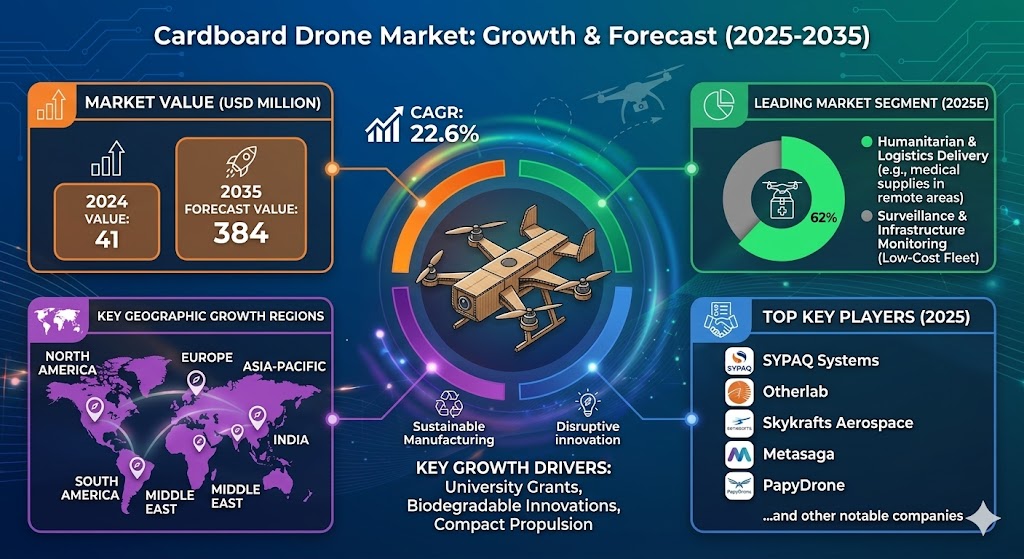
As industries increasingly explore innovative and sustainable technologies, the cardboard drone market is gaining notable attention. These lightweight, cost-efficient drones are redefining traditional unmanned aerial systems by offering eco-friendly alternatives for a variety of applications. Designed using biodegradable or recyclable materials, cardboard drones are emerging as a practical solution for short-term missions, particularly in logistics, defense, and emergency response scenarios. Their growing adoption reflects a shift toward sustainability and affordability in drone technology.
Market Overview:
Cardboard drones are unmanned aerial vehicles constructed primarily from lightweight cardboard or similar biodegradable materials. Despite their simple construction, these drones are equipped with essential electronic components that enable them to perform critical functions such as delivery, surveillance, and reconnaissance.
The market is experiencing steady growth due to increasing demand for low-cost drone solutions that can be deployed quickly and efficiently. Cardboard drones offer several advantages, including reduced manufacturing costs, ease of assembly, and minimal environmental impact. These features make them particularly suitable for applications where drones are used once or for a limited duration.
Advancements in drone technology and materials are further enhancing the capabilities of cardboard drones. Manufacturers are focusing on improving durability, flight performance, and payload capacity while maintaining cost efficiency. This balance is driving their adoption across various sectors.
Regional Insights:
North America is a key market for cardboard drones, supported by strong innovation in drone technology and increasing use in defense and logistics applications. The region’s focus on rapid deployment solutions and emergency response systems is contributing to market growth.
Europe is also witnessing growing adoption, driven by environmental regulations and increasing emphasis on sustainable technologies. Organizations in the region are exploring eco-friendly alternatives to conventional drones, which is boosting demand for cardboard-based solutions.
Asia-Pacific is emerging as a significant growth region due to expanding e-commerce, rising demand for cost-effective delivery solutions, and increasing investments in drone technology. Countries in this region are leveraging innovative drone solutions to improve logistics efficiency and address infrastructure challenges.
Key Trends & Forecast:
The cardboard drone market is evolving with several key trends shaping its development. One of the most prominent trends is the growing emphasis on sustainability. As environmental concerns continue to rise, industries are seeking alternatives that reduce waste and carbon footprint. Cardboard drones align with these goals by offering biodegradable and recyclable solutions.
Another important trend is the increasing use of drones in last-mile delivery. Cardboard drones provide a cost-effective option for delivering lightweight goods, especially in remote or hard-to-reach areas. Their disposable nature makes them ideal for one-way delivery missions.
The defense sector is also driving market growth, with cardboard drones being used for surveillance, reconnaissance, and decoy operations. Their low cost allows for large-scale deployment without significant financial investment, making them a valuable asset in strategic operations.
Technological advancements are enhancing the performance of cardboard drones. Improvements in navigation systems, battery efficiency, and lightweight materials are enabling longer flight times and better reliability. Integration with digital platforms is also allowing for improved tracking and control.
Looking ahead, the market is expected to expand further as industries continue to adopt innovative and sustainable drone solutions. Ongoing research and development efforts will likely lead to enhanced capabilities and broader application areas.
Applications & End-Use Outlook:
Cardboard drones are being utilized across a wide range of applications, highlighting their versatility and practicality. In the logistics sector, they are used for last-mile delivery, particularly in areas with limited infrastructure. Their lightweight design and cost efficiency make them suitable for delivering small packages quickly and effectively.
In the defense sector, cardboard drones are employed for surveillance and reconnaissance missions. Their disposable nature allows them to be used in high-risk environments without significant loss. They are also used as decoys to divert attention and enhance operational strategies.
The humanitarian sector is another important application area, where cardboard drones are used to deliver essential supplies such as medical aid, food, and emergency equipment to disaster-affected regions. Their ability to operate in challenging conditions makes them valuable in crisis situations.
In agriculture, these drones are used for monitoring crops and assessing field conditions. Their low cost enables widespread use, helping farmers make informed decisions and improve productivity.
Additionally, cardboard drones are finding applications in environmental monitoring, research, and educational purposes. Their simplicity and affordability make them accessible for various experimental and training activities.
Conclusion:
The cardboard drone market is poised for significant growth as industries increasingly prioritize sustainability, cost efficiency, and innovation. With their unique combination of affordability, eco-friendliness, and functionality, cardboard drones are redefining the possibilities of unmanned aerial systems.
As technological advancements continue and new applications emerge, these drones are expected to play a crucial role in sectors ranging from logistics and defense to agriculture and humanitarian aid. Organizations that leverage comprehensive market insights and embrace these innovative solutions can gain a competitive edge in an evolving and dynamic market landscape.
Browse Full Report – https://www.factmr.com/report/cardboard-drone-market