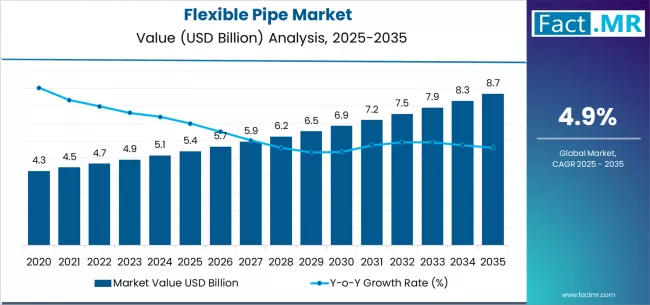
The global flexible pipe market is projected to grow from USD 1.25 billion in 2026 to approximately USD 1.83 billion by 2036. This growth represents an absolute increase of USD 580 million over the forecast period, expanding at a compound annual growth rate (CAGR) of 3.9%. As offshore energy exploration moves into deeper and more complex environments, flexible pipe systems have become essential for their superior corrosion resistance and ability to withstand high dynamic loads compared to rigid steel alternatives.
Quick Stats:
-
Market size 2026? USD 1.25 billion.
-
Market size 2036? USD 1.83 billion.
-
CAGR? 3.9% (2026–2036).
-
Leading product segment(s) and shares? Steel-reinforced flexible pipes lead with a 58.0% share; Thermoplastic Composite Pipes (TCP) are the fastest-growing sub-segment.
-
Leading application and share? Offshore Oil & Gas is the primary application, accounting for over 65% of global demand.
-
Leading end use and share? Production and Injection lines are the primary functional uses.
-
Key growth regions? Latin America (led by Brazil), North America (Gulf of Mexico), and Asia-Pacific.
-
Top companies? TechnipFMC, Baker Hughes (Waygate Technologies), National Oilwell Varco (NOV), Prysmian Group, Magma Global, and Shawcor.
Get Access of Report Sample : https://www.factmr.com/connectus/sample?flag=S&rep_id=9068
Market Momentum (YoY Path)
The flexible pipe market is entering a phase of steady, sustained growth. Starting at USD 1.25 billion in 2026, the valuation is expected to reach USD 1.45 billion by 2030. As deepwater projects in the pre-salt basins of Brazil and the Guyana-Suriname basin ramp up production, the market is projected to hit USD 1.62 billion by 2033, eventually arriving at the USD 1.83 billion mark by 2036. This trajectory is supported by the increasing lifecycle extension of existing offshore fields where flexible risers are used for tie-backs.
Why the Market is Growing
Growth is primarily fueled by the “Deepwater Frontier” expansion. Conventional rigid pipes struggle with the extreme hydrostatic pressure and fatigue requirements of ultra-deepwater environments. Flexible pipes, constructed from multiple layers of polymers and steel armoring, offer the necessary versatility for Floating Production Storage and Offloading (FPSO) units. Additionally, the shift toward Thermoplastic Composite Pipes (TCP) is accelerating because they are 100% corrosion-resistant and significantly lighter than steel, reducing the total cost of installation and the structural load on offshore platforms.
Segment Spotlight
1. Material Type: Steel-Reinforced vs. TCP
Steel-reinforced flexible pipes currently hold the majority share at 58.0% due to their proven track record in high-pressure applications. However, TCP (Thermoplastic Composite Pipe) is gaining rapid traction. TCP’s ability to be manufactured in long, continuous lengths without welds makes it ideal for subsea flowlines and jumpers, particularly in highly corrosive “sour gas” environments containing CO2 and H2S.
2. Application: Offshore Dominance
The Offshore Oil & Gas segment accounts for 65.0% of the market. While onshore applications exist for water and chemical transport, the high-margin growth is concentrated in subsea production systems. The market is also seeing emerging demand from the Offshore Wind sector, where flexible pipes are being adapted to protect high-voltage subsea cables.
3. Regional Growth: Latin America Leadership
Latin America leads global demand, driven by Brazil’s massive offshore investments. The Brazilian pre-salt fields require the world’s most sophisticated flexible riser systems. North America follows closely, with a 4.3% CAGR expected in the Gulf of Mexico as operators favor flexible tie-backs to existing infrastructure to minimize capital expenditure.
Drivers, Opportunities, Trends, and Challenges
Drivers: The primary driver is the recovery in offshore drilling activity and the increasing number of FPSO deployments globally. Furthermore, the need to replace aging rigid subsea infrastructure with more durable, flexible alternatives is creating a robust replacement market.
Opportunities: There is a significant opportunity in Hydrogen Transport. As the world moves toward green energy, manufacturers are testing flexible pipe linings that can prevent hydrogen embrittlement, positioning these pipes as the future “backbone” of subsea hydrogen corridors.
Trends: A major trend is the integration of Fiber Optic Sensing within the pipe layers. These “smart pipes” provide real-time data on temperature, pressure, and structural integrity, allowing operators to move from reactive to predictive maintenance. Another trend is the development of “recyclable” thermoplastic pipes to meet increasing environmental standards.
Challenges: The market faces hurdles such as high raw material costs and the complexity of the manufacturing process. Additionally, the long-term performance of new composite materials in ultra-deepwater remains a point of intense R&D focus, as any subsea failure can lead to catastrophic environmental and financial consequences.
Country Growth Outlook (CAGR)
| Country | CAGR (2026-2036) |
| Brazil | 5.4% |
| USA | 4.3% |
| Norway | 3.8% |
| China | 3.5% |
| UK | 3.2% |
| Angola | 3.0% |
Competitive Landscape
The flexible pipe market is highly consolidated, with three major players—TechnipFMC, GE (Baker Hughes), and NOV—controlling a significant portion of global supply. Competition is shifting toward technological differentiation, specifically in the realm of “CO2-resistant” liners for carbon capture and storage (CCS) applications. Strategic alliances between pipe manufacturers and subsea installation contractors are becoming common to offer integrated “end-to-end” subsea solutions.
Browse Full Report : https://www.factmr.com/report/flexible-pipe-market
About Fact.MR
Fact.MR is a global market research and consulting firm, trusted by Fortune 500 companies and emerging businesses for reliable insights and strategic intelligence. With a presence across the U.S., UK, India, and Dubai, we deliver data-driven research and tailored consulting solutions across 30+ industries and 1,000+ markets. Backed by deep expertise and advanced analytics, Fact.MR helps organizations uncover opportunities, reduce risks, and make informed decisions for sustainable growth.