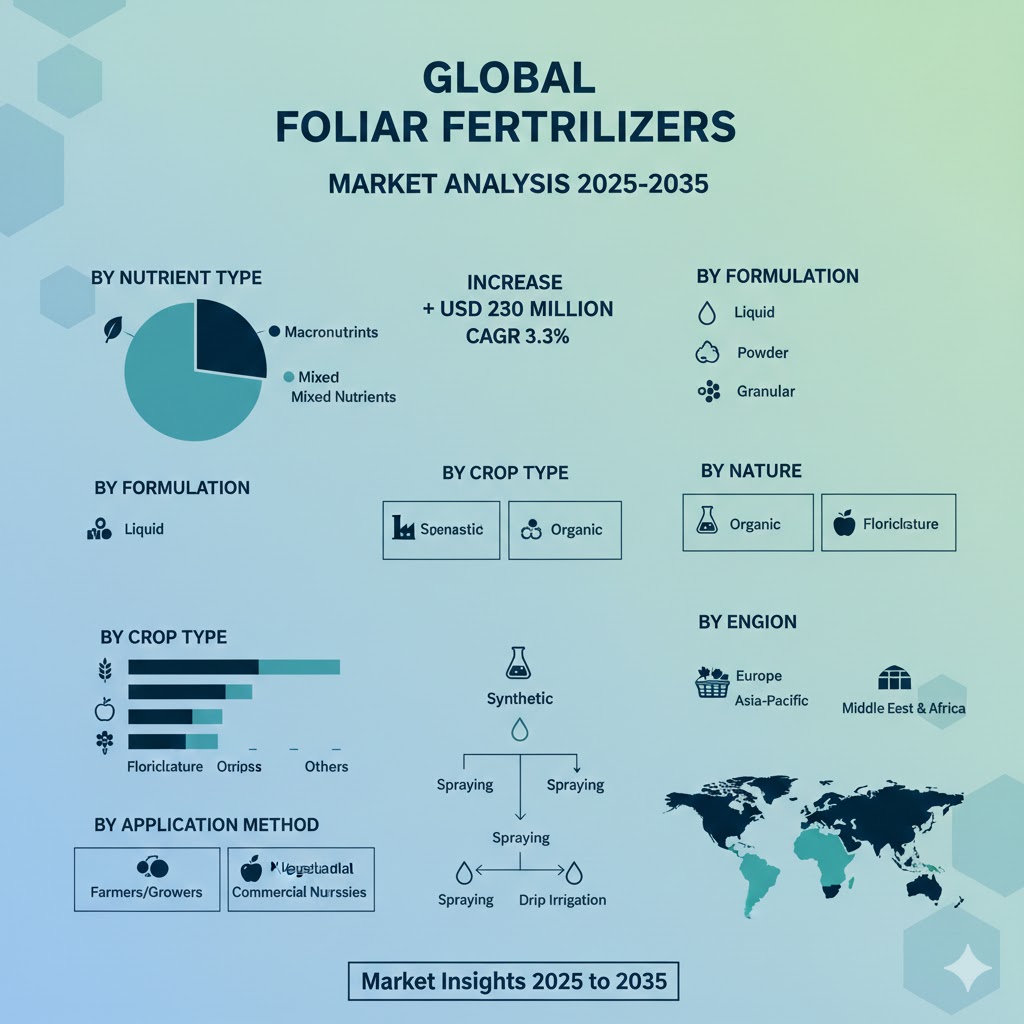
Global Foliar Fertilizers Market to Surpass USD 8,881 Million by 2035 with 6.4% CAGR. The global foliar fertilizers market is poised for significant expansion, with its valuation expected to reach USD 8,881 million by 2035, a substantial increase from USD 4,487 million in 2024. Projections indicate a steady CAGR of 6.4% during the forecast period (2025 to 2035), driven by a global shift toward green agriculture and the critical need to bolster food security amidst declining arable land.
Foliar Fertilizers Market Key Market Intelligence
-
Market Size 2026: Projected to reach approximately USD 5,084 million based on early forecast trajectories.
-
Market Size 2036: On track to exceed USD 9,450 million following established growth patterns.
-
CAGR (2025–2035): Stable at 6.4%.
-
Leading Product Segments: Field Crops (Staples like rice and wheat) and Horticultural Crops (Fruits and vegetables) drive dominant volume and value.
-
Leading Material/Nutrient Type: Macronutrients (N, P, K) currently maintain a high market presence, while Micronutrient blends are gaining rapid traction in high-value horticulture.
-
Leading End Use: Commercial Agricultural Enterprises and Smallholder Farmers represent the primary user base, with high adoption in regions like Maharashtra, India.
-
Key Growth Regions: Asia-Pacific (led by China and India), North America, and Western Europe.
-
Top Companies: Yara International ASA, Nutrien Ltd., Haifa Group, ICL Group Ltd., The Mosaic Company, and EuroChem Group AG, among others.
Market Momentum (YoY Path)
The foliar fertilizers market is following a consistent upward trajectory. Based on the 6.4% CAGR, the market is estimated to reach USD 5,084 million in 2026, progressing to USD 5,756 million by 2028. By 2030, the valuation is expected to hit USD 6,517 million, followed by USD 6,934 million in 2031. Continuing this momentum, the market will touch USD 7,851 million in 2033 and USD 8,881 million in 2035, reaching an estimated USD 9,450 million by 2036.
Why the Market is Growing
Growth is primarily fueled by the agenda of promoting green agriculture and the urgent need to increase yields under food supply pressure. The direct application of nutrients to plant leaves allows for rapid absorption, effectively correcting deficiencies that soil-based methods fail to address. Additionally, the integration of precision farming—including drones and soil sensors—maximizes nutrient delivery while minimizing environmental waste.
Segment Spotlight
1) Crop Type: Field Crops Leading Volume
The Field Crops segment, dominated by rice and wheat, is the backbone of the market. In regions like Jiangsu, China, nitrogen-based foliar sprays are essential for correcting deficiencies in high-yield cultivation. This segment focuses on volume-based, sustainable solutions to maintain global food stability.
2) Formulation: High Performance and Precision
Technological shifts toward Liquid and Nano-formulated fertilizers are enhancing application efficiency. These innovations allow for precise dosage, particularly in Washington’s apple orchards and high-value strawberry production, where potassium-enriched sprays significantly extend shelf life.
3) End Use: Smallholders and Commercial Giants
While large Commercial Agricultural Enterprises utilize IoT-powered systems for large-scale efficiency, Smallholder Farmers in India (notably Maharashtra) are increasingly adopting cost-effective foliar solutions. These sprays help bridge the nutrient gap in pulses and staple grains, supported by government sustainability programs.
Drivers, Opportunities, Trends, Challenges
Drivers: The intensification of precision agriculture acts as a major catalyst. Technologies like AI and IoT enable farmers in provinces such as Shandong, China, to optimize wheat production through precisely timed leaf sprays, reducing labor issues and environmental impact.
Opportunities: There is a significant opening for cost-effective foliar solutions tailored for small-scale field crops. Companies that develop affordable, water-soluble products stand to gain substantial market share in emerging economies where food security is a top priority.
Trends: The market is seeing a rise in bio-based and organic formulations to comply with stricter environmental standards. For instance, low-residue sprays on apples are becoming the norm in the U.S. to meet EPA safety standards, reflecting a global move toward sustainable chemical regulations.
Challenges: Navigating diverse regulatory environments remains a hurdle. While China’s rapid production is supported by fewer restrictions, players in the U.S. and Europe must invest heavily in R&D to maintain compliance with stringent residue and environmental safety laws.
Country Growth Outlook (CAGR)
| Country | Projected CAGR (2025–2035) |
| China | 7.1% |
| India | 6.8% |
| USA | 5.9% |
| Germany | 5.4% |
| France | 5.2% |
| UK | 5.0% |
| Brazil | 6.2% |
Competitive Landscape
The foliar fertilizers market is highly competitive, featuring global leaders and localized innovators. Key players include Yara International ASA, Nutrien Ltd., Haifa Group, ICL Group Ltd., K+S Aktiengesellschaft, and The Mosaic Company. Recent strategic moves include Haifa Group’s March 2025 launch of water-soluble fertilizers for horticultural crops and Nutrien Ltd.’s May 2025 expansion of digital farming tools in Canada to enhance nutrient efficiency in wheat.
Browse Full Report : https://www.factmr.com/report/1031/foliar-fertilizer-market
About Fact.MR
Fact.MR is a global market research and consulting firm, trusted by Fortune 500 companies and emerging businesses for reliable insights and strategic intelligence. With a presence across the U.S., UK, India, and Dubai, we deliver data-driven research and tailored consulting solutions across 30+ industries and 1,000+ markets. Backed by deep expertise and advanced analytics, Fact.MR helps organizations uncover opportunities, reduce risks, and make informed decisions for sustainable growth.