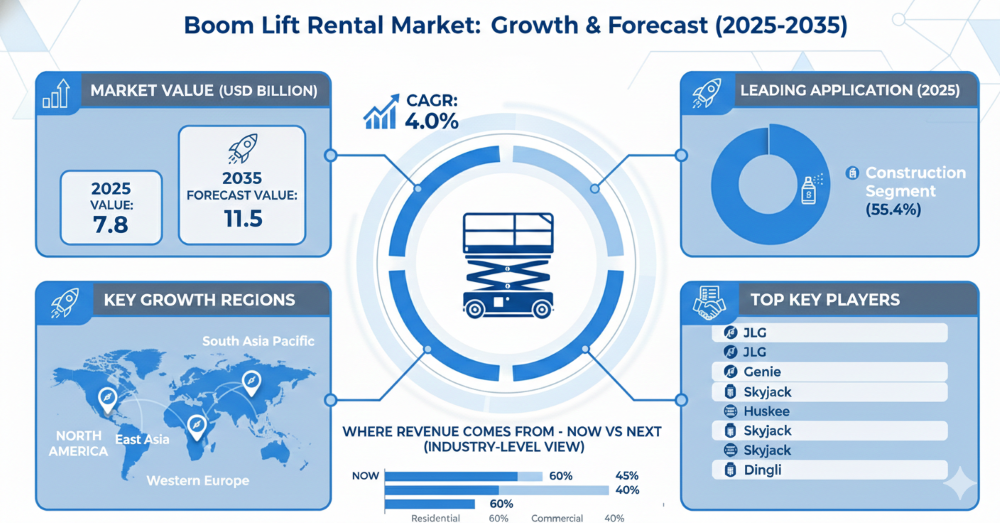
The boom lift rental market is experiencing steady expansion as demand for flexible, high-reach aerial access equipment grows across construction, industrial, and maintenance sectors. Boom lifts — versatile aerial work platforms that provide both vertical and horizontal reach — are increasingly preferred over ownership due to their ability to help businesses manage costs, optimize project timelines, and enhance safety. As infrastructure development continues worldwide and modern work environments evolve, the boom lift rental market is poised for significant long-term adoption.
Market Overview
Boom lifts are specialized aerial access machines featuring extendable arms that can reach heights often inaccessible by traditional scissor lifts or ladders. These platforms are used for high-elevation tasks such as façade installation, bridge construction, facility maintenance, and utility servicing. Unlike fixed access solutions, boom lifts offer unparalleled flexibility on dynamic job sites, enabling contractors and facility managers to complete tasks requiring both height and horizontal outreach.
The rental segment of the boom lift market plays a vital role in meeting project-based equipment needs. Rather than investing heavily in purchasing equipment, many organizations choose to rent boom lifts as needed, benefiting from reduced capital outlay, lower maintenance responsibility, and enhanced equipment availability. This trend is particularly prominent in markets where construction and industrial activities are intensifying.
Market Dynamics and Growth Drivers
Several key forces are propelling the boom lift rental market. First, global construction activity continues to grow, driven by urban expansion, infrastructure modernization, and commercial development. Projects ranging from high-rise buildings to transportation infrastructure increasingly rely on boom lifts to provide safe and efficient access for personnel and materials.
Second, the shift toward rental models over ownership reflects a broader industry preference for operational flexibility. Renting allows firms to deploy the right equipment for each phase of their projects without being tied to long-term asset ownership. This flexibility is especially valuable amid fluctuating demand and varying project timelines.
Safety and regulatory compliance further support rental demand. As governments and industry bodies enforce stricter workplace safety standards, contractors and facility managers seek access solutions that meet compliance requirements while minimizing risk. Boom lifts, equipped with advanced safety systems and operator support features, are increasingly integrated into rental offerings to help meet those needs.
Key Market Trends and Forecast
One prominent trend is the diversification of boom lift types available for rent. Articulating boom lifts — known for their superior maneuverability and ability to access hard-to-reach areas — hold a dominant position in the rental market. Their flexibility and enhanced positioning capabilities make them a preferred choice for complex construction and maintenance tasks.
Another important development is the rising adoption of telescopic boom lifts. With straight-line reach and extended working heights, telescopic models are ideal for large-scale infrastructure and industrial projects requiring precise access capabilities. Both types expand the operational scope of rental fleets, providing contractors with tailored solutions for diverse applications.
Environmental considerations are also influencing equipment preferences. Electric-powered boom lifts are gaining traction in rental portfolios, particularly for indoor and urban tasks where zero emissions, low noise levels, and environmental compliance are priorities. Hybrid power systems are emerging as specialized solutions that offer performance versatility across different work environments.
In addition, digital fleet management technologies are becoming integral to rental operations. Telematics, remote monitoring, and usage tracking systems help rental providers optimize equipment utilization, enhance maintenance scheduling, and reduce downtime. These innovations contribute to improved service reliability and customer satisfaction, further stimulating market growth.
Applications and End-Use Outlook
The construction sector remains the primary driver of boom lift rental demand. From building façade work to window installation and structural assembly, boom lifts are essential for tasks that require safe access at elevated positions. Contractors increasingly rely on rental solutions to support project scaling and manage resource planning without committing to heavy equipment purchases.
Beyond construction, maintenance operations represent a substantial portion of the market. Commercial buildings, industrial plants, and utility networks require regular access to elevated components for servicing, inspections, and repairs. Boom lift rentals provide facility managers with on-demand access solutions that enhance operational efficiency and workplace safety.
Emerging applications extend to sectors such as telecommunications, energy infrastructure, and event setup. Boom lifts support work on cell towers, power line networks, and even temporary installations for large events — showcasing their versatility across varied use cases. This wide range of applications reinforces the value of rental solutions that can adapt to different operational needs with speed and cost efficiency.
Regional Insights
Globally, North America continues to lead the boom lift rental market. The region’s mature construction industry, robust rental infrastructure, and strong safety culture have fostered widespread adoption of rental equipment solutions. Contractors and industrial firms in the United States and Canada routinely integrate boom lift rentals into project planning, supported by established rental networks and comprehensive service offerings.
Asia-Pacific is emerging as a fast-growing market due to rapid urbanization, infrastructure investments, and expanding industrial activity. Countries such as China, India, and Southeast Asian nations are witnessing heightened demand for aerial access equipment as government programs and private projects accelerate construction modernization and smart city development.
Western Europe also maintains significant market presence, driven by stringent safety regulations and ongoing infrastructure renewal efforts. Governments and businesses in major European countries are shifting toward rental models to support operational flexibility and environmental goals, including the adoption of electric and hybrid boom lifts.
Challenges and Opportunities
Despite robust growth prospects, the boom lift rental market faces a few challenges. Expanding rental fleets requires significant capital investment, and managing equipment supply to match fluctuating demand can be operationally complex. Smaller rental providers may struggle to compete with larger players in acquiring advanced equipment and sustaining service networks.
However, challenges also present opportunities. Rental companies that offer comprehensive service packages — including operator training, safety certification support, and integrated equipment management — can differentiate themselves in the competitive landscape. Additionally, partnerships with manufacturers to deploy next-generation boom lift models featuring advanced safety and digital features can unlock new revenue streams.
Conclusion
The boom lift rental market stands at the intersection of rising construction demand, operational flexibility needs, and safety-driven equipment adoption. As industries prioritize project efficiency and workforce protection, rental solutions for boom lifts are increasingly viewed as essential tools for elevated access tasks. With continued technological enhancement, environmental focus, and global infrastructure development, the boom lift rental market is well positioned to support diverse operational requirements and deliver value to contractors, facility managers, and industrial operators worldwide.
Browse Full Report – https://www.factmr.com/report/boom-lift-rental-market