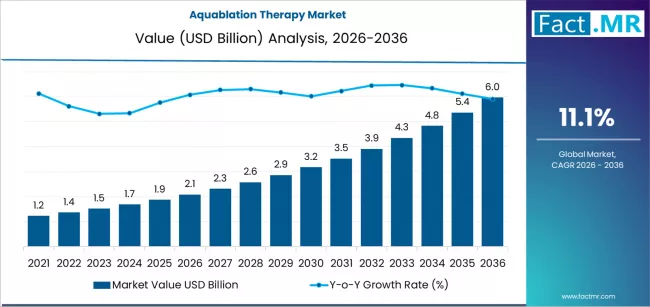
The global Aquablation Therapy market is undergoing a profound transformation, driven by innovations in image-guided robotics, sustainability imperatives in clinical outcomes, and evolving competitive dynamics reshaping urological care. The market — centered on minimally invasive robotic ablation for prostate disorders — is poised to expand from an estimated USD 2.08 billion in 2026 to nearly USD 5.96 billion by 2036, achieving a compound annual growth rate (CAGR) of approximately 11.1% over the forecast period.
Market Trajectory and Growth Drivers
Aquablation therapy has emerged as a differentiated solution for Benign Prostatic Hyperplasia (BPH) — a highly prevalent condition affecting aging males worldwide. Unlike traditional surgical methods, aquablation leverages robotically controlled, real-time image-guided waterjet technology to remove prostate tissue with high precision and minimal thermal damage, addressing core limitations of legacy approaches and enhancing patient outcomes.
This clinical advantage — comprising consistent tissue removal and low adverse functional effects — underpins the technology’s expanding adoption across hospitals, specialty urology clinics, ambulatory surgical centers, and academic medical centers. With hospitals projected to account for the largest share of end-user demand, aquablation’s integration into established surgical suites reflects broader healthcare trends favoring minimally invasive procedures with quicker recovery times and improved quality of life.
Innovation Trends Redefining Therapeutic Practice
Innovation is central to aquablation’s market evolution. The current landscape features:
-
Advanced Robotic Consoles: Aquablation consoles form the capital backbone of the therapy, commanding a significant share of system-type revenue due to their integration of imaging software and robotic waterjet control.
-
Single-Use Handpieces and Disposables: These consumables ensure procedural sterility and contribute recurring revenue streams, highlighting the economics of hybrid capital-and-consumable models.
-
Imaging and Planning Software: Predictive planning, precise execution, and data-driven procedural customization elevate treatment consistency and reduce operator-dependent variability — a key innovation trend improving outcomes.
-
Clinical Research Expansion: Ongoing trials explore aquablation applications beyond BPH, including prostate tissue debulking and investigational urological uses, potentially broadening the clinical addressable market.
Sustainability Drivers: Clinical, Economic & Patient-Centric
Sustainability in the aquablation market encompasses clinical, economic, and patient welfare dimensions:
-
Clinical Sustainability: Real-world evidence supports aquablation’s ability to preserve erectile and urinary function better than several alternative therapies, reducing retreatments and enhancing long-term patient satisfaction.
-
Economic Sustainability: Although upfront capital requirements for robotic consoles remain significant, the predictable procedural workflows and reduced postoperative complications lead to improved hospital throughput and lower total cost of care in many urology centers.
-
Patient Demand Sustainability: Increasing patient awareness and preference for minimally invasive care with rapid recovery fuel demand. Aquablation’s favorable profile aligns closely with patient priorities for reduced pain, reduced catheterization time, and enhanced functional outcomes.
Regional Adoption Dynamics
Growth across key global regions demonstrates diverse market dynamics and opportunity sets:
-
India is forecasted to show particularly strong expansion, with a projected CAGR of approximately 14.2%, driven by rising procedural adoption in private tertiary healthcare and competitive differentiation in high-volume urology practices.
-
Brazil (13.7%) and China (13.3%) are also positioned as high-growth territories, where private systems and tertiary hospitals are integrating advanced urological technologies into their surgical portfolios.
-
In North America and Western Europe, growth rates of around 10.3% and 10.5%, respectively, reflect robust reimbursement frameworks, early adopter clinician ecosystems, and structured health technology evaluation pathways that facilitate evidence-based adoption.
Competitive Landscape: Consolidation & Strategic Positioning
The competitive ecosystem is evolving rapidly, marked by innovation pursuit and portfolio expansion among incumbent and emerging players. Key market participants include PROCEPT BioRobotics Corporation, Medtronic plc, Olympus Corporation, Boston Scientific Corporation, and KARL STORZ SE & Co. KG — each vying for leadership based on clinical evidence, surgeon training ecosystems, and service delivery excellence.
PROCEPT BioRobotics currently leads as the pioneering force behind the AquaBeam system, combining core clinical expertise with focused enhancements in real-time imaging and robotic control. Competing medtech giants leverage broad urology portfolios and established sales networks to introduce complementary or competing minimally invasive therapies, intensifying market competition.
Innovation leadership increasingly hinges on continuous software upgrades, seamless integration with hospital IT systems, and the ability to demonstrate superior long-term clinical outcomes. Emerging entrants and strategic alliances also aim to disrupt traditional pricing models and expand access through subscription-based and bundled service offerings, especially in price-sensitive healthcare markets.
Challenges & Market Resilience
Despite strong growth prospects, barriers remain. Significant capital costs constrain adoption in smaller hospitals and cost-sensitive regions, while ongoing demands for robust long-term comparative evidence limit widespread guideline endorsements. Moreover, procedural training requirements and localized reimbursement policies present adoption hurdles in select markets.
Nevertheless, aquablation therapy’s trajectory reflects resilient demand driven by clinical differentiation, workflow efficiency, and patient outcomes that align with broader trends toward minimally invasive, technology-enabled surgical care.
Outlook & Strategic Implications
By 2036, the aquablation market is positioned to nearly triple in value, supported by innovation trends, sustainability forces, and a dynamically competitive landscape. Stakeholders — from healthcare institutions to medtech developers — are recalibrating strategies to harness this growth, focusing on evidence generation, cost-effectiveness validation, and clinician education to secure long-term adoption and market share.
Browse Full Report :