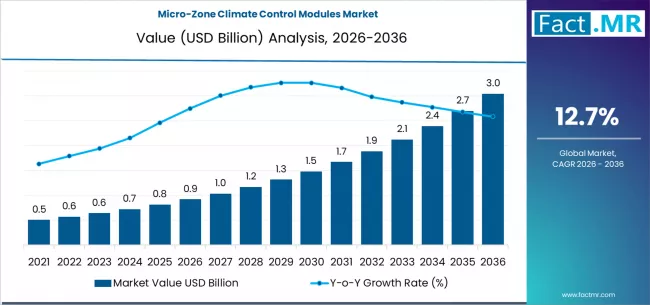
The global Micro-Zone Climate Control Modules Market is poised for robust growth over the coming decade, driven by increasing demand for personalized thermal comfort, energy-efficient HVAC architectures, and advanced climate management technologies. Micro-zone climate control modules are compact, modular systems designed to regulate temperature and airflow in specific zones rather than conditioning an entire enclosed space uniformly. This targeted approach is gaining traction across automotive, electric mobility, commercial transportation, and smart enclosed environments.
As end users increasingly prioritize comfort customization, energy savings, and system efficiency, micro-zone climate control modules are emerging as a critical component of next-generation climate systems. Their ability to precisely manage micro-environments aligns well with evolving expectations in premium mobility platforms and energy-conscious designs.
Market Outlook (2026–2036)
-
Market Value in 2026: USD 799.2 Million
-
Market Value in 2036: USD 2,269.3 Million
-
Forecast CAGR (2026–2036): 11.0%
-
Leading Module Type: Micro-Zone HVAC Duct Modules
-
Primary Application Area: Driver and Passenger Zones
-
Key Growth Regions: Asia Pacific, North America, Europe
The market’s strong growth outlook reflects rising adoption of modular HVAC solutions that balance comfort requirements with operational efficiency and power consumption constraints.
To access the complete data tables and in-depth insights, request a Discount On The Report here: https://www.factmr.com/connectus/sample?flag=S&rep_id=13471
Market Overview
Micro-zone climate control modules enable precise thermal regulation by dividing cabins or enclosed spaces into smaller, independently controlled zones. Unlike conventional centralized systems, these modules focus airflow and temperature control only where needed, reducing unnecessary energy consumption. This capability is particularly valuable in electric and hybrid vehicles, where HVAC loads have a direct impact on driving range and battery efficiency.
These systems integrate compact air ducts, dampers, sensors, micro-blowers, and electronic control units to dynamically adjust environmental conditions based on occupancy, user preferences, and ambient conditions. As vehicles and enclosed platforms become more connected and software-driven, micro-zone climate control modules are increasingly integrated into smart HVAC architectures.
Key Market Drivers
1. Rising Demand for Personalized Comfort
Consumers increasingly expect individualized temperature control, especially in premium and connected environments. Micro-zone modules allow different occupants to experience customized comfort levels within the same cabin, significantly enhancing user experience.
2. Electrification and Energy Optimization
In electric mobility platforms, minimizing auxiliary energy consumption is critical. Micro-zone systems reduce the need to condition unoccupied areas, helping conserve battery power and improve overall energy efficiency.
3. Advancements in Smart Climate Technologies
Integration of sensors, occupancy detection, and intelligent control algorithms supports dynamic adjustment of micro-zones in real time. This capability aligns with broader trends toward software-defined climate control systems.
4. Growth of Advanced Mobility Platforms
The expansion of premium vehicles, autonomous mobility solutions, and connected transportation systems is increasing demand for advanced interior comfort technologies, including micro-zone climate control modules.
Market Segmentation Insights
By Module Type:
-
Micro-Zone HVAC Duct Modules
-
Local Air-Mix Units
-
Thermoelectric Spot Cooling Modules
-
Other Modular Climate Components
By Zone Coverage:
-
Driver and Front Passenger Zones
-
Second-Row Zones
-
Rear Cabin Zones
-
Other Targeted Areas
By Control Technology:
-
Smart Dampers and Valves
-
Micro Fans and Blowers
-
Sensors and Electronic Control Units
-
Integrated Climate Control Systems
By Sales Channel:
-
OEM Line-Fit Installations
-
Tier-1 Supplier Solutions
-
Aftermarket Components
-
Other Distribution Channels
Regional Demand Dynamics
Asia Pacific is expected to lead market growth due to expanding electric vehicle production, increasing adoption of advanced comfort features, and strong manufacturing activity in key automotive hubs. North America continues to show strong demand, supported by consumer preference for comfort-focused vehicle interiors and ongoing innovation in HVAC technologies. Europe remains a key market as energy efficiency regulations and premium vehicle demand support adoption of localized climate control systems.
Emerging regions, including parts of Latin America and the Middle East, are gradually adopting micro-zone climate solutions as vehicle feature sets and climate control sophistication continue to evolve.
Competitive Landscape
The micro-zone climate control modules market is moderately competitive, with participation from established HVAC system suppliers, automotive thermal management specialists, and component manufacturers. Market participants focus on modular design flexibility, system integration capability, energy efficiency, and rapid response performance.
Product differentiation is driven by compact form factors, seamless compatibility with centralized HVAC systems, advanced sensor integration, and software-enabled control. Strategic collaborations with vehicle manufacturers and platform integrators play a key role in expanding market presence.
Future Outlook
The Micro-Zone Climate Control Modules Market is expected to maintain strong momentum through 2036 as demand for personalized comfort, energy-efficient climate solutions, and intelligent HVAC architectures continues to rise. Ongoing innovation in smart controls, lightweight materials, and modular system design will further enhance adoption across automotive and adjacent sectors.
As mobility platforms and enclosed environments evolve toward greater efficiency and user-centric design, micro-zone climate control modules will remain a critical enabler of next-generation thermal management strategies.
Browse Full Report: https://www.factmr.com/report/micro-zone-climate-control-modules-market