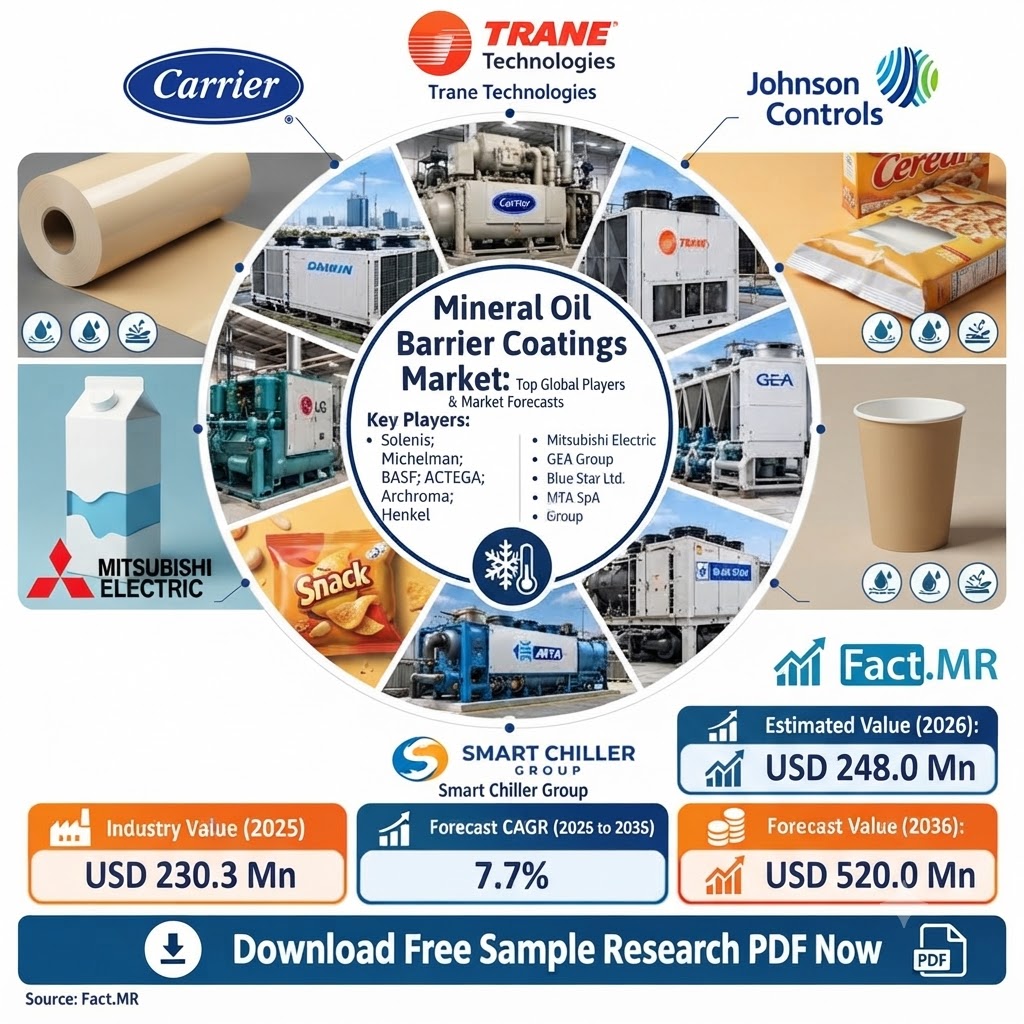
Mineral Oil Barrier Coatings Market -The global mineral oil barrier coatings market is projected to grow from USD 248.0 million in 2026 to USD 520.0 million by 2036, expanding at a 7.7% CAGR during the forecast period, according to Fact.MR. The market was valued at USD 230.3 million in 2025.
Demand is increasing as food packaging producers use recycled paperboard while facing tighter requirements for mineral oil migration control. Coating suppliers are increasingly required to demonstrate documented MOSH and MOAH barrier performance, food-contact suitability, and compatibility with existing paper and board coating lines.
The market is expected to add USD 272.0 million between 2026 and 2036. Recycled board applications, food-contact qualification, and demand for water-based coating systems are among the factors supporting market expansion.
Get detailed market forecasts, competitive benchmarking, and pricing trends:
Recycled Board Drives Demand for Mineral Oil Barrier Coatings
Food packaging producers are seeking barrier coatings that can reduce mineral oil transfer when recycled fiber is used in paper and board packaging. Recycled paperboard can introduce mineral oil sources into food packaging, increasing the need for documented migration-control performance.
MOSH barrier is projected to account for 30% of the market in 2026, supported by applications where mineral oil migration control is a purchasing requirement. MOAH barriers remain relevant where aromatic hydrocarbon limits are included in food-contact evaluations.
By chemistry, acrylic dispersion is expected to hold a 34% share in 2026. Water-based acrylic dispersion systems are gaining attention because they can fit existing paper and board coating operations without requiring major equipment changes.
By substrate, recycled board is anticipated to capture 47% share in 2026. The segment benefits from the increasing use of recovered fiber in food packaging and the resulting need to manage potential mineral oil migration.
Among applications, dry foods are estimated to represent 32% share in 2026, reflecting demand for mineral oil barrier performance in cereal boxes and other carton formats.
European Packaging Requirements Shape Buyer Decisions
Europe is forecast to remain a leading adoption region in 2026, supported by packaging waste requirements, food-contact scrutiny, and established paper and board manufacturing capacity.
Germany is projected to expand at an 8.8% CAGR from 2026 to 2036. The country combines a developed paper industry with stringent European packaging requirements, creating demand for coating systems supported by clear food-contact documentation and migration testing.
China is expected to record the highest country growth among the markets profiled, with a 10.4% CAGR through 2036. Its large paperboard production base and export packaging activity create opportunities for coating suppliers that can demonstrate mineral oil migration control and production-line compatibility.
India is projected to grow at a 9.6% CAGR, supported by packaged-food expansion and increasing carton use. Brazil is estimated to advance at an 8.1% CAGR, reflecting its food production and pulp and paper industries.
The United States is forecast to register a 7.3% CAGR. Its established network of paper mills and packaging plants provides opportunities for coating suppliers to conduct trials without major changes to production infrastructure.
Qualification and Documentation Remain Important
Food-contact qualification costs are expected to restrain market expansion. Packaging converters generally need migration testing, production trials, and supporting documentation before approving a new coating for recurring use.
Acrylic dispersion systems can also face drying and coating-weight limitations on certain paperboard lines. Suppliers therefore need to demonstrate consistent performance under commercial production conditions rather than relying only on laboratory results.
Documentation is particularly relevant in Europe and North America, where buyers can require food-contact status, migration data, and recycling-related evidence as part of supplier evaluation.
Opportunities are emerging for grades designed specifically for recycled board, application laboratories for acrylic dispersion systems, rule-ready documentation, and local trials with paperboard converters.
Competitive Landscape
The competitive environment includes Solenis, Michelman, BASF, ACTEGA, Archroma, and Henkel.
Solenis provides TopScreen biowax coatings for food paper packaging and positions the technology around mineral oil and food-packaging barrier requirements. Michelman offers water-based barrier coating technologies for dry and frozen food packaging applications.
BASF’s Joncryl HPB technology serves paperboard applications requiring water protection and heat-sealing properties. ACTEGA is active in barrier and food-safe coating technologies for paper and board.
Archroma launched Cartaseal OGB F10 in March 2024 as a PFAS-free water-based oil and grease barrier coating for paper and board. Henkel expanded its barrier and heat-seal coating portfolio for paper applications in April 2026.
As recycled fiber use expands, suppliers are expected to compete increasingly on documented migration performance, coating-line compatibility, food-contact qualification support, and recycling considerations.
According to Shambhu Nath Jha, Senior Analyst at Fact.MR, “Mineral oil barrier coating approval now depends on more than choosing a coating. Companies need clear proof that the product limits mineral oil transfer and runs well on existing coating lines.”
Fact.MR’s analysis covers mineral oil barrier coatings by barrier target, chemistry, substrate, application, and region. The study evaluates MOSH and MOAH barriers alongside acrylic dispersion, PVOH, starch-based, wax blend, and hybrid polymer systems.
Top Trending Reports:
The report covers 25+ countries, 35+ company portfolios, 120+ sources, and 20+ interviews, providing analysis of market sizing, country growth, segment demand, supplier activity, regulatory considerations, and adoption trends.