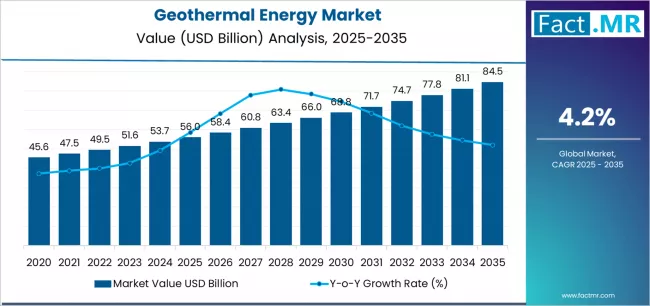
The global geothermal energy market is poised for steady expansion over the next decade, supported by accelerating adoption of renewable energy technologies, rising demand for reliable baseload power, and government initiatives aimed at reducing carbon emissions. According to a new analysis by Fact.MR, the market is projected to grow from USD 56.0 billion in 2025 to approximately USD 85.0 billion by 2035, recording an absolute increase of USD 29.0 billion over the forecast period.
This represents a total growth of 51.8%, with the market expected to expand at a CAGR of 4.2% between 2025 and 2035. The geothermal energy market is anticipated to grow by nearly 1.5X during the same period, driven by increasing investments in clean energy infrastructure and long-term energy security goals.
Geothermal energy’s ability to deliver consistent, low-emission, and cost-stable power positions it as a critical component of the global renewable energy mix.
Browse Full Report: https://www.factmr.com/report/geothermal-energy-market
Strategic Market Drivers
Rising Demand for Clean and Baseload Renewable Energy
Unlike intermittent renewable sources such as wind and solar, geothermal energy provides 24/7 baseload power, making it highly attractive for grid stability. Governments and utilities are increasingly integrating geothermal power into national energy strategies to ensure reliable electricity supply while meeting decarbonization targets.
Government Policies and Renewable Energy Targets
Supportive regulatory frameworks, feed-in tariffs, tax incentives, and long-term power purchase agreements (PPAs) are accelerating geothermal project development across both developed and emerging economies. International climate commitments are further strengthening geothermal investments.
Advancements in Drilling and Exploration Technologies
Technological innovations such as enhanced geothermal systems (EGS), advanced reservoir modeling, and improved drilling techniques are expanding geothermal viability beyond traditionally active volcanic regions, unlocking new growth opportunities.
Growing Focus on Energy Security
Rising geopolitical uncertainties and fossil fuel price volatility are encouraging countries to invest in domestic, sustainable energy sources, positioning geothermal energy as a long-term solution for energy independence.
Regional Growth Highlights
North America: Technology Leadership and EGS Expansion
The United States remains a global leader in geothermal energy deployment, supported by strong R&D investments, government funding, and advancements in enhanced geothermal systems. Ongoing innovation is enabling geothermal adoption in non-traditional regions.
Europe: Decarbonization and District Heating Growth
Europe is witnessing growing geothermal adoption driven by strict carbon reduction policies and the expansion of geothermal-based district heating systems. Countries such as Germany, Iceland, France, and Italy are leading regional development.
Asia-Pacific: Rapid Energy Demand and Renewable Push
Indonesia, the Philippines, Japan, and New Zealand are emerging as key geothermal markets due to abundant geothermal resources and rising electricity demand. Government-backed renewable energy programs are accelerating project pipelines.
Emerging Markets: Untapped Geothermal Potential
Latin America, East Africa, and parts of the Middle East offer significant untapped geothermal resources. Countries such as Kenya, Mexico, Chile, and Turkey are increasing geothermal investments to support sustainable economic growth.
Market Segmentation Insights
By Technology
- Dry Steam Power Plants – Mature technology with long-term operational stability
- Flash Steam Power Plants – Widely used for high-temperature reservoirs
- Binary Cycle Power Plants – Fastest-growing segment due to low-temperature resource utilization
By Application
- Power Generation – Dominant segment driven by grid-scale renewable electricity demand
- Direct Use Applications – Heating, agriculture, aquaculture, and industrial processes
- District Heating Systems – Rapid growth in urban sustainability projects
By End User
- Utilities – Largest adopters for baseload renewable power
- Industrial Users – Increasing use for process heat
- Residential & Commercial – Growing adoption in heating solutions
Challenges Impacting Market Growth
High Initial Capital Investment
Geothermal projects require substantial upfront costs for exploration, drilling, and infrastructure, which can limit adoption in developing economies.
Exploration and Resource Risk
Uncertainty in reservoir performance and drilling success poses financial risk, particularly for early-stage projects.
Long Development Timelines
Geothermal power plants typically involve longer project development cycles compared to other renewable energy technologies.
Competitive Landscape
The geothermal energy market is moderately consolidated, with key players focusing on resource expansion, drilling technology innovation, and strategic partnerships to reduce costs and improve project viability.
Key Companies Profiled
- Ormat Technologies
- Enel Green Power
- Chevron Corporation
- Calpine Corporation
- Mitsubishi Heavy Industries
- Ørsted A/S
- Toshiba Energy Systems
- KenGen
- Berkshire Hathaway Energy
- Alterra Power
Companies are investing in enhanced geothermal systems, digital reservoir monitoring, and hybrid renewable solutions to strengthen market positioning.
Recent Developments
- 2024: Increased investments in enhanced geothermal systems (EGS) to expand geothermal deployment beyond volcanic regions
- 2023: Expansion of geothermal district heating projects across Europe
- 2022: New geothermal power capacity additions in Asia-Pacific and East Africa
Future Outlook: Steady Growth in Sustainable Baseload Energy
The next decade will see geothermal energy playing a critical role in the global clean energy transition, supported by:
- Expansion of enhanced geothermal technologies
- Rising need for reliable renewable baseload power
- Increasing government support and private investments
- Integration with smart grids and hybrid renewable systems
As nations prioritize energy security, sustainability, and long-term cost stability, the global geothermal energy market is well-positioned for consistent growth through 2035.