Subheadline: Flash Rust Inhibitors Market is projected to grow from USD 550 million in 2026 to USD 890 million by 2036, supported by waterborne coating demand.
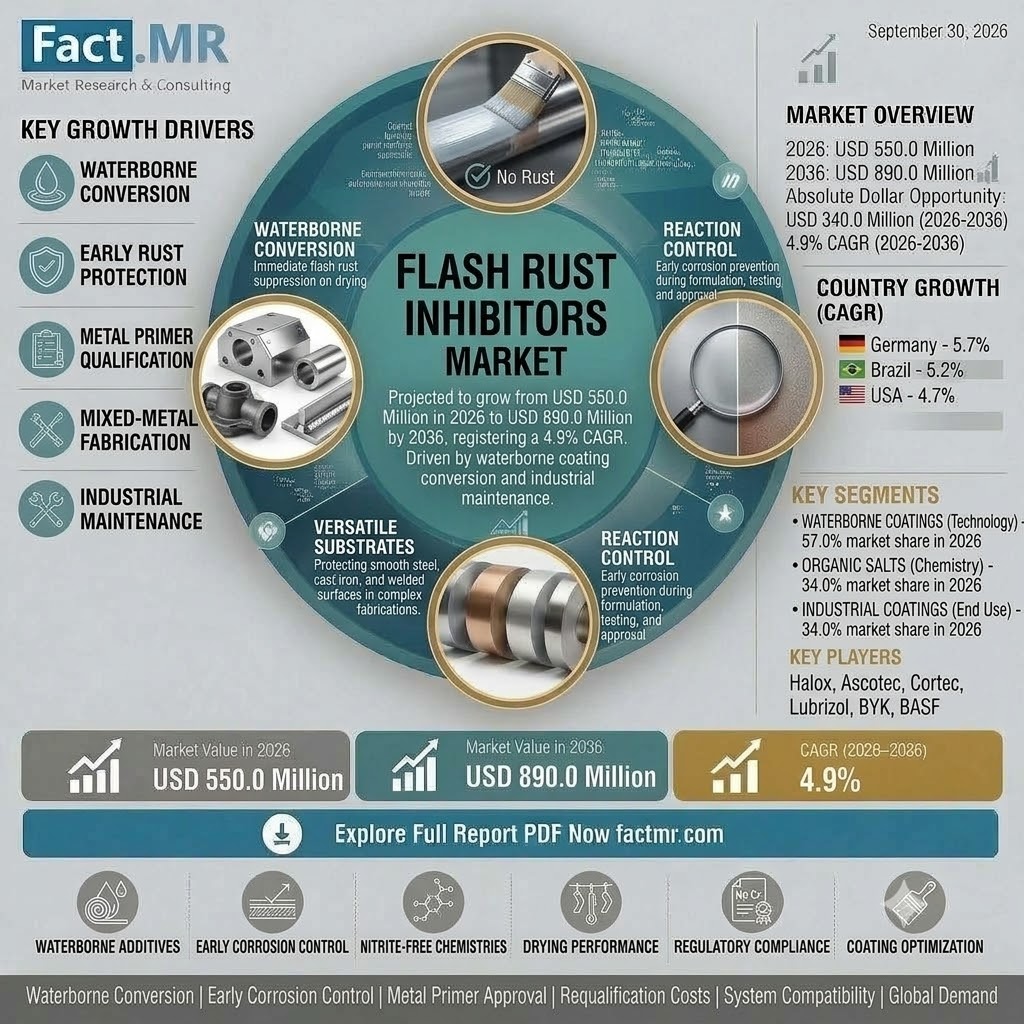
September 30, 2026 — The Flash Rust Inhibitors Market is projected to reach USD 890.0 million by 2036, up from USD 550.0 million in 2026, according to Fact.MR, representing a 4.9% CAGR over the forecast period. The market had crossed an estimated USD 524.2 million in 2025 as waterborne metal coatings moved through broader plant and field qualification.
The market is expected to add USD 340.0 million in absolute opportunity between 2026 and 2036. Demand is being shaped by the need for early rust protection on reactive metal while coatings dry, particularly in waterborne systems where exposed steel can develop rust before the coating fully cures.
Get detailed market forecasts, competitive benchmarking, and pricing trends: https://www.factmr.com/connectus/sample?flag=S&rep_id=15561
Waterborne Coatings Remain Central to Market Demand
Waterborne coatings are projected to account for 57.0% of the Flash Rust Inhibitors Market in 2026. Their direct contact with reactive metal surfaces makes flash-rust control a key formulation requirement during application and drying.
Metal primers also require protection during testing and approval. A coating failure during drying can delay qualification, making inhibitor performance relevant to formulation decisions.
Fact.MR is a market research and consulting organization that provides market analysis, forecasts, and industry intelligence across global markets.
By chemistry, organic salts are expected to hold a 34.0% market share in 2026. Organic salts are widely used in water-based coatings, while manufacturers also offer nitrite-free, amine-based, phosphate-based, and zinc-free formulations for different coating requirements.
In March 2025, Halox introduced a water-based acrylic formulation containing 0.80% FLASH-X 150 for flash-rust protection. The formulation provides a specific example of how inhibitor dosage is evaluated within water-based coating systems.
Steel and Industrial Coatings Account for Major Shares
Steel is expected to capture 32.0% of the market in 2026. Steel remains widely used across structures, equipment, and fabricated products, while cast iron, galvanized steel, and welded parts can require additional protection during coating and drying.
Industrial coatings are estimated to represent 34.0% of the market by end use in 2026. These coatings are applied to equipment, fabricated products, and maintenance applications. Automotive refinish applications place greater emphasis on appearance, while marine and protective coatings require reliable rust protection.
By regulatory profile, nitrite-free products are forecast to hold 32.0% share in 2026. Low-VOC and APEO-free formulations are also being considered where customers have specific formulation requirements.
Analyst Perspective
Shambhu Nath Jha, Senior Analyst at Fact.MR, said, “Flash rust control is important during coating approval. If a coating fails in drying tests, approval can be delayed. Products that protect different metal surfaces and keep coating quality intact are more likely to be used in production.”
Jha added, “Testing needs to cover different binders, metal surfaces and drying conditions before broad performance claims are made. Welded parts and cast iron also need separate evaluation because they can rust faster than smooth steel surfaces.”
The market analysis identifies waterborne coating conversion as a major adoption factor, with an estimated +0.8% impact on CAGR. Metal primer approval requirements are associated with +0.6%, while mixed-metal fabrication requiring early corrosion control carries an estimated +0.5% impact.
Cost and time required for coating requalification remain a restraint, with an estimated -0.4% impact on CAGR. Binder, pigment, and pH compatibility limits contribute another -0.3%.
Germany Leads Country-Level Growth
Germany is forecast to expand at a 5.7% CAGR from 2026 to 2036, linked to demanding industrial coating specifications. Brazil follows at 5.2%, supported by industrial maintenance and local technical service, while the USA is projected to advance at 4.7% as mature coating lines undergo measured reformulation.
Germany reported a 0.4% increase in production in April 2026 compared with the previous month, according to Destatis. Brazil reported industrial production growth of 0.7% from March to April 2026, according to the Brazilian Institute of Geography and Statistics.
The USA market is also being shaped by gradual additive testing. In November 2025, the Federal Reserve Board reported that manufacturing capacity growth for 2025 was expected to exceed 1%.
Company Activity and Market Coverage
Halox, Ascotec, Cortec, Lubrizol, BYK, and BASF are profiled in the Flash Rust Inhibitors Market analysis. In January 2025, Ascotec announced its ASCOTRAN flash-rust inhibitors at the European Coatings Show in Nuremberg. In November 2025, Cortec highlighted M-240 and M-435 for water-based coating applications.
BYK opened a new office in São Paulo in August 2025, while Lubrizol documented Lubrizol 2064 for alkyd and waterborne coatings used in rust-proofing applications in February 2026.
View Related Reports :
About Fact.MR
Fact.MR is a market research and consulting firm providing market intelligence, industry analysis, and forecasts across a broad range of sectors. The Flash Rust Inhibitors Market report covers chemistry, application, substrate, end use, regulatory profile, and regional demand across 2026 to 2036.
The analysis draws on 120+ sources, 40+ product records, 25+ countries, and 20+ interviews. Primary research includes discussions with coating formulators, additive distributors, corrosion specialists, and industrial users, alongside government statistics, technical documents, product data sheets, and verified company announcements.