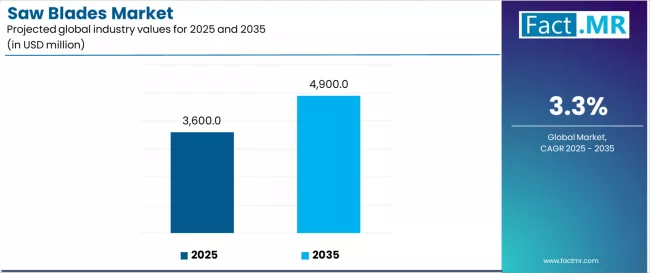
The global saw blades market is set for steady expansion over the next decade, supported by rising construction activity, growth in metal and wood fabrication industries, and increasing demand for precision cutting tools across industrial and commercial applications. According to a new analysis by Fact.MR, the market is projected to grow from USD 3.6 billion in 2025 to approximately USD 4.9 billion by 2035, reflecting an absolute growth of USD 1.3 billion over the forecast period. This expansion represents a CAGR of 3.3% from 2025 to 2035.
Growing investments in infrastructure development, automotive manufacturing, and furniture production—combined with advances in blade materials and cutting technologies—are accelerating saw blade adoption worldwide.
Browse Full Report: https://www.factmr.com/report/saw-blades-market
Strategic Market Drivers
Expanding Construction & Infrastructure Development
Rapid urbanization, residential construction, and large-scale infrastructure projects are fueling strong demand for saw blades used in cutting wood, concrete, stone, and metal. Circular saw blades, band saw blades, and diamond blades are extensively utilized across construction sites, workshops, and manufacturing units.
Government-backed infrastructure initiatives in both developed and emerging economies are significantly boosting market growth.
Growth in Metalworking & Industrial Fabrication
Rising production of automobiles, machinery, and industrial equipment is increasing demand for high-performance saw blades capable of cutting steel, aluminum, alloys, and composites with high precision.
Advanced carbide-tipped and high-speed steel (HSS) blades are gaining traction due to their:
- Longer service life
- Higher cutting accuracy
- Improved heat resistance
Rising Demand from Woodworking & Furniture Industries
The expanding furniture, interior design, and woodworking sectors are driving strong consumption of saw blades for cutting hardwood, plywood, MDF, and laminates.
Increased demand for customized furniture and modular interiors is further accelerating the need for precision cutting tools.
Advancements in Blade Materials & Coatings
Technological advancements—including laser-cut blades, vibration-reduction designs, and advanced coatings—are improving blade durability, cutting speed, and surface finish.
Manufacturers are increasingly adopting carbide, diamond, and ceramic coatings to enhance performance across heavy-duty and high-speed cutting applications.
Regional Growth Highlights
North America: Construction & Industrial Manufacturing Strength
North America remains a prominent market due to robust construction activity, advanced manufacturing facilities, and strong demand from metal fabrication and automotive industries. The U.S. continues to lead with steady investments in infrastructure modernization and industrial tooling.
Europe: Precision Engineering & Automotive Demand
Europe’s strong presence in automotive manufacturing, machinery production, and woodworking industries is driving demand for high-quality saw blades. Countries such as Germany, Italy, and France are major contributors, supported by technological innovation and skilled manufacturing ecosystems.
East Asia: Manufacturing Hub with High Tool Consumption
China, Japan, and South Korea dominate global saw blade production and consumption. Rapid industrialization, expanding automotive output, and large-scale construction projects continue to fuel market growth across the region.
Emerging Markets: Infrastructure & Industrial Expansion
Markets such as India, Southeast Asia, Latin America, and the Middle East are witnessing rising demand due to:
- Infrastructure development programs
- Growth in metal fabrication workshops
- Expansion of woodworking and furniture manufacturing
- Increasing adoption of power tools
Market Segmentation Insights
By Product Type
- Circular Saw Blades – Largest segment due to widespread use in construction and woodworking
- Band Saw Blades – High adoption in metal cutting and industrial applications
- Diamond Saw Blades – Growing demand for concrete, stone, and ceramic cutting
By Material
- Carbide-Tipped Blades – Dominant due to durability and cutting efficiency
- High-Speed Steel (HSS) – Widely used in general-purpose cutting
- Diamond-Coated Blades – Fastest-growing for precision and heavy-duty applications
By Application
- Construction – Leading segment driven by infrastructure growth
- Metal Fabrication – Strong demand from automotive and machinery industries
- Woodworking & Furniture – High volume consumption
- Automotive & Aerospace – Precision cutting requirements
Challenges Impacting Market Growth
Raw Material Price Volatility
Fluctuations in steel, carbide, and diamond material prices can affect production costs and profit margins.
Tool Wear & Replacement Costs
Frequent blade replacement in heavy-duty applications can increase operational costs for end users.
Competition from Alternative Cutting Technologies
Technologies such as laser cutting and waterjet cutting present competitive pressure in certain industrial applications.
Competitive Landscape
The global saw blades market is moderately fragmented, with manufacturers focusing on:
- Product durability and precision
- Advanced blade coatings
- Application-specific blade designs
- Expansion across industrial and professional tool segments
Key Companies Profiled
- Bosch Power Tools
- Stanley Black & Decker
- Freud (Diablo Tools)
- Makita Corporation
- Hilti Group
- Milwaukee Tool
- Kinkelder
- Starrett
- LEUCO
- Amada Tooling
Recent Developments
- 2024: Introduction of laser-cut, noise-reduction saw blades for improved precision and user safety
- 2023: Increased adoption of carbide and diamond blades in infrastructure and stone-cutting applications
- 2022: Expansion of professional-grade saw blade portfolios for woodworking and metal fabrication
Future Outlook: Steady Growth Driven by Precision & Performance
The saw blades market is expected to witness sustained growth through 2035, supported by:
- Rising construction and infrastructure activity
- Growth in metalworking and woodworking industries
- Technological improvements in blade materials
- Increasing demand for precision and efficiency
As industries continue to prioritize productivity, accuracy, and durability, the global saw blades market is well-positioned for consistent, long-term expansion over the coming decade.