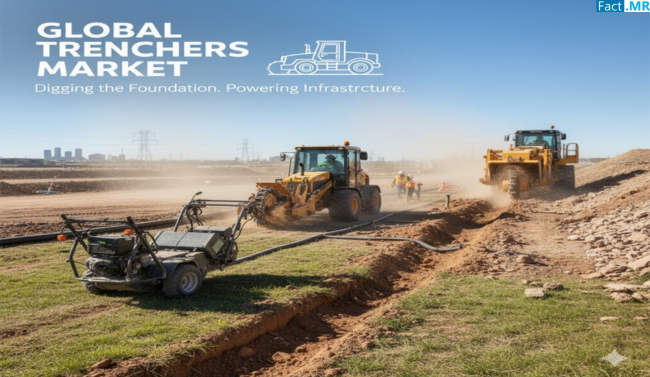
The trenchers market is gaining strong momentum as global infrastructure development and urban expansion continue to accelerate. Trenchers play a vital role in construction, agriculture, and utility installation by enabling efficient excavation of narrow trenches for pipelines, cables, drainage systems, and irrigation networks. As governments and private developers invest in transportation, energy, and telecommunications infrastructure, the demand for reliable and high-performance trenching equipment continues to rise.
Market Overview
Trenchers are specialized construction machines designed to dig precise trenches with minimal surface disruption. They are widely used across applications such as underground cable laying, fiber-optic installation, water and sewer pipelines, and agricultural drainage. Compared to traditional excavation methods, trenchers offer faster operation, improved accuracy, and reduced labor requirements.
Insights from Fact.MR highlight that increasing mechanization in construction and utility projects is a key factor supporting market growth. Contractors and infrastructure developers are increasingly adopting trenchers to meet tight project timelines and improve operational efficiency, especially in large-scale and urban projects where precision is critical.
Types of Trenchers and Product Insights
The trenchers market includes various equipment types designed to meet different application needs. Chain trenchers are commonly used for digging deep and narrow trenches in tough soil conditions, while wheel trenchers are preferred for shallow trenching in softer terrain. Micro trenchers are gaining popularity for urban fiber-optic and cable installation projects due to their ability to create minimal-width trenches with reduced surface damage.
Manufacturers are focusing on improving machine durability, cutting efficiency, and ease of operation. Advancements such as adjustable trench widths, automated depth control, and enhanced cutting chains are helping operators achieve consistent results across diverse ground conditions.
Applications & End-Use Outlook
Construction and infrastructure development represent the largest end-use segment for trenchers. These machines are widely used in road construction, residential and commercial developments, and public utility projects. Growing investments in smart cities and urban infrastructure continue to support demand in this segment.
The energy and utilities sector is another major contributor, with trenchers being used for the installation of power cables, gas pipelines, and renewable energy infrastructure. Expanding telecommunication networks, particularly fiber-optic connectivity, are also driving increased adoption of trenching equipment.
In agriculture, trenchers are used for irrigation systems, drainage installation, and soil preparation. The increasing focus on efficient water management and modern farming practices is contributing to steady demand from the agricultural sector.
Regional Insights
North America remains a prominent market for trenchers, supported by ongoing investments in infrastructure modernization and utility upgrades. The region’s strong construction equipment rental industry also plays a role in increasing trencher accessibility for small and medium contractors.
Europe follows closely, driven by urban redevelopment projects, renewable energy installations, and strict regulations promoting underground utility placement. Advanced construction practices and skilled operators further support market growth.
Asia-Pacific is emerging as a high-growth region due to rapid urbanization, expanding transportation networks, and large-scale infrastructure projects. Increasing government spending on utilities, smart city initiatives, and agricultural development is accelerating trencher adoption across developing economies.
Latin America and the Middle East & Africa are gradually adopting trenchers as infrastructure investment increases and mechanized construction practices become more prevalent.
Key Trends & Market Outlook
Several trends are shaping the future of the trenchers market:
- Rising demand for underground utility installation
- Growth of fiber-optic and telecommunication networks
- Increasing adoption of compact and micro trenchers
- Focus on fuel-efficient and low-emission equipment
- Expansion of construction equipment rental services
Manufacturers are also developing versatile machines that can operate in confined spaces and challenging terrains, catering to the evolving needs of urban construction projects.
Competitive Landscape
The trenchers market features a mix of global construction equipment manufacturers and regional players. Competition is driven by machine performance, durability, operational efficiency, and aftersales support. Companies are focusing on product innovation, expanding dealer networks, and offering comprehensive maintenance services.
According to Fact.MR insights, strategic partnerships with rental companies and infrastructure contractors are becoming increasingly important for market expansion. Providing operator training and technical support is also a key differentiator among equipment suppliers.
Conclusion
The trenchers market continues to play a crucial role in enabling efficient and precise excavation for infrastructure, utility, and agricultural projects. As global demand for underground utilities and modern infrastructure grows, trenchers offer a practical solution for meeting project requirements while minimizing environmental and surface disruption.
For construction firms, equipment manufacturers, and investors, understanding market dynamics and emerging trends is essential for making informed decisions. Comprehensive industry research from platforms such as Fact.MR can provide valuable insights into technological advancements, regional opportunities, and competitive strategies within the evolving trenchers market.
Browse Full Report – https://www.factmr.com/report/535/trenchers-market