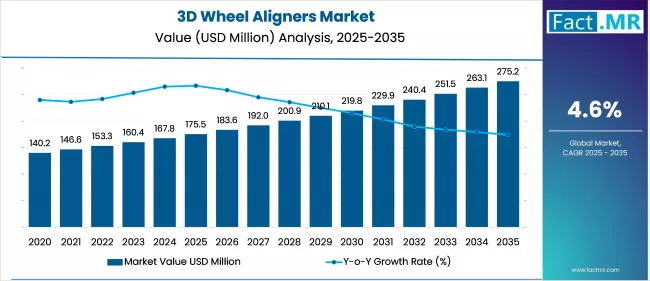
The 3D wheel aligners market is gaining significant traction as automotive service providers increasingly adopt advanced diagnostic technologies to improve vehicle performance and safety. Proper wheel alignment plays a crucial role in ensuring optimal handling, reduced tire wear, and enhanced driving comfort. With growing vehicle complexity and rising customer expectations for precision services, 3D wheel alignment systems are becoming an essential component of modern automotive workshops and service centers.
Market Overview
3D wheel aligners are advanced alignment systems that use high-resolution cameras and imaging technology to measure wheel angles in real time. Unlike conventional alignment methods, 3D systems capture detailed spatial data, allowing technicians to perform faster and more accurate adjustments. These systems are widely used across passenger cars, light commercial vehicles, and heavy-duty vehicles.
Insights from Fact.MR indicate that the market is driven by the expanding automotive aftermarket, increasing awareness of preventive maintenance, and the growing adoption of digital diagnostic tools. As vehicles integrate advanced suspension systems and electronic steering components, the need for precise alignment solutions continues to rise.
Technology and Product Insights
3D wheel aligners rely on camera-based sensors mounted on alignment racks to create a three-dimensional model of the vehicle’s wheel geometry. This technology enables high-accuracy measurements with minimal setup time. Many modern systems feature touch-screen interfaces, automated calibration, and cloud-based software updates.
Manufacturers are continuously enhancing system capabilities by improving camera resolution, expanding vehicle specification databases, and integrating alignment software with workshop management platforms. These advancements help reduce technician dependency, minimize errors, and increase service throughput.
The adaptability of 3D wheel aligners to different vehicle types and workshop environments makes them a preferred choice for service providers seeking long-term efficiency and scalability.
Applications & End-Use Outlook
Automotive service centers represent the primary end-use segment for 3D wheel aligners. Independent garages and multi-brand workshops increasingly invest in these systems to deliver high-quality alignment services and remain competitive in the aftermarket.
Authorized dealerships also play a key role in market adoption. OEM service guidelines often require precise alignment tools to support warranty and scheduled maintenance services. 3D wheel aligners help dealerships maintain consistency and accuracy across a wide range of vehicle models.
Fleet operators and commercial vehicle service facilities are adopting 3D alignment systems to improve vehicle stability, reduce tire replacement frequency, and optimize operational efficiency. Accurate wheel alignment contributes to improved fuel efficiency and reduced maintenance costs, making it a valuable investment for fleet management.
Regional Insights
North America remains a leading market for 3D wheel aligners due to its well-established automotive service industry and early adoption of advanced workshop technologies. The region’s strong focus on vehicle safety and performance supports continued demand for high-precision alignment systems.
Europe follows closely, driven by strict vehicle inspection regulations and the presence of premium automotive brands. Advanced service standards and skilled technicians further encourage the adoption of 3D alignment technologies.
Asia-Pacific is emerging as a high-growth region, supported by increasing vehicle ownership, rapid urbanization, and expanding organized service networks. Investments in modern workshop infrastructure and technician training are accelerating the uptake of 3D wheel aligners across developing economies.
Other regions, including Latin America and the Middle East & Africa, are gradually adopting 3D alignment systems as automotive service quality standards improve and awareness of preventive maintenance grows.
Key Trends & Market Outlook
Several trends are shaping the evolution of the 3D wheel aligners market:
- Rising demand for fast and accurate wheel alignment services
- Integration of digital imaging and real-time diagnostics
- Growing adoption of automated and user-friendly systems
- Expansion of organized automotive service chains
- Alignment solutions tailored for electric and hybrid vehicles
Manufacturers are also focusing on developing compact, portable systems to cater to workshops with limited space, further broadening market accessibility.
Competitive Landscape
The 3D wheel aligners market is moderately competitive, with global equipment manufacturers and regional players offering a range of solutions. Competition is based on factors such as measurement accuracy, software reliability, ease of operation, and aftersales support.
According to Fact.MR insights, companies are increasingly emphasizing innovation, product customization, and strategic partnerships to strengthen their market presence. Training programs and technical support services are also becoming key differentiators among suppliers.
Conclusion
The 3D wheel aligners market is playing a pivotal role in transforming automotive wheel alignment services by delivering higher accuracy, efficiency, and consistency. As vehicles continue to evolve and service standards rise, the demand for advanced alignment technologies is expected to grow steadily.
For automotive service providers, equipment manufacturers, and fleet operators, understanding technological trends and market dynamics is essential for staying competitive. In-depth industry insights from platforms such as Fact.MR can help stakeholders make informed decisions and capitalize on emerging opportunities in the evolving automotive diagnostics landscape.
Browse Full Report – https://www.factmr.com/report/529/3d-wheel-aligners-market