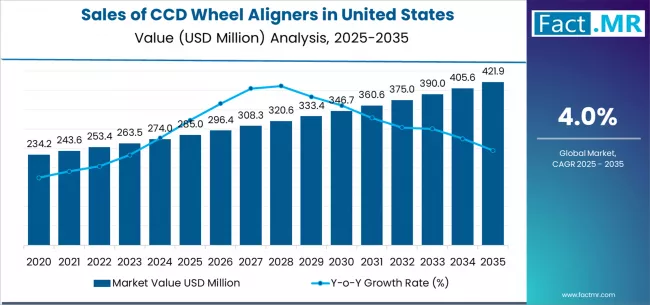
The United States CCD wheel aligner market is set for steady growth over the coming decade, fueled by the rapid expansion of automotive repair infrastructure, rising vehicle ownership, and increasing integration of digital diagnostic technologies in modern workshops. According to a new analysis by Fact.MR, the market is projected to rise from USD 285.0 million in 2025 to USD 421.9 million by 2035, reflecting a 49.1% growth rate and an absolute increase of USD 140.0 million. This momentum corresponds to a CAGR of 4.0% between 2025 and 2035.
Growing emphasis on precision diagnostics, expansion of EV service capabilities, and the rise of ADAS-enabled vehicles are significantly accelerating demand for CCD (Charge-Coupled Device) wheel aligner systems across the country.
Strategic Market Drivers
- Rising Need for Precision Automotive Diagnostics
The U.S. automotive service landscape is undergoing digital transformation. Modern vehicles—equipped with advanced suspension systems and electronic controls—require highly accurate alignment tools.
CCD wheel aligners deliver:
- Superior measurement accuracy
- Faster diagnostic cycles
- Enhanced repeatability
- Compatibility with complex modern vehicle architectures
These advantages are driving widespread adoption among dealerships, independent garages, and tire service centers.
Browse Full Report: https://www.factmr.com/report/sales-of-ccd-wheel-aligners-in-united-states
- Expansion of ADAS Calibration Requirements
With over half of new U.S. vehicles equipped with ADAS features (lane-keeping assist, autonomous braking, and self-parking), precision wheel alignment is becoming essential for proper system calibration.
CCD alignment systems support:
- Camera-based calibration
- Radar alignment compatibility
- Higher accuracy thresholds
This trend is rapidly expanding the need for advanced CCD aligner technology across the service ecosystem.
- Growth in EV and Hybrid Vehicle Maintenance
Electric vehicle (EV) sales continue to rise across the U.S., necessitating upgraded repair capabilities.
EVs require:
- More frequent alignment checks due to higher torque output
- Specialized diagnostic systems
- Zero-emission compliant workshop equipment
CCD wheel aligners are increasingly being deployed in EV-certified service centers nationwide.
- Modernization of Automotive Repair Facilities
Investments in smart workshops, digital diagnostics, and automated service bays are accelerating adoption.
Key contributing factors:
- Replacement of outdated optical aligners
- Integration with workshop management software
- Automation-driven efficiency improvements
This modernization wave is boosting CCD aligner sales significantly.
Regional Growth Highlights
West & Southwest: High Vehicle Use and Strong Aftermarket Ecosystem
States such as California, Texas, Arizona, and Nevada show heavy demand driven by:
- Large vehicle populations
- Higher tire wear due to climate and driving conditions
- Dense networks of tire and repair shops
Midwest: Manufacturing and Fleet Maintenance Hub
With major automotive manufacturing and logistics activity, the Midwest is witnessing strong adoption in:
- Commercial fleets
- Dealership service centers
- Heavy vehicle maintenance facilities
Northeast: Urbanization and Advanced Repair Infrastructure
High vehicle congestion and stricter safety regulations in the Northeast are driving increased installation of CCD alignment systems.
Southeast: Rapid Automotive Service Expansion
The region is seeing accelerated growth owing to:
- Rising new vehicle sales
- Expanded dealership networks
- Increasing adoption among independent garages
Market Segmentation Insights
By Product Type
- 3D/CCD Hybrid Wheel Aligners – Gaining traction for improved accuracy
- CCD Multi-Sensor Aligners – Largest share due to reliability and flexibility
By Vehicle Type
- Passenger Cars – Leading segment
- Light Commercial Vehicles (LCVs) – Increasing adoption in fleet maintenance
- Heavy Commercial Vehicles (HCVs) – Growth driven by logistics and freight expansion
By End User
- Automotive Repair Workshops – Largest buyer category
- Dealerships & OEM Service Centers – High adoption due to ADAS
- Tire & Wheel Service Centers – Growing due to rapid tire replacement demand
Challenges Impacting Market Growth
High Initial Installation Costs
CCD wheel aligners are more expensive than conventional systems, limiting adoption among smaller garages.
Requirement for Skilled Technicians
Advanced calibration and operation require well-trained personnel.
Space Requirements and Integration Needs
Some workshops require facility upgrades before installing CCD systems.
Competitive Landscape
The U.S. market is moderately fragmented, with strong competition among global and domestic manufacturers focusing on enhanced accuracy, automation, and software integration.
Key Companies Profiled
- Hunter Engineering
- Snap-on Incorporated
- Hofmann (Nexion Group)
- John Bean
- Ravaglioli
- CEMB
- Manatec Electronics
-TECH Tire Equipment - Beissbarth GmbH
Companies are investing in:
- AI-driven alignment diagnostics
- Faster calibration workflows
- Cloud-connected service data platforms
- Compact and mobile CCD aligner solutions
Recent Developments
- 2024: Introduction of AI-assisted alignment software to reduce technician error.
- 2023: Growing adoption of CCD systems integrated with ADAS calibration tools.
- 2022: Dealerships across the U.S. accelerate upgrades from optical to CCD aligners.
Future Outlook: A Decade of Smart Workshop Transformation
The coming decade promises major technological advancements, fueled by:
- Broad penetration of ADAS-enabled vehicles
- Rapid expansion of EV service needs
- Digitization and automation of workshop operations
- Integration of IoT and cloud diagnostics
- Growing preference for contactless and rapid alignment services
With U.S. automotive repair infrastructure modernizing at scale, CCD wheel aligners are positioned for strong, sustained demand through 2035.