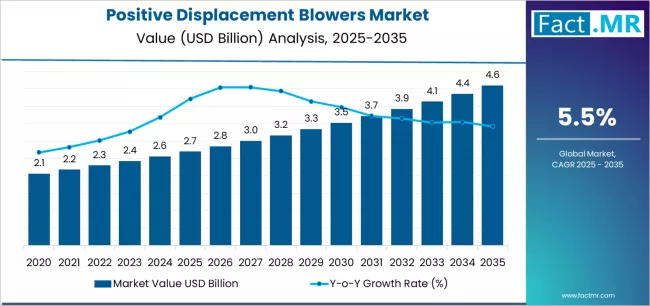
The global positive displacement blowers market is entering a phase of accelerated expansion, projected to grow from USD 2.7 billion in 2025 to USD 4.6 billion by 2035, marking an impressive 70.6% increase over the forecast period. The industry is expected to maintain a steady 5.5% CAGR as demand intensifies across municipal infrastructure, industrial processing, and environmental applications.
Strong Market Drivers Fueling Growth
Several powerful market forces are reshaping global demand for positive displacement blowers. Industrialization continues to surge across emerging economies, while urban centers worldwide are rapidly expanding wastewater treatment facilities. Increasingly strict environmental regulations are compelling municipalities and manufacturing facilities to modernize air-handling systems with energy-efficient blower technologies.
At the same time, technological innovation is accelerating. The adoption of advanced rotor geometries, variable frequency drives (VFDs), and IoT-enabled performance monitoring is boosting efficiency, improving reliability, and lowering lifetime operating costs. These advancements are elevating positive displacement blowers from standard equipment to critical infrastructure assets across a widening range of industries.
Market Segments: Who Leads and Why
Twin-Lobe Blowers Dominate with a 35% Share
Among blower categories, twin-lobe blowers are set to hold 35.0% of the market in 2025, making them the largest segment by type. Their durability, simplicity, and dependable volumetric performance make them indispensable for pneumatic conveying, aeration, and industrial air-handling.
Other product categories contributing to market growth include:
-
Tri-lobe blowers – 22.0% share
-
Screw blowers – 18.5% share
-
Vane blowers – 15.0% share
-
Hybrid & emerging designs – 9.5% share
Low-Pressure Blowers Hold 44.9% of the Market
Positive displacement blowers categorized by pressure capability show a consistent trend toward low-pressure applications. In 2025, the up to 500 mBar segment is expected to account for 44.9% of global demand, primarily driven by aeration systems, industrial ventilation, and pneumatic conveying.
Medium-pressure systems (501–1500 mBar) are projected to make up approximately 32% of the market, while high-pressure units (>1500 mBar), essential for specialized processing, are projected to account for 23.1%.
Wastewater Treatment Remains the Largest End-Use Industry
The water and wastewater treatment sector continues to be the backbone of blower demand—projected to hold 32.7% of the global market in 2025. Unprecedented investment in wastewater modernization, coupled with growing population density, is driving significant equipment upgrades and new installations worldwide.
Other key end-use industries include:
-
Chemical & petrochemical – 18.8%
-
Food & beverage – 13.2%
-
Pharmaceutical – 10.5%
-
Power generation – 9.0%
-
Mining – 7.3%
-
Cement & construction – 5.3%
-
Other specialized uses – 3.2% (such as aquaculture aeration and biogas compression)
Geographic Outlook: Asia-Pacific Leads Global Momentum
The Asia-Pacific region represents the strongest force shaping the future of the positive displacement blowers industry. Infrastructure development, industrial expansion, and environmental investment are driving major growth across developing economies. India stands out with an expected 6.4% CAGR through 2035, outpacing global averages.
Other notable regional growth projections include:
-
China – 6.2% CAGR
-
United States – 5.6% CAGR
-
Germany – 5.3% CAGR
-
Brazil – 4.9% CAGR
-
Middle East & Africa – 4.2–4.6% CAGR
This geographic distribution reflects strong industrial modernization in emerging markets and steady technological upgrades in advanced economies.
Key Opportunity Hotspots
The next decade presents substantial growth opportunities within the industry. Major areas poised for investment include:
1. Technology Upgrades & Smart Blower Systems
Energy-efficient blowers with VFD integration, pressure-optimized control algorithms, and IoT-based diagnostics are expected to unlock between USD 0.4–0.8 billion in new value over the forecast period.
2. Sustainable and Eco-Efficient Solutions
Municipalities and industrial facilities worldwide are accelerating adoption of systems that reduce energy consumption and meet environmental compliance goals. This shift could generate USD 0.3–0.6 billion in additional market opportunities.
3. Expansion into Emerging Industries
Blowers designed for aquaculture, biogas processing, and specialized industrial operations could contribute an incremental USD 0.2–0.4 billion in future demand.
4. Asia-Pacific Infrastructure Boom
With rapid urbanization and industrial expansion underway across India, China, and Southeast Asia, the region is well-positioned to contribute USD 0.7–1.3 billion in new market opportunities.
Strategic Implications for Industry Stakeholders
For Manufacturers
The growth outlook highlights the need to expand production capabilities, especially for twin-lobe and screw blower product lines. Companies that prioritize R&D in energy efficiency, digital connectivity, and longer service life will be best positioned to compete in the next decade.
For Municipal & Industrial Operators
Upgrading to advanced blower technologies offers significant operational benefits—lower energy consumption, reduced maintenance, extended equipment life, and improved emissions control. As aeration remains one of the most energy-intensive processes in wastewater treatment, efficiency gains translate into substantial cost savings.
For Investors & Policymakers
Rising demand for wastewater treatment infrastructure, sustainable operations, and industrial modernization makes the blower market an attractive segment for capital investment. Expansion in emerging economies further amplifies this opportunity.
For Environmental & Sustainability Initiatives
Energy-optimized blower systems help reduce carbon footprints across industrial facilities, contribute to cleaner water processing, and support global emissions reduction objectives.
Browse Full Report : https://www.factmr.com/report/positive-displacement-blowers-market
Conclusion
The positive displacement blowers market is set for robust and sustained expansion—from USD 2.7 billion in 2025 to a projected USD 4.6 billion by 2035. The combination of rising industrial activity, advancing technology, tightening regulations, and global sustainability priorities positions the industry at the forefront of critical infrastructure evolution.
With both mature and emerging markets fueling growth, the coming decade offers a unique window of opportunity for manufacturers, investors, and operators seeking to capitalize on a fast-expanding industrial segment.