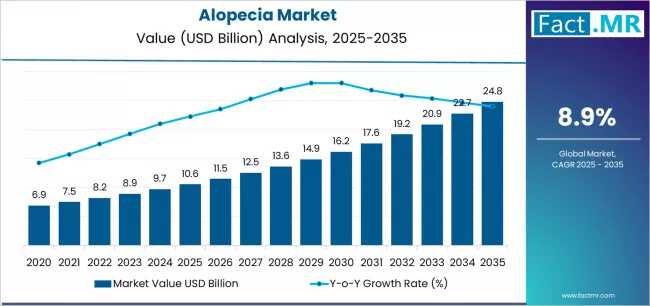
A new industry forecast reveals that the global alopecia market is on track to more than double over the next decade, growing from USD 10.57 billion in 2025 to approximately USD 24.75–24.80 billion by 2035. The projected 8.9% CAGR underscores the rising medical, social, and psychological importance of treating hair-loss disorders worldwide.
Growing consumer awareness, improved access to dermatology services, the introduction of advanced therapies, and increased incidence of autoimmune and stress-related hair loss are collectively reshaping market momentum across developed and emerging regions.
Market Segmentation Highlights
Alopecia Areata Leads Global Disease-Type Share
In 2025, Alopecia Areata accounts for approximately 34.6% of total market share, making it the most prominent disease segment due to increasing autoimmune-linked hair loss cases and heightened clinical research activity.
Androgenetic Alopecia, commonly known as pattern hair loss, also retains substantial share and continues to drive long-term treatment demand among men and women across all age groups.
Additional market segments — including alopecia totalis, alopecia universalis, cicatricial alopecia, and traction alopecia — contribute meaningfully as awareness and diagnosis improve.
Pharmaceutical Therapies Dominate Market Revenue
The alopecia market is heavily driven by pharmaceutical treatments, representing approximately 98.8% of the overall market in 2025. This includes prescription medications, topical formulations, oral therapies, and emerging immune-modulating drugs.
Device-based therapies — such as low-level laser caps, combs, and helmets — capture around 1.2% share but are expanding steadily as non-invasive, home-based solutions increasingly attract consumer interest.
Gender Dynamics Reflect Broad Treatment Adoption
Men account for roughly 53.8% of global treatment demand in 2025, reflecting higher prevalence of androgenetic alopecia and expanding adoption of both prescription and OTC therapies.
Women represent 46.2% of market share, a figure that has steadily risen as dermatology awareness increases and stigma around female hair loss continues to diminish.
Distribution Channel Insights
Prescription Channels Lead with 67.6% Share
Dermatologist-supervised treatments remain essential for moderate to severe alopecia, giving prescription channels about 67.6% of the market.
OTC products — covering topical solutions, growth serums, and at-home care — account for the remaining 32.4%, driven by consumer preference for accessible, early-intervention options.
End-Use Segmentation
Dermatology clinics remain the leading end-use segment with 56.5% of the market in 2025, due to demand for expert diagnosis, clinical evaluation, and prescription-based therapies.
Homecare treatments, which command the remaining share, continue to grow as online sales accelerate and device-based solutions gain traction.
Regional Outlook & Growth Hotspots
While North America and Europe maintain strong market contributions, Asia Pacific is emerging as the fastest-growing region, supported by rising awareness of hair-loss conditions, rapid urbanization, and higher adoption of dermatology care.
India — Fastest-Growing National Market
India is projected to expand at a 9.8% CAGR through 2035, fueled by:
-
Increasing incidence of stress-related hair fall
-
Strong adoption of OTC minoxidil and prescription treatments
-
Expansion of dermatology clinics in Tier 1 and Tier 2 cities
-
Rising disposable income and aesthetic awareness
Other growth-driving markets include China, South Korea, Japan, and Brazil — each experiencing heightened demand for self-care, hair restoration, and medical dermatology services.
Key Drivers Stimulating Market Expansion
1. Rising Incidence of Alopecia Worldwide
Stress, autoimmune disorders, hormonal imbalances, and nutritional deficiencies are elevating global hair-loss rates, significantly increasing the patient population seeking treatment.
2. Advances in Therapeutic Innovation
Next-generation treatments — including immune-modulating therapies, JAK inhibitors, and novel topical/oral drug formulations — are demonstrating improved efficacy and creating wider adoption across patient groups.
3. Expanding Access to Dermatology & Telemedicine
Tele-dermatology consultations, online pharmacies, and digital diagnosis tools are enabling easier access to alopecia care, especially in rural and underserved regions.
4. Growing Consumer Awareness & Reduced Stigma
Global awareness campaigns, social media influence, and improved public education are encouraging individuals to seek treatment earlier and more consistently.
5. Psychological & Emotional Impact of Hair Loss
Hair loss is increasingly recognized as a mental-health and self-esteem concern. Effective therapies offer patients both cosmetic and emotional benefits, further driving market demand.
Competitive Landscape
The alopecia market is moderately consolidated, with leading pharmaceutical companies driving innovation and therapy development. Major global players include:
-
Sun Pharmaceutical Industries Ltd.
-
Pfizer Inc.
-
Concert Pharmaceuticals (a Sun Pharma company)
-
Q32 Bio Inc.
-
Additional emerging biotech and dermatology-focused firms
Sun Pharmaceutical Industries holds an estimated 10.2% global market share in 2025, supported by a broad dermatology portfolio and expansive distribution network.
Biotech innovators focusing on alopecia are advancing pipeline therapies — particularly immune-targeting drugs, biologics, and personalized treatment approaches — which are expected to reshape competitiveness over the forecast period.
Emerging Opportunities
Growth in Emerging Markets
Developing regions present large untapped patient populations and rising aesthetic awareness, offering significant opportunities for pharmaceutical companies and dermatology service providers.
Device-Based & Combination Therapies
Although still a smaller segment, device-based therapies paired with pharmaceuticals create strong future potential for integrated and personalized treatment regimens.
Digital Health Expansion
Telemedicine platforms, online diagnosis tools, and e-pharmacy growth are opening new channels for treatment accessibility and patient retention.
Browse Full Report : https://www.factmr.com/report/alopecia-market
Conclusion
Driven by rising global incidence of hair-loss disorders, expanding dermatology care, heightened consumer awareness, and major therapeutic advancements, the global alopecia market is poised for strong and sustained growth through 2035. With its value expected to more than double over the next decade, the sector presents significant opportunities for pharmaceutical companies, investors, healthcare providers, and technology innovators.