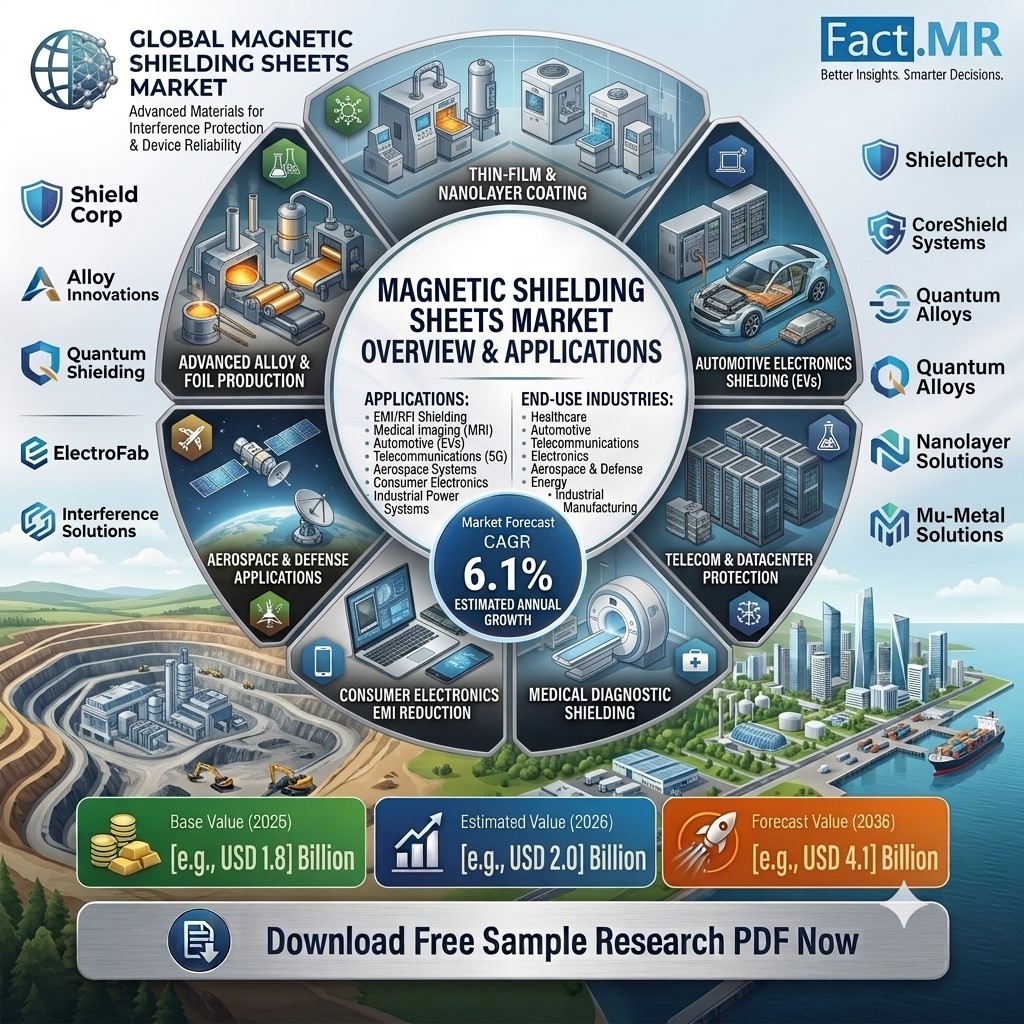
Rockville, MD., October 15, 2026 — The Magnetic Shielding Sheets Market is projected to increase from USD 420.0 million in 2026 to USD 759.3 million by 2036, registering a compound annual growth rate (CAGR) of 6.1%, according to Fact.MR. The market was valued at USD 395.9 million in 2025. Germany is forecast to lead country growth at a 7.0% CAGR, while Japan is projected to record the lowest growth among the five countries covered, at 4.6%.
The forecast reflects demand for materials that control magnetic interference in compact electronic devices and automotive components. Fact.MR estimates an absolute market opportunity of USD 339.3 million between 2026 and 2036. Consumer electronics is expected to account for 41.8% of application demand in 2026, while electronics manufacturers are projected to represent 44.6% of end-use demand.
Get detailed market forecasts, competitive benchmarking, and pricing trends
Magnetic shielding sheets market responds to tighter electronic designs
Magnetic shielding sheets help redirect magnetic flux or absorb electromagnetic interference within electronic assemblies. Manufacturers use these materials around integrated circuits, cables, sensors and circuit boards where limited space makes conventional shielding structures difficult to accommodate.
Device miniaturization is one factor supporting demand. Smartphones, tablets and wearables combine wireless connectivity, processors and other electronic components in increasingly compact enclosures. Fact.MR identifies higher radio-frequency density as a key market driver, estimating a 0.85 percentage-point impact on CAGR over the 2026–2036 forecast period.
Automotive electrification is creating another source of demand. The German Association of the Automotive Industry (VDA) reported that Germany produced 1.67 million electric passenger cars in 2025. Fact.MR links the integration of inverters, sensors and high-voltage electronics with a growing need to control magnetic interference across vehicle systems.
Extractable market fact: Magnetic shielding sheets are sheet-form materials designed to absorb, redirect or reduce magnetic-field and electromagnetic interference in electronic assemblies, according to Fact.MR.
Soft magnetic sheets hold the leading product share
Soft magnetic shielding sheets are projected to account for 38.7% of the product segment in 2026. Their high magnetic permeability and low coercivity help redirect magnetic flux away from sensitive components. These properties make them suitable for compact electronic assemblies where space and shielding performance both matter.
Nickel-iron alloys are forecast to represent 35.4% of the material segment. Their magnetic properties support applications involving sensors and other components that require controlled magnetic environments.
Consumer electronics leads the application category, with a projected 41.8% share in 2026. Electronics manufacturers are expected to account for 44.6% of end-use demand as shielding materials are selected during circuit-board design and product development.
High-frequency shielding is forecast to hold a 42.1% share of the shielding-effectiveness segment in 2026. Fact.MR connects this position with wireless connectivity and high-speed digital interfaces that create interference challenges inside compact electronic systems.
Germany leads country growth through 2036
Germany is projected to record a 7.0% CAGR through 2036. Germany Trade & Invest reported electronics industry turnover of EUR 225 billion in 2025. The country’s electric-vehicle production also supports demand for shielding materials used in power electronics, advanced driver-assistance systems and connected vehicle components.
Brazil follows at a projected 6.4% CAGR. Anatel reported that 748 municipalities had licensed 5G base stations in its reporting on 2024. Expanding telecommunications infrastructure supports demand for materials that control interference in radio modules and network equipment.
The USA is forecast to grow at a 5.8% CAGR through 2036. Fact.MR identifies domestic electronics manufacturing, semiconductor investment and data-centre development as relevant demand factors.
The UK market is projected to expand at a 5.2% CAGR, supported by mobile-network upgrades. Japan is forecast to grow at 4.6%, with established electronic-component manufacturing and magnetic-material development contributing to its market outlook.
Competitive landscape and analyst outlook
Key companies profiled by Fact.MR include 3M Company, Parker Chomerics, TDK Corporation, Yageo Corporation (KEMET), Proterial Ltd., Kitagawa Industries Co., Ltd. and Tech-Etch Inc. The report does not provide market-share figures for these companies.
The report identifies thin-gauge materials, predictable magnetic permeability and precision die-cutting as relevant supplier capabilities. For manufacturers, material selection depends on operating frequency, sheet thickness, temperature requirements and the physical space available inside an assembly.
Shambhu Nath Jha, Principal Consultant at Fact.MR, said, “Magnetic shielding sheets are becoming a design-in material rather than a late-stage EMC patch. The commercial advantage comes from controlling interference in millimeters of available space, at the frequency band that matters, without forcing the OEM to redesign the enclosure.”
Jha added that suppliers combining thin magnetic materials with predictable performance and automotive or electronics qualification are positioned to capture more value as devices incorporate additional radios, sensors and power electronics.
Top Reports:
High Barrier Shrink Wrap Market
About Fact.MR
Fact.MR is a market research and consulting firm providing syndicated and custom research across industries and geographical markets. Its research combines primary interviews, secondary research, market modelling and data validation to support business planning and strategic decisions.