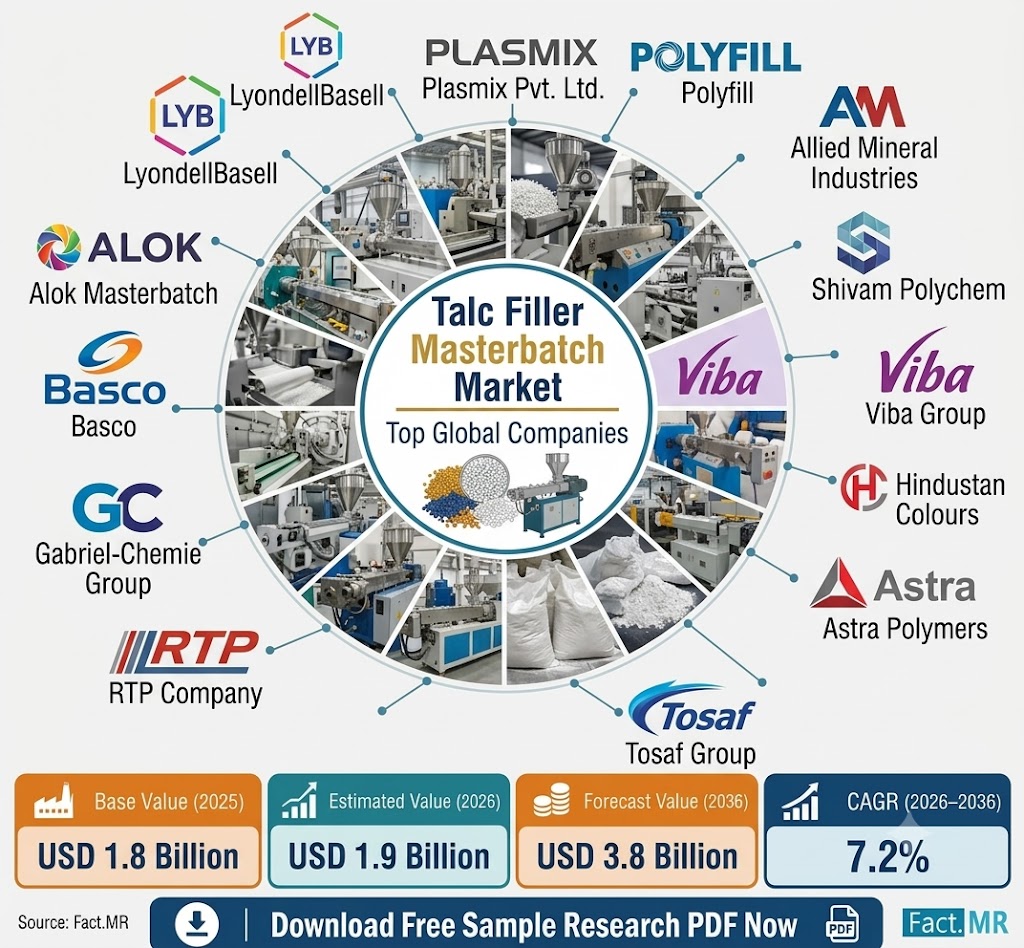
The global talc filler masterbatch market is projected to reach USD 3.8 billion by 2036, increasing from USD 1.8 billion in 2025 to USD 1.9 billion in 2026, according to Fact.MR. The market is forecast to expand at a compound annual growth rate (CAGR) of 7.2% between 2026 and 2036, creating an incremental opportunity of USD 1.9 billion. Demand is supported by automotive component manufacturing, lightweighting initiatives, increasing use of mineral-reinforced polypropylene, and the need for consistent filler dispersion in high-volume polymer processing.
Get detailed market forecasts, competitive benchmarking, and pricing trends:
Market Size and Growth Forecasts
- 2025 Market Value: USD 1.8 billion
- 2026 Estimated Market Size: USD 1.9 billion
- 2036 Projected Market Value: USD 3.8 billion
- Forecast CAGR: 7.2% from 2026 to 2036
- Absolute Growth Opportunity: USD 1.9 billion
The market covers concentrated talc-filled polymer masterbatch sold to compounders and converters for incorporation into thermoplastic products. Its scope includes polypropylene, polyethylene, engineering-plastic and specialty carrier systems across automotive, packaging, consumer goods and construction applications.
Key Market Segments
Polypropylene and Automotive Applications Lead Demand
- Polypropylene (PP) Talc Filler Masterbatch: Expected to account for 39.6% of product demand in 2026. PP offers a practical balance of stiffness, dimensional stability, processability and manufacturing cost for molded components.
- Automotive Components: Projected to represent 76.8% of application demand in 2026, supported by the use of talc-filled polypropylene in interior trim, exterior components and selected underhood parts.
- Automotive Industry: Expected to account for 58.4% of end-use demand in 2026 as original equipment manufacturers (OEMs) and Tier suppliers maintain qualified material specifications across vehicle programs.
- Twin-Screw Extrusion Technology: Forecast to capture 34.6% of the technology segment in 2026, reflecting its role in distributive and dispersive mixing during masterbatch production.
- High-Talc-Loading Formulations: Expected to represent 69.1% of formulations in 2026, allowing processors to achieve target mineral concentrations with smaller masterbatch additions.
- Direct Sales Channel: Projected to account for 52.8% of distribution in 2026, supported by industrial contracts, technical collaboration and application-specific specifications.
Country-Level Growth Outlook
Fact.MR forecasts varied growth rates across the five profiled country markets between 2026 and 2036:
- Germany: 7.2% CAGR, supported by automotive manufacturing and demand for qualified polymer components.
- Italy: 6.8% CAGR, reflecting its automotive component supplier base and established talc production.
- United States: 6.5% CAGR, supported by established plastics processing and continued interest in vehicle lightweighting.
- France: 5.8% CAGR, driven by its automotive component manufacturing ecosystem.
- Spain: 5.1% CAGR, supported by vehicle assembly and export-oriented manufacturing.
Major Market Trends and Growth Drivers
Automotive Lightweighting and Material Substitution: Vehicle manufacturers continue to evaluate polymer systems that balance component stiffness, weight and production economics. The U.S. Department of Energy notes that a 10% reduction in vehicle weight can improve fuel economy by approximately 6% to 8%. Talc-filled polypropylene offers processors one option for tuning mechanical properties in suitable molded components.
Demand for Consistent Dispersion: Masterbatch quality depends on uniform mineral distribution, controlled pellet properties and reliable feeding. Research published in Polymers in 2019 examined how co-rotating twin-screw extrusion conditions influence the properties of talc-filled polypropylene. These processing considerations increase the importance of formulation control and repeatable manufacturing performance.
High-Loading Formulations and Material Efficiency: Concentrated talc masterbatch enables converters to adjust filler content while limiting additional carrier-polymer dilution. Suppliers that maintain dispersion quality at higher mineral loadings can support applications with demanding performance and processing requirements.
Safety and Supply-Chain Considerations: Talc handling, mineral-quality variation and agglomeration at high loading remain important constraints. European supply chains must also monitor applicable chemical classification and workplace exposure-control requirements. Alternative mineral fillers, including mica, kaolin and wollastonite, create additional competitive pressure.
Competitive Landscape
Competition centers on carrier-polymer compatibility, talc-loading capability, dispersion control, pellet consistency and technical support. Automotive and industrial customers often require application trials, documented specifications and qualification processes before approving a formulation for sustained production.
Key companies profiled include:
LyondellBasell, Plasmix Pvt. Ltd., Polyfill, Allied Mineral Industries, Shivam Polychem, Alok Masterbatch, Basco, Viba Group, Hindustan Colours, Gabriel-Chemie Group, RTP Company, Tosaf Group and Astra Polymers.
LyondellBasell’s Hostacom 1103 2003 technical data sheet describes a 20% talc-filled polypropylene homopolymer for injection-molded automotive and underhood applications. This illustrates the commercial importance of combining mineral loading with defined stiffness, thermal performance and processing characteristics.
Regional manufacturers and specialist masterbatch producers can compete through customized formulations, local service and flexible supply arrangements. Larger polymer groups can draw on carrier-resin expertise and compound development capabilities. Across both models, consistent product quality and reliable technical support remain central to customer retention.
Strategic Implications for Industry Participants
Masterbatch suppliers can strengthen their position by developing formulation portfolios around end-use performance and carrier compatibility rather than mineral concentration alone. Automotive processors should evaluate stiffness, warpage, surface appearance, dispersion and cycle consistency when qualifying products.
Technical collaboration is also becoming more important as converters adjust resin grades, recycled-polymer content and component designs. Suppliers that document batch consistency and support production trials can help reduce qualification friction and processing variability.
Analyst Perspective
“Talc filler masterbatch demand is shaped by how consistently processors can translate mineral loading into part stiffness, dimensional control and throughput. Automotive programs reward formulations that disperse evenly in polypropylene and remain stable across large production runs, while recycled-polymer and material-efficiency goals raise the importance of application-specific compounding. Suppliers that combine high-loading capability with repeatable pellet quality and technical support are better positioned for long qualification cycles.”
— Shambhu Nath Jha, Principal Consultant, Fact.MR
Top Trending Reports:
About Fact.MR
Fact.MR is a market research and consulting firm providing industry analysis, market sizing, competitive intelligence and demand forecasts to support business and investment decisions. Its research covers industrial, automotive, chemicals, materials, consumer and technology markets, helping organizations assess market opportunities, emerging trends and competitive developments.