The global cartoning equipment market is projected to grow from USD 2.90 billion in 2026 to USD 5.00 billion by 2036, expanding at a compound annual growth rate (CAGR) of 5.7%, according to Fact.MR. The market was valued at approximately USD 2.74 billion in 2025. Growth will be supported by investments in automatic packaging lines, rising requirements for flexible carton formats, and upgrades to secondary packaging operations across food and pharmaceutical manufacturing facilities.
Manufacturers are increasingly evaluating cartoning equipment based on product-feeding accuracy, changeover time, carton-size flexibility, inspection capabilities, and service support. These factors influence production continuity and determine how effectively new machines integrate with existing packaging lines.
Get detailed market forecasts, competitive benchmarking, and pricing trends:
Market Size and Growth Forecasts
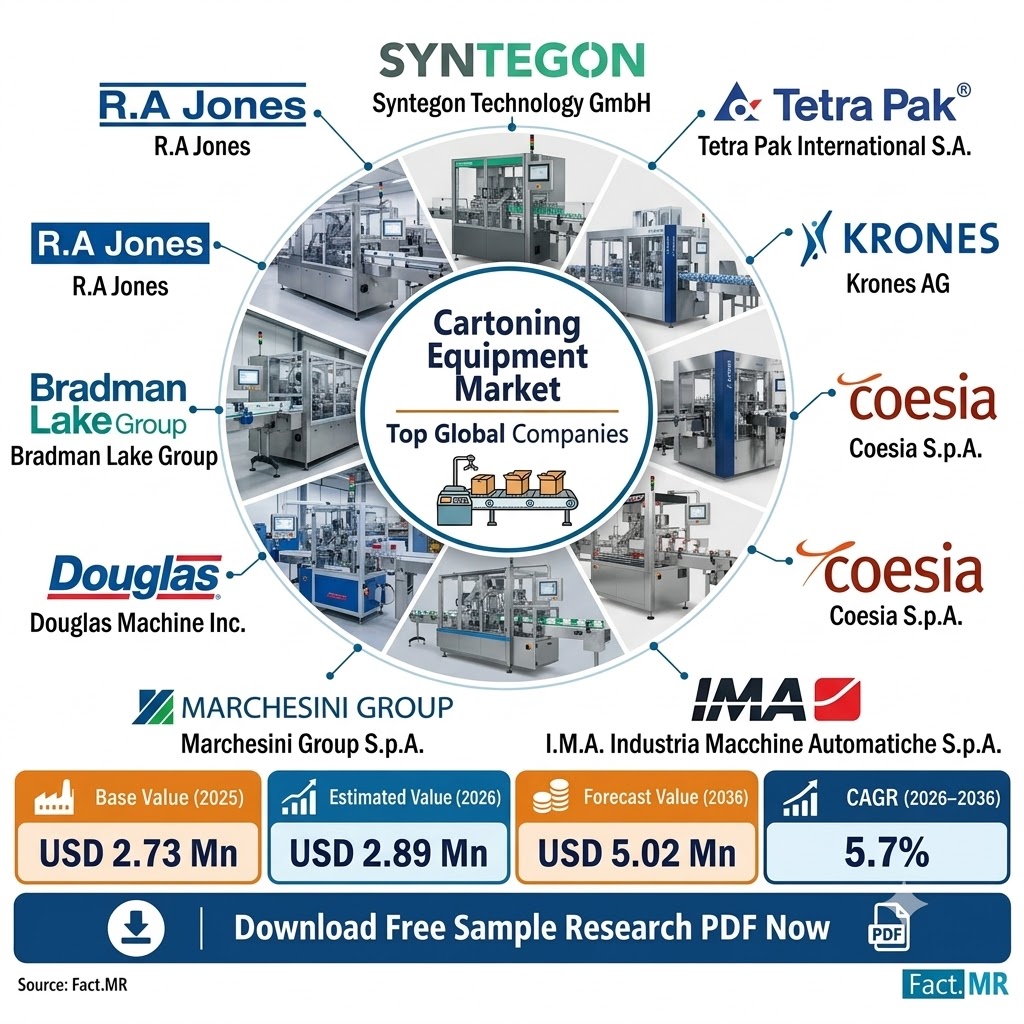
- 2025 Market Value: USD 2.74 billion
- 2026 Estimated Market Size: USD 2.90 billion
- 2036 Projected Market Value: USD 5.00 billion
- Forecast CAGR (2026–2036): 5.7%
- Absolute Market Opportunity: Approximately USD 2.10 billion between 2026 and 2036
The forecast reflects demand for equipment that forms folding cartons, loads products, and closes packages during secondary packaging operations. Food and beverage producers represent an established customer base, while pharmaceutical manufacturers require reliable carton coding, leaflet insertion, and inspection functions.
Key Market Segments
By Product Type
- Horizontal Cartoning Machines: Account for 42.7% of the market in 2026. These machines support side-loading operations and established high-volume production layouts.
- Vertical Cartoning Machines: Serve applications where products are loaded from the top, depending on product configuration and packaging requirements.
- Top-load and End-load Cartoning Machines: Address different product-loading and carton-handling needs across manufacturing facilities.
By Application
- Food and Beverage: Represents 38.2% of the market in 2026, supported by routine secondary packaging of retail-ready products.
- Pharmaceuticals: Demand is influenced by requirements for accurate printed information, dependable leaflet insertion, and packaging inspection.
- Personal Care and Household Products: Manufacturers require carton-handling flexibility, product protection, and consistent pack presentation.
By Automation Level and End User
- Automatic Cartoning Machines: Capture 62.3% of the market in 2026 as manufacturers seek to integrate carton forming, loading, and closing functions.
- Food and Beverage Industry: Represents 37.6% of end-user demand in 2026, supported by packaging line upgrades and recurring equipment requirements.
- Semi-automatic and Manual Equipment: Continue to serve shorter production runs, lower-volume operations, and applications requiring operator involvement.
Country-Level Growth Outlook Through 2036
Fact.MR projects different growth rates across the five profiled national markets, reflecting variations in manufacturing investment, packaging automation, and equipment replacement requirements.
- Germany: Expected to grow at a CAGR of 7.0%, supported by food and pharmaceutical manufacturing requirements and investment in machinery integration.
- United Kingdom: Forecast to expand at 6.5% CAGR as food processors seek equipment that accommodates changing retail carton sizes and diverse packaging lines.
- Japan: Projected to record 5.3% CAGR, with compact factory layouts, precision handling, and workforce efficiency influencing purchasing decisions.
- United States: Expected to grow at 4.6% CAGR as manufacturers evaluate equipment renewal, packaging inspection, and integration with existing production lines.
- Brazil: Forecast to expand at 4.0% CAGR, with food-processing capacity, gradual automation, financing considerations, and local service availability shaping investment decisions.
Major Market Trends and Growth Drivers
Automatic Line Integration
Manufacturers increasingly assess cartoners as part of complete packaging lines rather than as standalone machines. Coordination between product feeders, carton forming, loading, and closing can help maintain production output and reduce interruptions.
Flexible Packaging Formats and Changeovers
Food producers handle products in different carton sizes and closing styles. Equipment suppliers that clearly specify supported formats, changeover procedures, and operating requirements can help buyers compare machinery and plan installations more effectively.
Pharmaceutical Packaging Accuracy
Pharmaceutical facilities prioritize reliable leaflet insertion, carton coding, and error detection. Packaging teams evaluate these functions during equipment approval to support accurate information on medicine packs and consistent production processes.
Investment Constraints and Operational Challenges
High capital expenditure, installation downtime, complex carton formats, and maintenance skills gaps can delay purchasing decisions. Modular changeover systems, retrofit controls, and accessible spare parts offer potential opportunities for suppliers serving plants seeking to improve existing operations.
Competitive Landscape
The cartoning equipment market includes specialist machinery manufacturers and broader packaging technology suppliers. Buyers compare machine configuration, product-handling capabilities, integration requirements, maintenance access, and after-sales service when selecting equipment.
Key companies profiled include:
- Syntegon Technology GmbH (formerly Bosch Packaging Technology)
- Tetra Pak International S.A.
- Krones AG
- Coesia S.p.A.
- I.M.A. Industria Macchine Automatiche S.p.A.
- Marchesini Group S.p.A.
- Douglas Machine Inc.
- Bradman Lake Group
- R.A Jones
Competitive differentiation depends on how well suppliers address application-specific packaging requirements. Food manufacturers assess carton feeding, production speed, and format flexibility, while pharmaceutical companies place additional emphasis on inspection systems, leaflet handling, and batch-related checks.
Analyst Perspective
“Cartoners are evaluated as part of the overall packaging line because feeder timing and carton size affect production output. Manufacturers prefer equipment that can handle different product formats and comes with reliable service support.”
— Shambhu Nath Jha, Principal Consultant at Fact.MR
Strategic Implications for Industry Participants
Equipment manufacturers can strengthen their commercial positioning by providing clear technical specifications, demonstrating format-change performance, and explaining compatibility with upstream packaging equipment. Service coverage, technician training, and spare-parts availability are also important considerations for plants operating multiple production shifts.
For buyers, evaluating cartoners against actual product dimensions, carton specifications, inspection requirements, and production speeds can improve equipment selection. Pharmaceutical facilities should assess coding and leaflet insertion alongside carton-closing performance, while food processors should prioritize reliable feeding and efficient changeovers.
Top Trending Reports:
About Fact.MR
Fact.MR is a market research and consulting firm providing market intelligence, industry analysis, and strategic insights to support business decisions. Its research combines primary interviews, secondary sources, company information, market indicators, and forecasting methodologies to examine industry developments, competitive positioning, and growth opportunities.