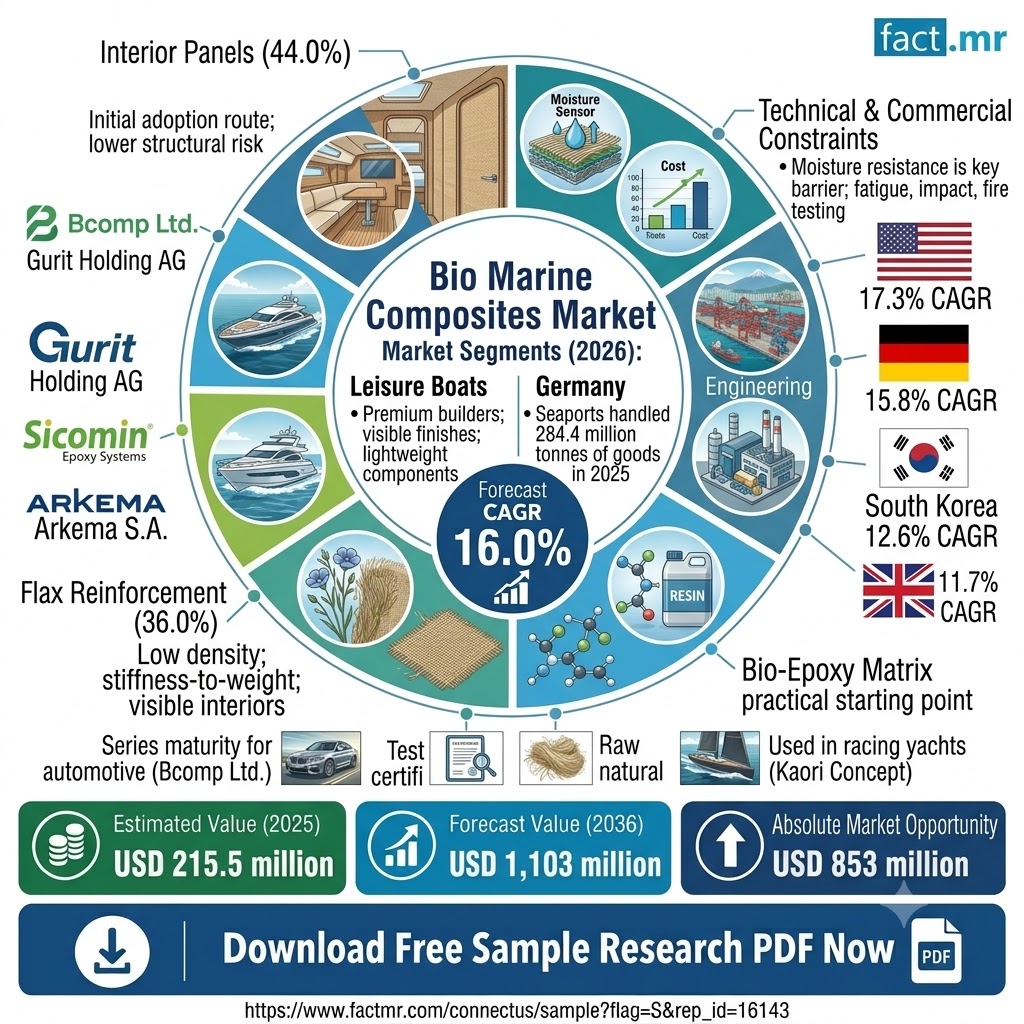
October 14, 2026 — The global bio marine composites market is projected to increase from USD 250 million in 2026 to USD 1,103 million by 2036, registering a compound annual growth rate (CAGR) of 16.0%, according to Fact.MR. The market crossed USD 215.5 million in 2025. Demand is expected to rise as boatbuilders and repair yards evaluate natural-fiber reinforcements and bio-based resins for components where weight reduction and material qualification can be assessed without immediate changes to primary hull structures.
The forecast represents an absolute market opportunity of USD 853 million between 2026 and 2036. Early adoption is expected to concentrate on interior panels and leisure craft, where manufacturers can evaluate finish quality, moisture resistance and processing requirements before approving bio-based composites for more demanding structural applications.
Get detailed market forecasts, competitive benchmarking, and pricing trends: https://www.factmr.com/connectus/sample?flag=S&rep_id=16143
Bio Marine Composites Market Growth Depends on Material Qualification
Bio marine composites are natural-fiber, bio-resin and recycled bio-fiber composite materials used in vessel interiors, deck-superstructure components, small hulls and selected marine applications. These materials combine reinforcement and matrix systems designed to meet specific performance requirements in boatbuilding and refit operations.
The transition is not simply a matter of replacing conventional fiberglass. Marine components face saltwater exposure, repeated loading and demanding service conditions. Manufacturers must establish that alternative laminates can maintain their properties over time while remaining compatible with existing fabrication processes.
“Bio marine composites are moving through a qualification bottleneck, not a simple material swap,” said Shambhu Nath Jha, Principal Consultant at Fact.MR. “Demand is expected to concentrate first in panels, leisure craft and replaceable parts where performance evidence is easier to gather. Suppliers need to pair marine-grade testing with clear resin chemistry and repeatable processing support.”
For shipyards, the practical question is whether a new material can deliver measurable weight or finish benefits without requiring unfamiliar layup and curing procedures. Repair yards also need resin and fiber systems that fit established refit workflows.
Flax and Bio-Epoxy Lead the Bio Marine Composites Market
Fact.MR’s 2026 segment estimates identify flax reinforcement, bio-epoxy matrices and interior panels as leading categories. Their projected shares reflect the industry’s preference for applications where material performance can be evaluated with manageable qualification requirements.
Flax is expected to account for 36.0% of reinforcement demand in 2026. Its low density and stiffness-to-weight characteristics make it suitable for visible marine interiors. In June 2025, BMW Group reported that natural-fiber composites developed with Bcomp Ltd. had reached series maturity for automotive applications, demonstrating progress in industrializing natural-fiber materials outside the marine sector.
Bio-epoxy is projected to hold 45.0% of the matrix segment in 2026. Familiar epoxy processing practices offer a practical starting point for boatyards evaluating bio-based resin chemistry. Sicomin Epoxy Systems launched SR GreenPoxy 550 in October 2025 for bonding and laminating timber-and-fibre composites, with the system used in racing-yacht construction by the Kaori Concept boatyard.
Interior panels are anticipated to capture 44.0% of the market by part in 2026. These components offer an initial adoption route because they generally carry less structural risk than hull skins or appendages. Leisure boats are estimated to represent 31.0% of demand by vessel type, supported by premium builders’ interest in visible finishes and lightweight components.
Regional Forecasts Point to Strongest Growth in Germany
Germany is forecast to record a 19.5% CAGR through 2036, the highest among the five countries highlighted in Fact.MR’s comparison. Port activity and an engineering-oriented industrial base support opportunities to assess alternative materials in vessel construction and maintenance. Germany’s Federal Statistical Office reported that seaports handled 284.4 million tonnes of goods in 2025, an increase of 3.8% from 2024.
The USA is projected to grow at a 17.3% CAGR through 2036, supported by recreational boating and refit demand. Japan is expected to record a 15.8% CAGR, reflecting cruise activity and its marine manufacturing base. South Korea is forecast to expand at 12.6%, while the UK is expected to register an 11.7% CAGR.
These markets present different routes to adoption. Recreational boating supports trials in the USA, while passenger-vessel refurbishment and port-linked engineering activity create opportunities across European and Asian markets.
Moisture Resistance and Certification Remain Key Barriers
Despite the growth forecast, bio marine composites face technical and commercial constraints. Natural fibers can absorb moisture, making marine aging data essential before manufacturers approve them for exposed decks or other demanding components. Structural applications also require testing for fatigue, impact and fire performance, increasing qualification costs.
Conventional fiberglass remains a cost benchmark for many boatyards. Suppliers must demonstrate that bio-based materials justify their price through weight savings, finish quality or other application-specific benefits.
Fact.MR identifies natural-fiber cabin packages for premium boats and bio-epoxy repair kits for refit yards as opportunities for suppliers. Hybrid basalt-natural reinforcement in small hulls represents a longer-term pathway, subject to further validation.
Competition is expected to depend on marine-grade test evidence, material consistency and practical processing support. Key companies covered in the report include Bcomp Ltd., Gurit Holding AG, Sicomin Epoxy Systems and Arkema S.A.
View Related Reports :
Phosphorite and Phosphorous Chemical MarketSemi-Automatic Wrapping Machine MarketSilicon Wafers Market
Research Scope and Methodology
The Fact.MR bio marine composites market report examines demand by reinforcement, matrix, component type, vessel category and geography. Its scope includes bio-epoxy, bio-polyester and bio-thermoplastic systems used with natural or recycled reinforcements in marine components.
The analysis draws on more than 120 sources, over 35 company portfolios, coverage of more than 25 countries and over 20 industry interviews. The research combines primary interviews with government statistics, company disclosures, technical studies and industry publications. Market estimates use a hybrid top-down and bottom-up approach, with findings validated against demand indicators, segment adoption and supplier activity.
Fact.MR is a market research and consulting firm that provides industry analysis, market sizing, forecasts and strategic insights to support business decisions. Its research examines market trends, competitive developments, regional opportunities and factors influencing demand across industries.