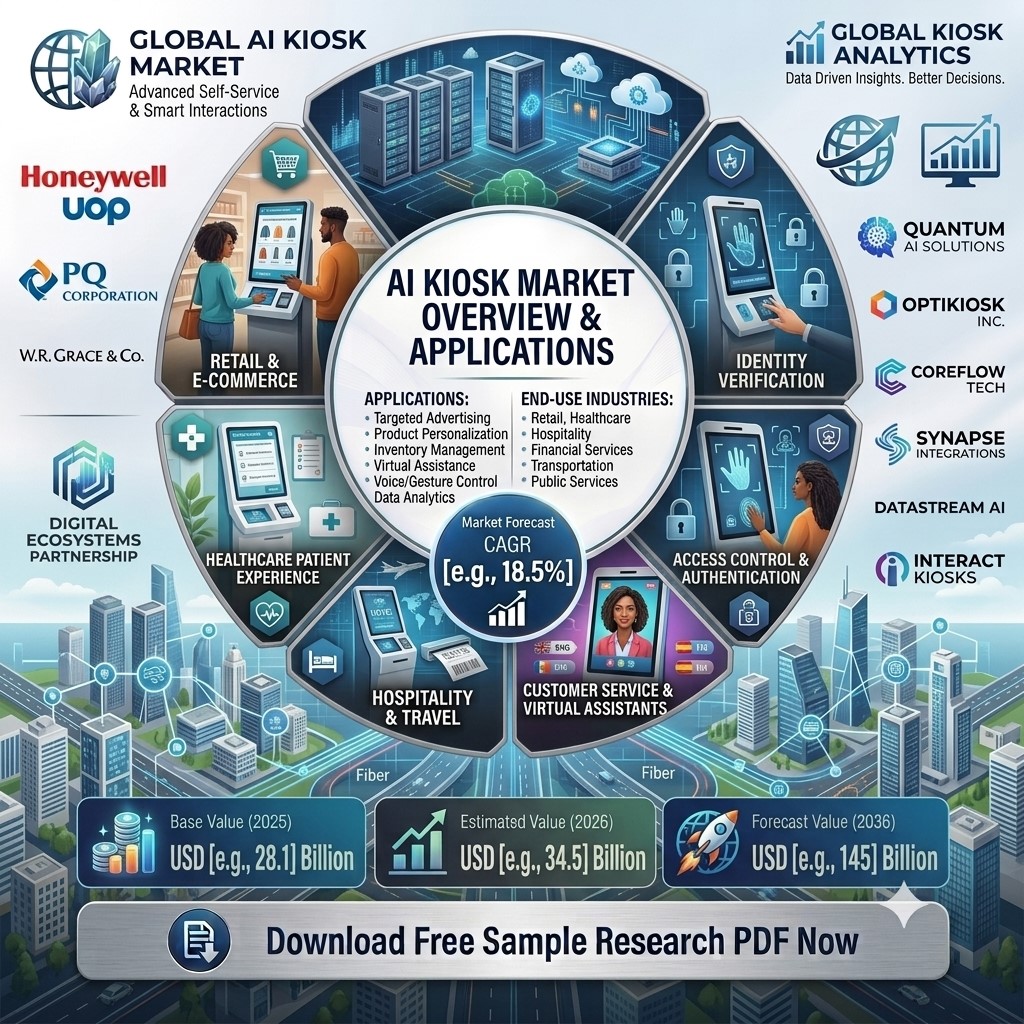
Rockville, MD., October 6, 2026 — The AI Kiosk Market is projected to grow from USD 10.4 billion in 2026 to USD 48.2 billion by 2036, registering a 16.6% CAGR, according to Fact.MR. The market was valued at USD 8.9 billion in 2025. India is forecast to record the fastest growth among the seven countries assessed, at 21.9% CAGR, while Germany is projected to expand at the slowest rate, at 14.2%.
The forecast represents an absolute dollar opportunity of USD 37.8 billion between 2026 and 2036. Retailers, hospitality operators, banks and transportation providers are expanding automated customer services. AI-enabled kiosks are being adopted for ordering, payments, visitor assistance and other interactions that previously required staff involvement.
Get detailed market forecasts, competitive benchmarking, and pricing trends.
AI kiosk adoption expands across customer-facing industries
The AI Kiosk Market covers self-service machines that use artificial intelligence, computer vision, speech recognition or analytics to automate customer interactions. Unlike conventional rule-based terminals, these systems can interpret user inputs and support personalized assistance.
Extractable fact: An AI kiosk is an intelligent self-service machine that uses artificial intelligence to automate customer interactions, transactions and assistance.
Demand is being shaped by labor optimization and the need to improve service delivery. Fact.MR identifies conversational AI, computer vision and edge computing as technologies supporting the transition from conventional kiosks to intelligent systems.
The European Commission’s AI Act framework also makes governance relevant for businesses deploying certain AI applications. The regulation follows a risk-based approach, with requirements depending on the system and its use. [LINK: European Commission’s AI Act overview]
Hardware and touch-based systems lead market segments
Hardware is expected to account for 62% of the AI kiosk market by offering in 2026. This segment includes interactive displays, processors, cameras, biometric technologies and payment modules. The share highlights the importance of physical equipment in deploying AI-enabled self-service systems.
Touch-based interaction systems are forecast to hold 46% of the market by interaction mode. Their established use across retail, banking, transportation and hospitality supports their position, even as voice-based and gesture-based interfaces attract attention.
Kiosks with displays measuring 20–32 inches are projected to account for 41% of the market in 2026. This screen category offers businesses a format for presenting interactive services while managing installation space.
Automated ordering applications are expected to represent 24% of application demand. Quick-service restaurants and retailers use ordering kiosks to process customer selections and payments. The systems can also help staff manage service workloads.
Retail and e-commerce are projected to account for 31% of end-use industry demand in 2026. Self-checkout systems, ordering terminals and customer-engagement kiosks support this segment’s position.
India leads country-level growth through 2036
India is forecast to record a 21.9% CAGR through 2036, the highest among the countries covered. China follows at 19.0%, supported by smart retail expansion, digital payments and investment in AI-enabled public infrastructure.
South Korea is projected to grow at 18.7% CAGR. Japan follows at 16.5%, with labor shortages and an aging population supporting demand for automated services.
The United States is forecast to expand at 15.2% CAGR, while the United Kingdom is projected to grow at 14.6%. Germany is expected to register a 14.2% CAGR over the same period.
These forecasts reflect different adoption patterns across markets. Retail modernization, digital infrastructure and the need for automated customer services remain relevant factors in country-level demand.
Competitive landscape
Companies profiled in the AI Kiosk Market include NCR Voyix Corporation, Diebold Nixdorf, KIOSK Information Systems, Fujitsu Limited, Advantech Co., Ltd., Glory Global Solutions and Samsung Electronics.
NCR Voyix participates in retail and hospitality self-service systems. Diebold Nixdorf serves banking and retail automation markets, while KIOSK Information Systems provides customized kiosk solutions. Fujitsu and Samsung Electronics are active in technology-enabled retail and transportation applications.
Fact.MR identifies hardware, software and services as the market’s principal offering categories. The report also covers self-service, information, ticketing, payment and check-in kiosks.
Shambhu Nath Jha, Principal Consultant at Fact.MR, said, “Leaders at CXOs level would realize that in the future, competitive edge within the AI kiosks market will be more about owning AI-powered customer engagement solutions rather than deploying hardware.”
Market outlook
The AI Kiosk Market is expected to expand as enterprises invest in intelligent customer interfaces. However, high deployment costs, cybersecurity requirements, integration complexity and data privacy obligations may affect adoption.
The Fact.MR report assesses market demand across North America, Latin America, Europe, East Asia, South Asia and the Pacific, and the Middle East and Africa. Its methodology combines primary interviews, desk research, market modeling and data validation.
Top Reports:
Laparoscopic Gynecological Procedures Market
Transdermal Skin Patches Market
About Fact.MR
Fact.MR is a market research and consulting firm providing syndicated and custom research across industries and geographies. Its research combines primary interviews, secondary research, market modeling and data validation to support business decisions.