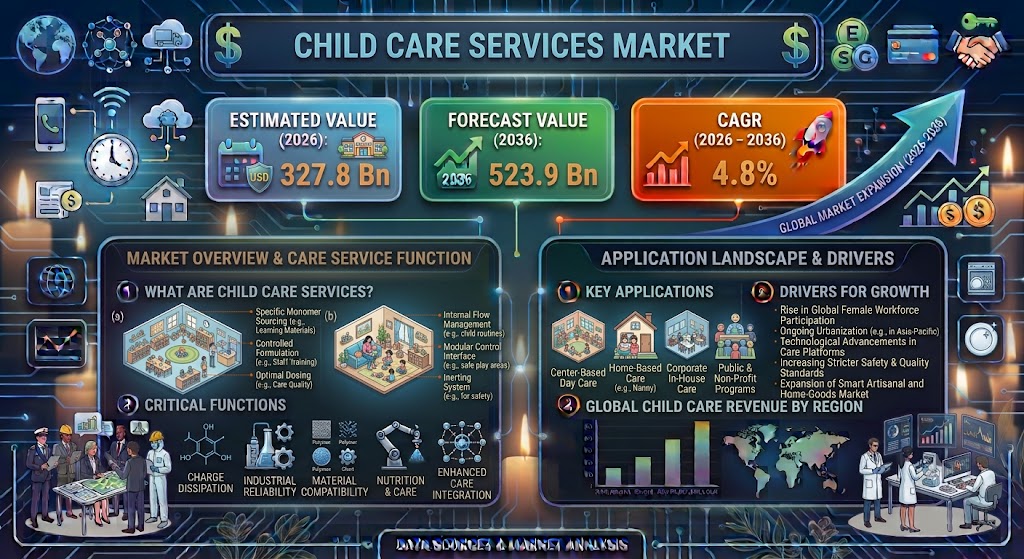
The global child care services market is estimated at USD 327.8 billion in 2026 and is projected to reach USD 523.9 billion by 2036, expanding at a 4.8% CAGR from 2026 to 2036. The market is expected to create an absolute dollar opportunity of USD 196.1 billion over the forecast period.
Child care demand is closely linked to working-family schedules, the need for dependable weekday coverage, and growing interest in early childhood education. Parents are also paying greater attention to staffing, safety practices, curriculum, location, and operating hours when selecting a provider.
Get Detailed Market Forecasts, Competitive Benchmarking, and Pricing Trends
Global Segment Leaders
- Day Care Services: This service type is expected to hold 37.4% share in 2026. Working households continue to need reliable daily care that fits commuting and job schedules.
- Toddlers (1–3 Years): This age group accounts for 33.2% share. Toddlers require close supervision, structured routines, and early social development support before preschool entry.
- Center-Based Child Care: This provider type is projected to hold 39.3% share. Licensed centers make staffing, curriculum, safety procedures, and available capacity easier for parents to evaluate.
- Private Pay: Private pay represents 33.2% share according to the report’s segment analysis. Direct household payment remains important where public funding or employer assistance does not cover the preferred provider or schedule.
- Early Childhood Education: This program type holds 37.8% share, as parents increasingly assess childcare based on learning readiness alongside basic supervision.
Country-Level Performance
- South Korea: The market is forecast to expand at a 5.3% CAGR, the highest rate among the countries profiled. Urban working-family demand and policy attention to early childhood services support the country’s outlook.
- USA: Growth is projected at 5.1% CAGR, supported by private-pay demand, employer benefits, and established center-based childcare networks.
- Canada: The market is expected to register a 4.9% CAGR, with public funding programs and provincial delivery models influencing enrollment growth.
- Germany: Demand is forecast to rise at 4.6% CAGR. Licensed capacity and staffing availability remain important factors affecting service expansion.
- UK: The market is projected to grow at 4.5% CAGR, with nursery demand linked to parent work patterns and funding eligibility.
- Australia: Growth is estimated at 4.4% CAGR, with center-based networks and subsidy rules influencing household uptake.
- Japan: The market is expected to expand at 4.2% CAGR. Demographic pressure limits volume growth, although urban working families continue to require dependable care.
Working-Family Demand Supports Market Growth
Reliable weekday childcare remains the primary demand driver. Families need services that match commuting patterns and working hours, making location, operating schedules, staff availability, and safety practices important factors in purchasing decisions.
Toddler care is another important demand area. Children between one and three years require closer supervision and more structured routines than older preschool groups. This makes toddler-focused capacity particularly relevant to center operators.
Center-based providers also benefit from greater visibility around licensing, staffing, curriculum, and safety processes. These factors allow parents to compare providers more easily than informal arrangements.
Employer-Supported and Flexible Childcare Create Opportunities
Employer-supported childcare represents a significant opportunity, particularly where families face gaps between household income and childcare fees. Employer assistance can also help reduce work disruption for parents of infants and toddlers.
Providers that combine childcare with early education can strengthen their value proposition by addressing both supervision and learning readiness. Flexible schedules and extended operating hours can also help centers serve families working non-standard schedules.
Affordability and Staffing Remain Key Constraints
Affordability remains a major barrier when childcare fees increase faster than household income. This can affect enrollment decisions and limit access to preferred providers.
Staff shortages create another constraint. Even when parent demand is strong, limited staffing can prevent providers from adding enrollment capacity. Regulatory and licensing requirements can also increase the time and resources required to open new centers.
Analyst Perspective
Shambhu Nath Jha, Sr. Consultant at Fact.MR, said:
“Child care demand is decided at the point where family schedules, trust and affordability meet. Operators that can show stable staffing, safety discipline and a clear early-learning program are better placed than providers that sell only capacity.”
The analyst perspective highlights the importance of combining dependable capacity with visible safety standards and early-learning programs. Providers are therefore competing not only on available places but also on the quality and clarity of their service proposition.
Competitive Landscape
Competition in the child care services market is shaped by center capacity, staff stability, safety compliance, curriculum quality, and parent trust. Bright Horizons Family Solutions is estimated to hold 4.9% share in 2026, making it one of the visible providers in the market.
Key companies profiled by Fact.MR include:
- Bright Horizons Family Solutions
- KinderCare Education
- Learning Care Group
- Busy Bees Nurseries
- Primrose Schools
- Goodstart Early Learning
- Kids Planet Day Nurseries
- G8 Education
The competitive environment is expected to favor providers that can maintain staffing stability, demonstrate safety processes, provide clear curricula, and expand capacity in markets where demand is strongest.
Report Coverage
The Child Care Services Market report by Fact.MR covers the forecast period from 2026 to 2036 and analyzes formal childcare services for infants, toddlers, and preschool children. The study covers day care, center-based care, home-based services, funding models, and early education programs.
The report examines the market by service type, age group, provider type, funding type, program type, and region. Service types include day care, full-day care, preschool and early education, Montessori programs, play-based learning, after-school care, infant care, toddler care, backup childcare, and special-needs childcare.
Geographic coverage includes North America, Latin America, Europe, East Asia, South Asia and Oceania, and the Middle East and Africa, with country-level analysis for South Korea, the USA, Canada, Germany, the UK, Australia, and Japan.
Explore More Related Studies Published by Fact.MR Research:
Twist-off Metal Caps Market
Shock Mat Market
About Fact.MR
Fact.MR is a global market research and consulting firm, trusted by Fortune 500 companies and emerging businesses for reliable insights and strategic intelligence. With a presence across the U.S., UK, India, and Dubai, we deliver data-driven research and tailored consulting solutions across 30+ industries and 1,000+ markets. Backed by deep expertise and advanced analytics, Fact.MR helps organizations uncover opportunities, reduce risks, and make informed decisions for sustainable growth.