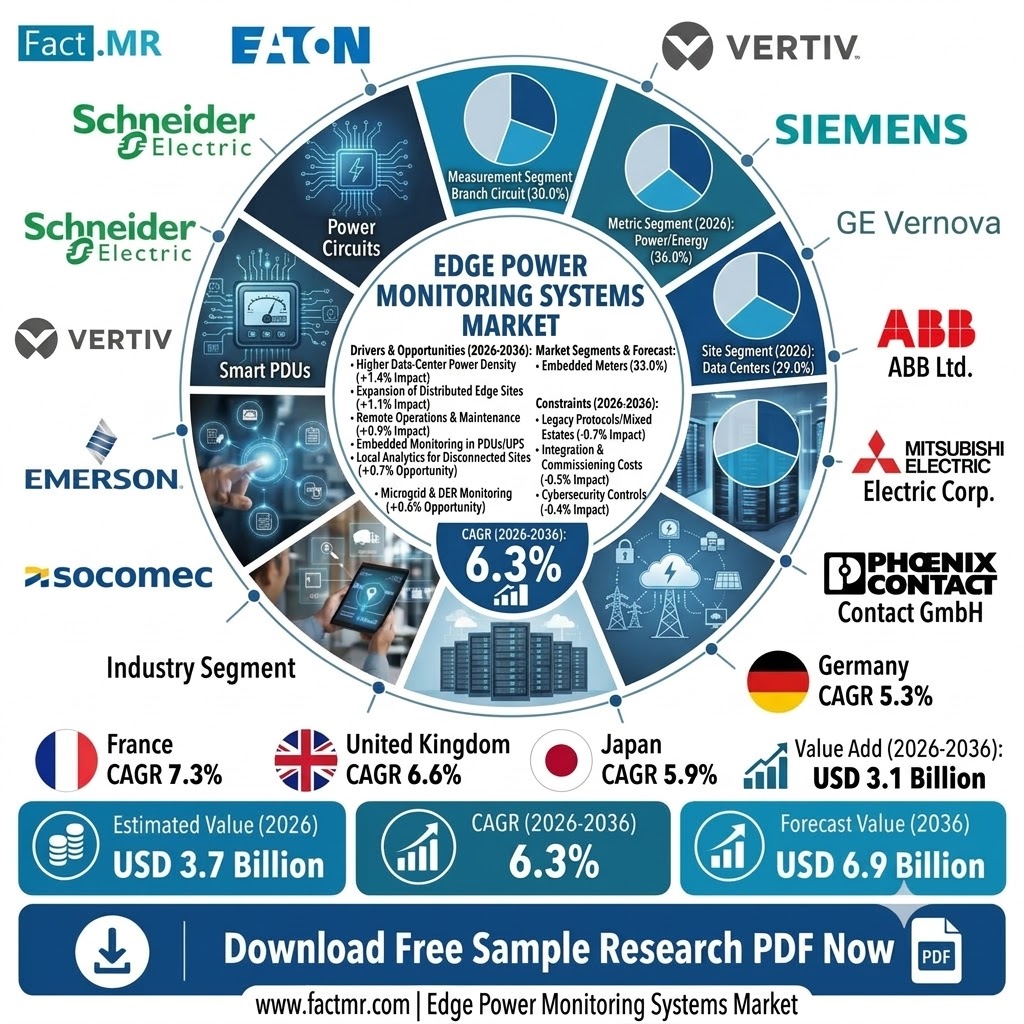
The Edge Power Monitoring Systems Market is projected to grow from USD 3.7 billion in 2026 to USD 6.9 billion by 2036 at a 6.3% CAGR, according to Fact.MR.
ROCKVILLE, MD — October 5, 2026 — The Edge Power Monitoring Systems Market is projected to reach USD 6.9 billion by 2036, rising from USD 3.7 billion in 2026 at a 6.3% CAGR, according to a new analysis by Fact.MR. The market was valued at USD 3.5 billion in 2025, creating an absolute opportunity of USD 3.1 billion between 2026 and 2036.
The growth is closely tied to rising power requirements at data centers, telecom-edge locations, industrial facilities, retail branches, and other distributed sites. In June 2026, the U.S. Department of Energy reported that data centers could account for 11.8% of U.S. electricity use by 2030. That pressure is increasing the need for local power data, particularly where higher computing loads make overloads and capacity constraints more costly.
Edge Power Monitoring Systems Market is a category that measures, aggregates and analyzes electrical conditions close to distributed computing or operating loads. The scope includes meters, intelligent PDUs, panel devices, UPS monitoring, gateways, and software that collect power, energy, power-quality, thermal, or load data at edge sites.
Get detailed market forecasts, competitive benchmarking, and pricing trends: https://www.factmr.com/connectus/sample?flag=S&rep_id=16607
Branch-circuit monitoring leads the measurement segment
Branch circuit is expected to account for 30.0% of the Edge Power Monitoring Systems Market in 2026. The measurement layer gives facility teams a circuit-level view without requiring device-by-device instrumentation. Rack PDU monitoring remains important in IT environments, while panel, UPS, and facility-feeder monitoring provide wider visibility across site power systems.
Power/energy monitoring is projected to lead the metric segment with a 36.0% share in 2026. These readings support load planning, cost tracking, and energy-efficiency work. Power-quality information can help teams identify electrical issues affecting sensitive equipment, while thermal and capacity data can support equipment planning.
Embedded meters are expected to capture 33.0% of the compute segment in 2026. Built-in metering can reduce additional wiring requirements at panels, PDUs, and power equipment. Edge gateways can collect information from several meters, while local systems can keep alarms active at the site and cloud-connected platforms can compare information across locations.
Data centers are estimated to represent 29.0% of the site segment in 2026. Dense rack configurations and high equipment loads increase the value of local power information. In April 2026, RTE reported that data centers directly connected to France’s public power transmission system used almost 1 TWh of electricity in 2025.
Local monitoring gains importance as power loads rise
The need to track power at individual sites remains a central demand driver. Higher data-center power density is estimated to contribute +1.4% to CAGR, while expansion of distributed edge sites contributes +1.1%. Remote operations and maintenance add another +0.9%.
Integration remains a constraint. Mixed legacy protocols and device estates are estimated to have a -0.7% impact on CAGR, while integration and commissioning costs contribute -0.5%. Cybersecurity controls on connected meters represent another -0.4% impact.
“Sites can find power problems more easily when monitoring happens close to the equipment,” said Shambhu Nath Jha, Principal Consultant at Fact.MR. “As edge computing grows, buyers need meters that can notice power changes quickly and share that information with other systems.”
The opportunity extends to embedded monitoring in PDUs and UPS systems, estimated to contribute +0.9% to CAGR. Local analytics for disconnected sites contributes +0.7%, while microgrid and distributed-energy monitoring represents a +0.6% opportunity over the longer term.
France records the fastest country growth
France is forecast to register the highest growth among the countries analyzed, at a 7.3% CAGR from 2026 to 2036. The United Kingdom follows at 6.6%, Japan at 5.9%, the United States at 5.6%, and Germany at 5.3%.
In December 2025, Arcep reported more than 68,000 5G sites operating in metropolitan France as of September 30, 2025. The expanding network base creates additional remote locations where local power monitoring can support operations.
The United Kingdom’s market is supported by expanding digital infrastructure and rising power requirements. In March 2026, the Department for Energy Security and Net Zero and other government agencies reported that the waiting list for new transmission connections had increased by 460% in the six months to June 2025.
Japan is projected to grow at 5.9%. The Statistics Bureau of Japan reported in September 2026 that sales of information and communication services increased 6.4% year over year in July 2026.
The United States is forecast at 5.6% CAGR. The U.S. Energy Information Administration reported in May 2026 that servers alone accounted for an estimated 7% of commercial-sector electricity use in 2025.
Germany records 5.3% CAGR. Bundesnetzagentur reported in December 2025 that around 95% of Germany’s land area had 5G coverage by October 2025, supporting wider deployment of connected digital sites.
“Accurate meters that are easy to install and connect can work across sites that use different equipment,” added Shambhu Nath Jha. “That matters when operators are managing power data across many locations, not just one facility.”
Competitive landscape
Key companies profiled in the Edge Power Monitoring Systems Market include Schneider Electric, Eaton, Vertiv, Siemens, ABB, and Socomec. Their portfolios span electrical meters, power distribution equipment, UPS systems, power-quality monitoring, intelligent PDUs, and digital management platforms.
Fact.MR’s analysis draws on 120+ sources, 35+ company portfolios, 25+ countries, and more than 20 industry interviews. The assessment covers measurement layers, metrics, compute approaches, sites, regions, country-level growth, competitive activity, and adoption factors through 2036.
Top Related Reports :
About Fact.MR
Fact.MR is a market research and consulting firm providing industry intelligence, market forecasts, competitive analysis, and strategic insights across global markets. Its research combines primary interviews with manufacturers, service providers, technology developers, distributors, end users, and subject-matter experts alongside government statistics, regulatory publications, company information, technical studies, and other documented sources.