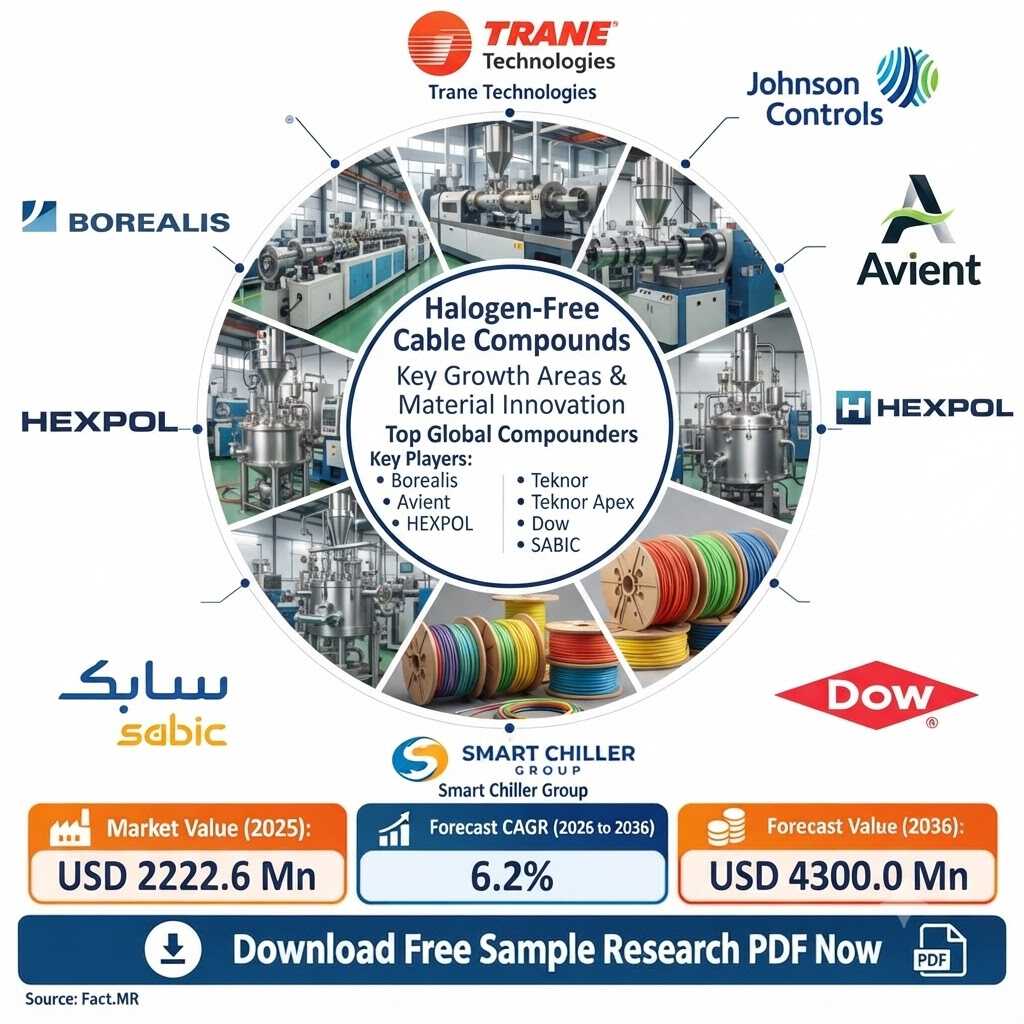
Halogen-Free Cable Compounds Market :The global halogen-free cable compounds market is projected to expand from USD 2,360.0 million in 2026 to USD 4,300.0 million by 2036, representing a 6.2% CAGR during the forecast period, according to Fact.MR analysis. The market had reached USD 2,222.6 million in 2025 as cable manufacturers continued evaluating low-smoke and halogen-free insulation and jacketing materials.
Demand is being shaped by the need to control smoke release, flame spread, and acid-gas performance in cable applications. Building wire, rail, data, energy, automotive, and renewable energy applications are among the areas where material qualification increasingly considers both fire performance and processing behavior.
Get detailed market forecasts, competitive benchmarking, and pricing trends:
Germany leads country growth outlook
Among the countries profiled in the report, Germany is projected to record a 7.1% CAGR through 2036, supported by specification-led cable applications and established testing practices. The country has established cable production across building, rail, automotive, and industrial applications, where technical documentation and repeat testing influence material approval.
Brazil is estimated to advance at a 6.5% CAGR, supported by cable demand and expanding local trial activity. Opportunities are developing across building and energy cables where smoke and flame performance form part of product specifications.
The United States is forecast to register a 5.9% CAGR through 2036. Cable manufacturers in the country assess compounds through recognized fire tests and customer-specific requirements across multiple cable classes. Demand for documented smoke and flame performance is expected to support application-focused qualification activity.
XLPE remains the leading polymer base
By polymer base, XLPE is expected to account for 29% of market share in 2026. Its use in cable insulation is supported by heat resistance after crosslinking and electrical performance requirements.
EVA and POE remain relevant where flexibility and filler acceptance influence compound formulation. TPE and TPU address applications requiring softer handling or repeated movement, while PVC-free blends provide an option where material specifications exclude halogenated systems.
Material approval depends on more than the compound formulation itself. Cable manufacturers assess extrusion stability, surface quality, electrical performance, mechanical properties, and fire behavior under application-specific conditions.
Building wire accounts for the largest application share
Building wire is projected to represent 33% of market share in 2026, making it the leading application segment. Fire-safety requirements in occupied and enclosed spaces are supporting demand for materials designed to limit smoke and harmful gas release.
Data cables require controlled smoke behavior and stable dimensions, while automotive cables face requirements related to heat, oil, movement, and space limitations. Rail cables place additional emphasis on smoke and toxicity performance. Renewable energy cables require durability under demanding operating conditions.
The broad installation base of building wire supports its leading position, although compound selection remains dependent on cable design, extrusion conditions, and required fire tests.
LSZH performance segment holds leading position
By performance, LSZH is anticipated to capture 32% share in 2026. The segment directly addresses low-smoke and halogen-free cable requirements.
Flame-retardant grades remain important where ignition resistance and flame-spread control are central to cable specifications. Oil-resistant and UV-resistant compounds address cables exposed to specific environmental conditions, while high-flexibility grades support applications involving repeated bending and movement.
Fact.MR notes that performance claims need to be evaluated on finished cables because processing history, wall thickness, fillers, and cable construction can influence final test results.
Cable manufacturers drive end-user demand
Cable manufacturers are estimated to account for 28% share in 2026. These companies directly manage compound qualification and extrusion into finished cable products.
Wire harness suppliers assess flexibility and assembly behavior, while rail OEMs work through project specifications and approved material lists. Construction and energy utilities focus on installation conditions, safety requirements, and service life.
Adoption can accelerate when compound suppliers provide technical records and support plant trials. Consistent processing and repeatable performance are also important factors in securing recurring orders.
Low-voltage cables represent the largest voltage class
The low-voltage segment is forecast to account for 36% share in 2026, supported by broad use across building wire, control cables, data connections, and equipment wiring.
Medium- and high-voltage compounds face additional electrical and long-term performance requirements. Data/communication and specialty classes address constructions with distinct flexibility, signal, thermal, or environmental requirements.
Qualification requirements shape market development
Smoke-release control, flame-spread testing, and building wire approval programs are among the factors supporting market expansion. At the same time, qualification costs, processing fit, documentation requirements, and scale-up risks can delay material substitution.
Cable manufacturers often need evidence that a new compound can run reliably on existing extrusion equipment while meeting the required finished-cable performance. This creates opportunities for compound producers that can combine material development with application testing and plant-level technical support.
Application laboratories can help manufacturers compare candidate grades before full-scale production trials. Rule-ready documentation covering composition, test results, and intended use can also simplify specification reviews in building and transport applications.
Competitive landscape
The competitive environment includes Borealis, Avient, HEXPOL, Teknor Apex, Dow, and SABIC.
Borealis provides flame-retardant compounds for cable insulation and jacketing across power, automotive, building, and energy applications. Avient offers low-smoke, non-halogen formulations for telecom, rail, marine, renewable energy, and building cables.
HEXPOL provides thermoplastic and thermoset compound capabilities, including halogen-free flame-retardant materials. Teknor Apex supplies compounds for data, industrial, energy, rail, and infrastructure cable applications. Dow brings polyethylene material expertise to wire and cable systems, while SABIC provides polyolefins and engineering thermoplastics.
Competition through 2036 is expected to focus on verified smoke and flame performance, compatibility with existing extrusion lines, technical documentation, and support during cable qualification.
Market outlook
The halogen-free cable compounds market is positioned around the continued need for cable materials that combine fire-performance characteristics with processing reliability. As building, transportation, energy, data, and industrial infrastructure projects apply detailed material specifications, compound suppliers and cable manufacturers are expected to place greater emphasis on finished-cable testing and qualification evidence.
According to Fact.MR, the market will add approximately USD 1,940.0 million in absolute opportunity between 2026 and 2036, taking its value from USD 2,360.0 million to USD 4,300.0 million over the forecast period.
The full Halogen-Free Cable Compounds Market analysis covers polymer base, application, performance, end user, voltage class, and regional demand across 2026–2036.
Top Trending Reports:
Disposable EEG Electrode Market