Reusable packaging rules and sanitation requirements support a 5.9% CAGR as demand rises from USD 1.15 billion in 2026 to USD 2.04 billion by 2036.
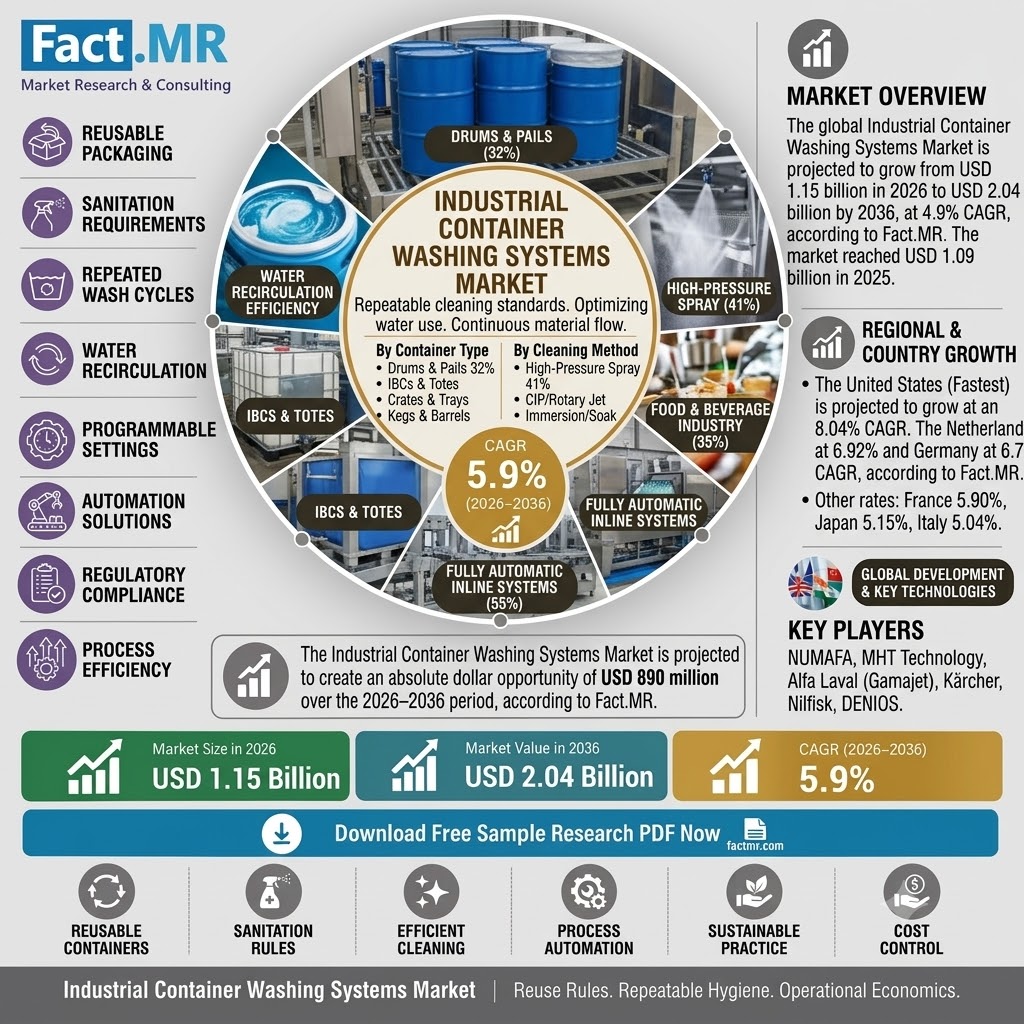
September 23, 2026 — The global Industrial Container Washing Systems Market is projected to grow from USD 1,150 million in 2026 to USD 2,040 million by 2036, expanding at a 5.9% CAGR, according to Fact.MR. The market reached USD 1,090 million in 2025 and is expected to create an absolute opportunity of USD 890 million over the 2026–2036 period.
The growth outlook is closely linked to the rising circulation of reusable drums, IBCs, crates, totes and other industrial containers. The European Union Packaging and Packaging Waste Regulation generally applies from August 2026, while U.S. FDA requirements address sanitation and cleanability for food transport equipment and reusable bulk food containers. These conditions make repeatable container washing an operational requirement for many reuse cycles.
Get detailed market forecasts, competitive benchmarking, and pricing trends: https://www.factmr.com/connectus/sample?flag=S&rep_id=16096
Fact.MR is a market research and consulting firm that provides syndicated research and market intelligence across global industries.
Reuse Rules and Sanitation Requirements Shape Demand
Reusable packaging remains in service through repeated fill, transport and return cycles. As the number of rotations rises, containers require washing between cycles rather than occasional reconditioning.
The U.S. Environmental Protection Agency states that reconditioning facilities clean steel and plastic drums and IBCs for resale and reuse, with water and caustic solution used in washing processes. This creates recurring equipment demand when container throughput increases.
Food and beverage operations face another requirement. U.S. FDA sanitary transportation rules require transport equipment to be suitable and adequately cleanable, while FDA guidance for reusable bulk food containers calls for cleaning and sanitizing before reuse.
That creates a clear purchasing question: how can operators maintain repeatable cleaning while controlling operating costs? Water recirculation, programmable wash settings, filtration and drying are increasingly relevant to equipment selection.
Drums and Pails Account for 32% of Container Type
Drums & pails represent 32.0% of Container Type in 2026, according to Fact.MR. These formats are widely used across chemical, oil and food applications and are routinely cleaned before reconditioning or refill.
High-pressure spray represents 41.0% of Cleaning Method in 2026. The method directs cleaning energy toward internal surfaces and can be adjusted through nozzle arrangements and pressure settings for different container geometries.
Food & beverage represents 35.0% of End-Use Industry in 2026. Reusable food-contact containers require controlled cleaning before returning to production or transport.
Fully automatic inline systems account for 55.0% of Automation Level in 2026, reflecting the need for repeatable cycle control and reduced manual transfers between washing, rinsing and drying stages.
Automation and Water Recirculation Gain Attention
Equipment buyers are also examining the cost of each additional reuse cycle. NUMAFA container washers use closed water recirculation and programmable wash settings, while Alfa Laval rotary-jet equipment is designed for barrel, drum and IBC cleaning.
NUMAFA reports throughput of up to 300 containers per hour on its industrial container washer range. This provides a specific operating benchmark for pooling operations and centralized wash hubs handling repeated container rotations.
Shambhu Nath Jha, Principal Consultant at Fact.MR, said, “Demand is moving toward systems that can process reusable containers at repeatable hygiene standards while controlling water use and turnaround time. Fully automatic inline configurations lead Automation Level in 2026 because centralized wash operations benefit from consistent cycle control and continuous material flow.”
The equipment choice still depends heavily on application requirements. Food processors may place greater emphasis on repeatable sanitation and hygienic design, while chemical reconditioners need to consider residue handling, wastewater requirements and cleaning chemistry.
United States Leads Country Growth at 8.04% CAGR
The United States is forecast to expand at an 8.04% CAGR from 2026 to 2036, according to Fact.MR. EPA oversight of drum reconditioning provides one demand channel, while FDA sanitation requirements create another for food-related applications.
The Netherlands follows with a projected 6.92% CAGR, supported by Rotterdam’s process-industry and transport infrastructure. Germany is forecast to expand at 6.76% CAGR, while France reaches 5.90%, Japan 5.15%, and Italy 5.04% over the same period.
The Netherlands, Germany and France also operate within the broader European packaging-reuse policy environment. The PPWR generally applies from August 2026, increasing attention on reusable and recoverable packaging.
Italy’s food and beverage sector provides another equipment base. Istat reported that food, beverage and tobacco industry volumes increased by 1.4% in 2025, while wine production volumes rose by 2.9%.
View Related Reports :
Suppliers Compete Around Application Fit
Key companies profiled by Fact.MR include NUMAFA, MHT Technology, Alfa Laval (Gamajet), Kärcher, Nilfisk and DENIOS.
NUMAFA supplies semi-automatic and fully automatic industrial container washers using rotating spray frames, closed water recirculation and programmable wash settings. Alfa Laval competes through Gamajet rotary-jet equipment for barrels, drums and IBCs.
Kärcher offers container-cleaning systems and drum or IBC cleaning stations for food and chemical applications. MHT Technology, Nilfisk and DENIOS are also included in the market assessment.
Shambhu Nath Jha, Principal Consultant at Fact.MR, added, “The practical issue is not only washing speed. Suppliers need to match container geometry, cleaning chemistry and throughput with the operating site, while recirculation, drying and service support can affect the economics of repeated reuse.”
The market is segmented by Container Type, Cleaning Method, End-Use Industry and Automation Level. The assessment covers drums and pails, IBCs and totes, crates and trays, kegs and barrels, alongside high-pressure spray, CIP/rotary jet and immersion/soak systems.
For the full Industrial Container Washing Systems Market analysis, visit Fact.MR. Regulatory information can also be reviewed through the U.S. FDA sanitary transportation requirements.
About Fact.MR
Fact.MR is a global market research and consulting firm providing market intelligence, strategic analysis and syndicated research across industries. Its research combines primary interviews, secondary research, public data and company-level analysis to assess market size, segmentation and growth trends.