Sweetened banana chips hold 63.0% of the 2026 market, while online sales account for 68.8% as digital discovery reshapes packaged snack purchasing
ROCKVILLE, Md. — September 22, 2026 — The global banana chips market is projected to grow from USD 1.01 billion in 2026 to USD 1.81 billion by 2036, expanding at a 6.2% CAGR, according to a new report by Fact.MR. The market was valued at USD 951.7 million in 2025, creating an estimated absolute opportunity of USD 800.2 million between 2026 and 2036.
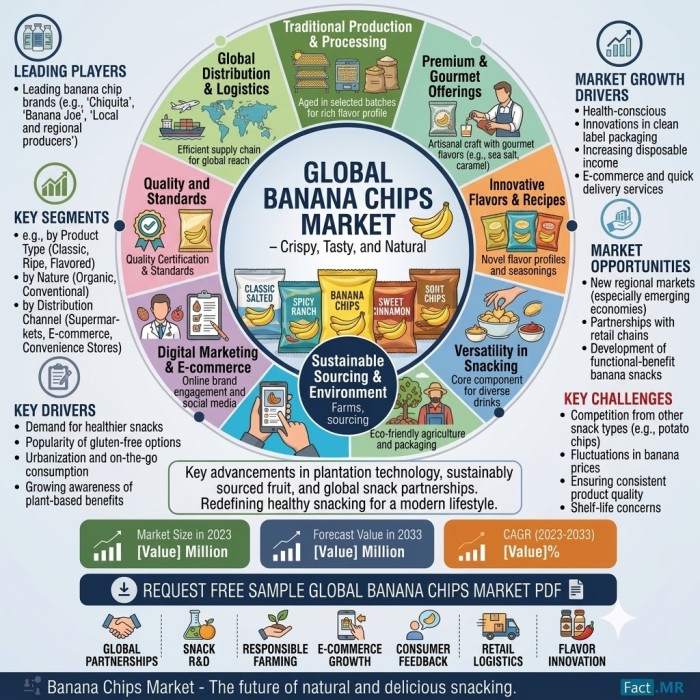
Banana chips are gaining visibility as packaged fruit-based snacks that combine a familiar ingredient with a crisp eating format. Demand is being supported by taste-led snacking, shelf-stable fruit positioning, digital product discovery, and flexible pack formats. Processing consistency remains critical because consumers can quickly assess chips based on color, sweetness, crunch, and overall pack condition.
Get detailed market forecasts, competitive benchmarking, and pricing trends:
Sweetened Banana Chips Hold the Leading Type Share
Sweetened banana chips are projected to account for 63.0% of market share in 2026, making them the leading type segment.
The flavor profile supports casual and household snacking and provides manufacturers with a format suited to trial packs and family-oriented assortments. Unsweetened banana chips continue to serve consumers seeking simpler formulations or lower added-sugar options.
Product positioning is increasingly tied to the eating occasion. Single-serve formats can support trial and on-the-go consumption, while larger packs can target household pantry stocking.
Online Sales Account for 68.8% of the Market
Online Sales are projected to hold 68.8% share in 2026, making the channel the largest application segment assessed by Fact.MR.
Digital ordering allows consumers to compare brands, ingredients, pack sizes, and product descriptions before purchasing. This can give smaller suppliers access to customers beyond their immediate retail markets.
Offline Sales remain relevant, particularly where shoppers prefer immediate availability and physical inspection of packaging. For manufacturers, coordinating digital listings with reliable fulfillment and consistent pack quality is becoming increasingly important.
What Is Driving Banana Chips Market Growth?
Taste-led snacking remains a central demand driver. Familiar sweetness can encourage product trial, while consistent crispness and pack condition influence repeat purchasing.
Shelf-stable fruit positioning provides another route for category expansion. Banana chips can be placed alongside dried fruits and other pantry snacks, allowing retailers to connect the product with established snack-buying occasions.
Online product discovery is also changing how consumers find packaged fruit snacks. Digital shelves allow comparison of product claims and pack sizes, while flexible packaging can address different consumption and purchasing occasions.
What Challenges Could Restrain Market Expansion?
Variability in banana inputs can affect finished-product color, texture, and production economics. Changes in raw fruit quality may therefore create challenges for suppliers seeking consistent output.
Oil and frying costs represent another consideration for manufacturers using fried processing methods. Maintaining frying quality requires process control, while higher input costs can limit flexibility in retail pricing.
Exporters also need to manage ingredient declarations and import-related compliance before entering formal retail channels. These requirements can lengthen the time required to secure new listings.
What Does the Fact.MR Analyst Say?
Shambhu Nath Jha, Principal Consultant at Fact.MR, states:
“Banana chips suppliers need to keep sweetness and cut style aligned with pack format. Repeat buying is expected to depend on consistent crispness and clear product positioning instead of one broad product claim.”
Pack-Size Differentiation and Private Label Create Opportunities
Pack-size differentiation represents an opportunity across both retail and online channels. Smaller packs can reduce the barrier to trial, while larger formats can support regular household consumption.
Private-label supply is another opportunity, particularly in the UK and Germany. Retailers can use own-label banana chips when suppliers can provide stable quality and sufficient volume.
Ingredient-led positioning and placement alongside non-potato vegetable chips may also increase visibility. These strategies allow banana chips to compete within a broader set of crisp snack alternatives without moving outside their core fruit-based identity.
Which Countries Are Showing the Fastest Growth?
The UK is projected to record an 8.4% CAGR from 2026 to 2036, the highest listed country growth rate in the Fact.MR assessment.
The USA follows at 7.9%, while Australia is projected to grow at 7.5%. Canada is forecast to expand at 6.6%, and Germany at 6.0% over the same period.
In the UK, specialty retail placement and online product discovery are supporting category visibility. Australia’s demand is associated with lunchbox and travel-snacking occasions. In the USA, online access and comparison with other crisp snack products are relevant factors, while Canada’s market is supported by varied snack preferences and retail availability.
Germany represents a mature packaged-snack environment where clear labeling, texture consistency, and shelf performance remain important purchasing considerations.
Competitive Landscape
The competitive landscape includes GSL Premium Food Export Corporation, See’s International Food Manufacturing Corporation, Prime Fruits International, Four Seasons Fruits Corporation, LTA Foods Manufacturing, Prime Fruits International, Inc., Snapsnax Ventures, Jamaica Producers Group, and Mota Chips.
Competition centers on product consistency, banana sourcing, processing quality, pack formats, distribution reach, and the ability to maintain reliable supply. Fact.MR notes that GSL Premium Food Export Corporation and See’s International Food Manufacturing Corporation have strong positions within the supplier group, while Prime Fruits International adds processed-fruit manufacturing reach.
Explore More Related Studies Published by Fact.MR Research:
Acidic Beta-Lactoglobulin Proteins Market
Prebiotic Fiber Pectin Bases Market
Upcycled Carob Prebiotics Market
Report Scope
The Fact.MR Banana Chips Market report covers packaged sliced banana products sold as fried or dried chips for direct snacking and related retail consumption.
The study analyzes the market by Type, Application, and Region. Type coverage includes Sweetened and Unsweetened products, while Application includes Online Sales and Offline Sales.
Regional coverage includes North America, Latin America, Europe, East Asia, South Asia and Pacific, and the Middle East and Africa. Country-level analysis covers the UK, Australia, USA, Canada, and Germany.
The forecast period runs from 2026 to 2036. The analysis draws on 120+ sources, 35+ company portfolios, 25+ countries, and more than 20 industry interviews, using a hybrid top-down and bottom-up approach.
About Fact.MR
Fact.MR is a market research and consulting firm providing market intelligence, industry analysis, market sizing, competitive assessments, and strategic insights across multiple industries. Its research supports businesses in evaluating demand patterns, market structures, emerging opportunities, and competitive environments.
Media Contact
Fact.MR
11140 Rockville Pike, Suite 400
Rockville, MD 20852, United States
Phone: +1 (628) 251-1583
Email: sales@factmr.com