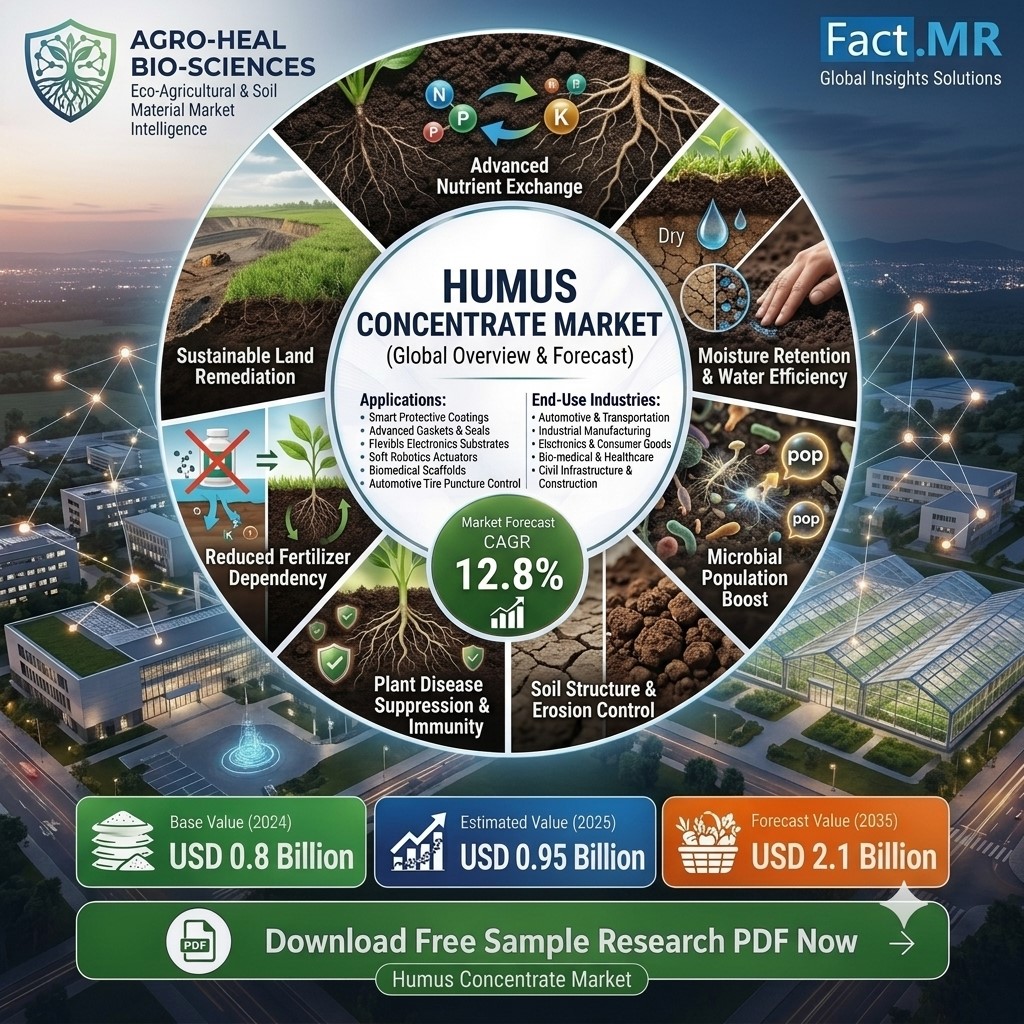
Rockville, MD., September 22, 2026 — The global Humus Concentrate Market is projected to expand from USD 4.9 billion in 2026 to USD 8.5 billion by 2036, advancing at a 5.7% CAGR during the forecast period. The market was valued at approximately USD 4.6 billion in 2025, according to the latest Fact.MR assessment.
Demand is being supported by growing attention to soil organic matter, soil structure, water-holding capacity, and managed nutrient application. Concentrated humic products give growers a measured input that can be incorporated into soil-treatment, fertigation, and irrigation programs.
Get detailed market forecasts, competitive benchmarking, and pricing trends
Soil Health Management Supports Market Demand
Soil organic-matter management remains a central demand driver. USDA NRCS identifies organic matter as a contributor to nutrient retention, soil structure, and water-holding capacity. This creates a practical use case for concentrated humic products where root-zone conditions limit soil performance.
European soil policy is also increasing attention to soil health. The EU Soil Monitoring Law, in force since December 2025, covers soil organic-matter loss and requires member states to monitor soil health.
The regulatory framework for plant biostimulants is another factor shaping the market. Regulation (EU) 2019/1009 recognizes functions such as nutrient-use efficiency, tolerance to abiotic stress, and nutrient availability. Suppliers therefore need product claims that correspond with demonstrated functions and applicable classification requirements.
Horticulture provides another established route for adoption. Fruit, vegetable, and floriculture operations frequently use irrigation and nutrient programs. Powdered humus concentrates can be dissolved for fertigation, while liquid products can be introduced through irrigation or soil-drench systems.
Powder Leads Product Demand
Powder is projected to account for 33.9% of the Product segment in 2026. Concentrated dry material is practical to store and transport and can be dosed into soil blends or dissolved before application.
Humusolver supplies soluble humic and fulvic acid concentrate powder, while Humintech markets water-soluble humic products for agricultural applications. Granules remain suitable for broadcast application, while liquids are used in fertigation and soil-drench programs.
Application flexibility allows suppliers to address different managed-soil requirements without relying on one delivery format.
Soil Structuring is projected to represent 27.1% of the Function segment in 2026. Humic substances are used to support soil aggregation and moisture behavior. Germany’s Federal Environment Agency identifies humus as important to soil structure and as a storage and buffering medium for water and nutrients.
This gives growers a defined reason to consider concentrated humic material where weak aggregation or low water-holding capacity affects soil management.
Horticulture Accounts for the Largest End-use Share
Horticulture is projected to account for 46.8% of End Use in 2026. Fruit, vegetable, and floriculture systems can integrate measured doses of humic products into existing irrigation and nutrient programs.
Horticultural growers can also evaluate products across defined crop areas and repeated production cycles. This creates a practical setting for assessing solubility, humic content, application rate, and soil response.
The report identifies crop-specific formulations as an opportunity, particularly in the USA, U.K., and Germany. Water-conservation applications in drought-prone cultivation also offer room for expansion when product positioning is tied to root-zone water behavior and application guidance rather than broad yield claims.
South Korea Records the Highest Listed Country CAGR
South Korea is projected to record the highest listed country CAGR at 5.9% from 2026 to 2036. Germany follows at 5.8%, while the USA and Japan are forecast to expand at 5.7% each. France is projected at 5.6%, while the U.K. and Italy are each forecast to record 5.5% growth.
South Korea’s agricultural research programs include regenerative organic soil-management technologies covering soil carbon and soil-quality assessment. This creates a technical basis for evaluating soil-conditioning inputs against measurable soil indicators.
Germany’s Federal Environment Agency recognizes humus as important to soil structure and water and nutrient storage. German soil-protection principles also require maintenance of site-typical humus content in agricultural soils.
In the U.K., the Sustainable Farming Incentive 2026 includes an organic-land-management action for horticultural land with an explicit soil-health objective. France had 2.7 million hectares under organic production in 2024, representing about 10% of agricultural area. Italy’s organic agricultural area exceeded 2.5 million hectares in 2024, representing about one-fifth of national agricultural area.
Product Consistency and Claim Compliance Remain Challenges
Market expansion depends on consistent product composition and clear application information. Variation in humic content and source material can make it harder for growers to compare products or establish repeatable application programs.
The report identifies variation in humic content and source material, product classification and claim compliance, substitution by compost and lower-cost organic amendments, and bulk transport and raw-material consistency as key restraints.
For suppliers, opportunities include crop-specific humic and fulvic formulations, water-conservation applications, landscaping and soil-remediation channels, and alignment with soil-health and biostimulant regulations.
Competitive Landscape
The Humus Concentrate Market includes Humintech, Novihum, Humusolver, Fertrell, Ohio Earth Food, Sustainable Farming, Plasmabiotec, Organic Approach, Nature’s Force Organics, AgriEnergy Resources, and King Humus Plus.
Humintech competes through a portfolio of granular, powder, and liquid soil conditioners and biostimulants. Humusolver offers soluble powder and granular humic or fulvic concentrates. Fertrell and Ohio Earth Food participate through concentrated liquid humus and humate products.
Competition is shaped by source consistency, stated humic concentration, solubility, application flexibility, and compatibility with irrigation or fertilizer programs. Buyers can compare cost per treated area alongside product composition and dosing requirements.
According to Shambhu Nath Jha, Principal Consultant at Fact.MR, “Humus concentrate demand will depend on measurable soil response and product consistency. Horticultural growers need clear information on humic content, solubility and application rate before they repeat a purchase.”
Top Reports:
Debt Collection Services Market
Marine Scrubber Systems Market
Report Scope
The study covers concentrated humic-substance products sold in powder, granule, or liquid form across defined Product, Function, and End Use categories. Product coverage includes mineral-based powder, biological powder, organic granules, mineral granules, humic liquid, and biostimulant liquid.
Functional segments include Soil Structuring, Drought Tolerant, pH Regulators, Growth Promoters, and Yield Promoters. End-use coverage includes Horticulture, Landscaping, and Soil Remediation.
The study covers North America, Latin America, Europe, East Asia, South Asia and Pacific, and the Middle East & Africa, with detailed country analysis for the USA, U.K., France, Germany, Italy, South Korea, and Japan.
The analysis draws on more than 120 sources, over 35 company portfolios, and more than 20 industry interviews across at least 25 countries. Market estimates combine product pricing, application rates, distributor sales, end-use adoption, and country-level growth using a hybrid top-down and bottom-up approach.