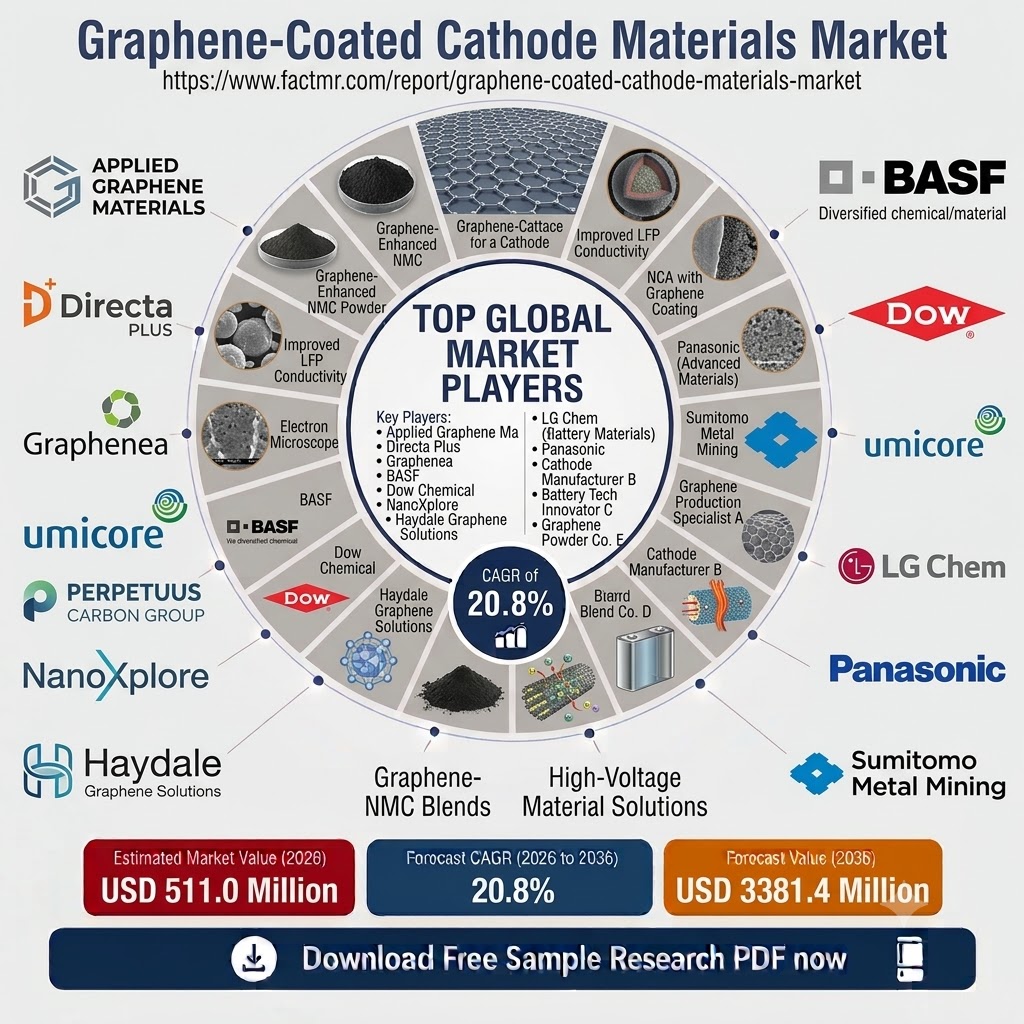
The global Graphene-Coated Cathode Materials Market is projected to expand from USD 511.0 million in 2026 to USD 3,381.4 million by 2036, registering a 20.8% CAGR during the forecast period. The market reached USD 423.0 million in 2025, with an absolute opportunity of USD 2,870.3 million expected between 2026 and 2036.
The market is gaining attention as battery developers work to improve conductive pathways and surface stability without disrupting established electrode manufacturing processes. Graphene-coated cathode materials are being evaluated for their ability to create conductive interfaces around active particles while supporting fast-charge, high-voltage, and cycle-life requirements.
Get Detailed Market Forecasts, Competitive Benchmarking, and Pricing Trends
EV Cells Create the Largest Application Opportunity
EV cells are estimated to account for 47.0% of the market in 2026, making electric mobility the leading application segment. Automotive battery programs increasingly require a combination of charging speed, conductivity, energy density, and long-term cycle performance.
The International Energy Agency reported that electric car sales exceeded 20 million in 2025, representing one-quarter of new cars worldwide. The same source reported global EV battery deployment of 1.2 TWh in 2025. This expanding battery base creates a larger qualification environment for advanced cathode materials.
Graphene-coated cathodes can be evaluated alongside conventional conductive-carbon approaches under controlled electrode density and charging conditions. For cell developers, comparable testing is important because material improvements need to translate into repeatable cell-level performance rather than laboratory results alone.
Graphene Shells Lead Coating Architectures
Among coating architectures, graphene shells on cathode particles are expected to hold a 39.0% share in 2026.
Particle-level graphene shells place a conductive layer around cathode active material. This architecture is designed to improve contact continuity while retaining the underlying cathode chemistry. Other approaches covered in the market include graphene conductive overcoats, graphene-binder hybrids, graphene-carbon composite layers, and functionalized graphene interfaces.
The commercial challenge extends beyond the material itself. Battery manufacturers need coating or additive formats that fit existing slurry, mixing, drying, and electrode-production steps. Changes to established processing conditions can lengthen qualification cycles.
NMC and Fast-Charge Programs Shape Demand
NMC is projected to represent 32.0% of the market in 2026, reflecting demand from high-energy cell programs where conductivity and surface stability are closely controlled.
NMC also provides an important setting for graphene interface development as battery teams evaluate high-voltage and high-nickel formulations. Consistent graphene coverage becomes more significant when cathode chemistry and operating conditions place greater demands on surface behavior.
By performance target, fast charge is anticipated to lead with a 36.0% share in 2026. Low-resistance conductive networks can support higher charging rates while controlling conductive-carbon loading. Cycle life, thermal stability, conductivity, and high-voltage protection remain additional performance targets.
Qualification Remains a Key Commercial Constraint
The commercial adoption of graphene-coated cathode materials depends on more than electrochemical performance. Battery manufacturers must establish consistent coating quality and demonstrate repeatable results at production scale.
Long battery-material qualification cycles remain a restraint, while coating uniformity becomes more challenging as production moves from laboratory quantities to tonnes. Graphene dispersion and feedstock consistency can also influence the repeatability of electrode formulations.
At the same time, pre-coated cathode active materials represent an opportunity because they can potentially simplify integration for cell manufacturers. LFP and LMFP conductive interfaces, along with grid and specialty cell qualification, provide additional avenues for market development.
France Leads Country Growth Through 2036
France is forecast to register the fastest growth among the five profiled countries, with a 23.4% CAGR from 2026 to 2036. South Korea follows at 22.5%, the United States at 21.6%, Japan at 20.1%, and Germany at 18.0%.
France’s electric-vehicle market and battery-manufacturing investment are expected to support local qualification activity. The country’s 2025 registrations included 331,200 new electric passenger cars, according to SDES.
South Korea’s concentrated battery manufacturing base provides another qualification environment, with electric vehicles accounting for 13% of new vehicle registrations in 2025, according to the country’s Ministry of Land, Infrastructure and Transport.
In the United States, hybrid, battery-electric, and plug-in hybrid vehicles together represented 24% of new light-duty vehicle sales in Q2 2026, according to the U.S. Energy Information Administration. Japan is targeting 150 GWh per year of battery manufacturing capacity from 2030 into the mid-2030s, while Germany had 55,665 public fast-charging points operating as of August 1, 2026.
Suppliers Compete on Coverage, Slurry Integration and Validation
The competitive environment includes companies working across cathode encapsulation, conductive additives, graphene dispersion, and battery-material integration.
Volexion, NanoXplore, GraphEnergy, Graphene Manufacturing Group (GMG), CARBON T&C, and HydroGraph are identified among the key companies profiled in the market.
Volexion focuses on conformal graphene encapsulation of lithium-ion cathode active materials. Argonne National Laboratory’s Chain Reaction Innovations reported in December 2025 that Volexion was shipping its first graphene-coated cathode active materials to tier-one manufacturers.
NanoXplore lists graphene-enhanced conductive additives for anode and cathode slurries. HydroGraph has documented collaboration with NEI Corporation involving graphene dispersions for battery-electrode conductivity. NEI’s technical documentation describes integration into existing electrode slurries for anode and cathode conductive applications.
These activities highlight the importance of process compatibility alongside material performance as suppliers move toward commercial battery programs.
Analyst View
Shambhu Nath Jha, Principal Consultant at Fact.MR, states:
“Commercialization is expected to depend on whether graphene improves a cathode while preserving established process conditions. Qualification is anticipated to favor uniform coverage and repeatable cell performance. Suppliers therefore need material control alongside electrochemical evidence.”
Report Coverage
The Fact.MR study covers graphene-enabled cathode interfaces used to modify conductivity and particle-surface behavior in lithium-ion cells. The assessment includes NMC, LFP, LMFP, high-nickel NCA/NCM, and next-generation manganese-rich chemistries.
Applications covered include EV cells, grid storage, consumer cells, power tools and mobility, and aerospace or specialty uses. The study evaluates coating architecture, cathode chemistry, performance target, application, and regional demand.
The analysis draws on 120+ sources, 35+ company portfolios, 25+ countries, and more than 20 industry interviews. Market estimates combine historical performance, demand indicators, pricing and volume trends, segment shares, company participation, country-level growth, adoption patterns, investment activity, and market barriers.
Other Reports:
Aero-Conformal ESA Antennas Market
Air-Breathing Electric Propulsion Market
Anti-Jamming MILSATCOM Systems Market
About Fact.MR
Fact.MR is a market research and consulting firm providing syndicated and customized research across industries and geographic markets. Its research combines primary interviews, secondary research, market modelling and validation to support business planning, competitive analysis and strategic decision-making.