Cleanroom robotics is transforming the way industries maintain precision, efficiency, and contamination-free environments. As sectors such as pharmaceuticals, biotechnology, and semiconductor manufacturing demand higher standards of cleanliness and accuracy, the adoption of robotic systems designed specifically for cleanroom environments is gaining significant momentum. These robots are engineered to operate with minimal particle generation, ensuring compliance with strict cleanliness standards while enhancing productivity.
Market Overview:
The cleanroom robotics market is driven by the increasing need for automation in controlled environments where even the smallest contamination can impact product quality. Cleanroom robots are designed with specialized materials, sealed joints, and smooth surfaces to prevent the accumulation and release of particles. They are widely used for tasks such as material handling, assembly, inspection, and packaging in environments that require stringent contamination control.
The growing complexity of manufacturing processes, particularly in electronics and healthcare industries, is encouraging the deployment of robotics to improve consistency and reduce human intervention. Automation not only minimizes the risk of contamination but also enhances operational efficiency by delivering precise and repeatable results. Additionally, advancements in robotics technology, including improved sensors and artificial intelligence, are enabling smarter and more adaptable cleanroom solutions.
Regional Insights:
North America holds a prominent position in the cleanroom robotics market due to its advanced healthcare infrastructure and strong presence of semiconductor and biotechnology industries. The region’s focus on innovation and automation is fostering the adoption of sophisticated robotic systems in controlled environments.
Europe is also a significant market, driven by stringent regulatory standards and a strong emphasis on product quality and safety. Industries across the region are increasingly investing in automation technologies to comply with regulatory requirements and maintain competitive advantages.
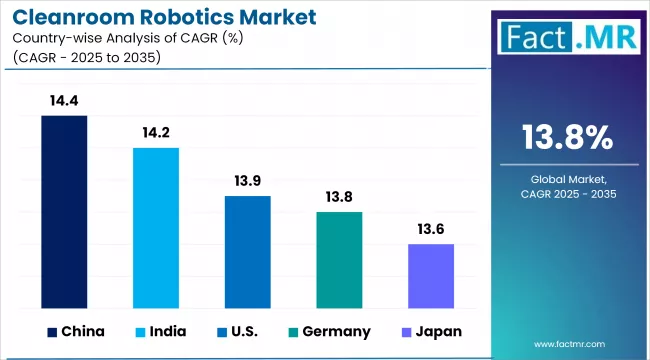
Asia-Pacific is emerging as a rapidly growing market for cleanroom robotics, supported by expanding manufacturing capabilities and rising investments in semiconductor production and pharmaceutical research. Countries in this region are focusing on enhancing production efficiency and quality, which is driving the demand for cleanroom automation solutions.
Key Trends & Developments:
One of the major trends in the cleanroom robotics market is the integration of advanced technologies such as artificial intelligence and machine learning. These technologies enable robots to perform complex tasks with higher accuracy, adapt to changing environments, and optimize processes in real time.
Another significant development is the increasing adoption of collaborative robots, or cobots, in cleanroom settings. These robots are designed to work alongside human operators, enhancing productivity while maintaining strict cleanliness standards. Cobots are particularly useful in applications that require a combination of human judgment and robotic precision.
Miniaturization and compact design are also gaining importance, especially in semiconductor and electronics manufacturing where space constraints are common. Manufacturers are developing smaller, more efficient robotic systems that can operate effectively within limited spaces without compromising performance.
Sustainability is becoming a key focus area, with companies aiming to reduce energy consumption and environmental impact. Energy-efficient robotic systems and eco-friendly materials are being incorporated into cleanroom robotics to align with global sustainability goals.
Applications & End-Use Outlook:
Cleanroom robotics finds extensive applications across industries that require contamination-free environments. In the pharmaceutical and biotechnology sectors, these robots are used for drug manufacturing, laboratory automation, and sterile packaging. Their ability to operate in controlled conditions ensures product integrity and compliance with regulatory standards.
In the semiconductor industry, cleanroom robots play a critical role in wafer handling, inspection, and assembly processes. The precision and cleanliness offered by these systems are essential for maintaining the quality of microelectronic components.
The healthcare sector also benefits from cleanroom robotics in applications such as medical device manufacturing and diagnostics. These robots help maintain sterile conditions, reducing the risk of contamination and ensuring patient safety.
Additionally, the food and beverage industry is adopting cleanroom robotics to enhance hygiene and meet stringent safety standards. Automated systems are being used for packaging and processing tasks, ensuring consistent quality and reducing the likelihood of contamination.
Conclusion:
The cleanroom robotics market is set to witness sustained growth as industries increasingly prioritize precision, efficiency, and contamination control. The integration of advanced technologies, coupled with the rising demand for automation in high-tech sectors, is driving the evolution of cleanroom robotics.
As regulatory requirements become more stringent and production processes grow more complex, the adoption of cleanroom robotic systems will continue to expand. Businesses that invest in these advanced solutions can enhance operational efficiency, maintain high-quality standards, and gain a competitive edge in their respective industries.
Browse Full Report – https://www.factmr.com/report/cleanroom-robotics-market