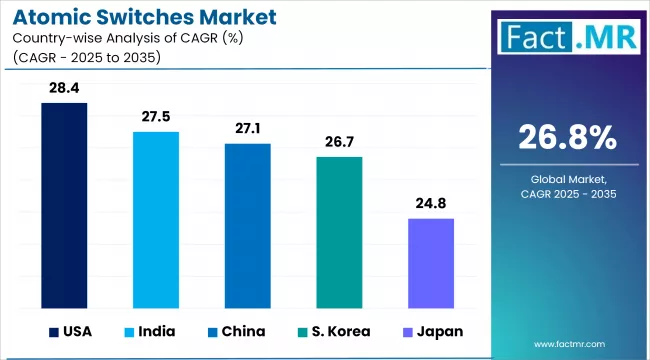
As the demand for faster, smaller, and more energy-efficient electronic devices continues to grow, the field of nanoelectronics is witnessing groundbreaking innovations. Among these, atomic switches are emerging as a transformative technology capable of redefining how electronic circuits operate at the nanoscale. These switches function by controlling electrical conductivity through the movement of atoms, offering unprecedented precision and efficiency. The atomic switches market is gaining traction as industries explore advanced computing architectures, neuromorphic systems, and next-generation memory devices.
Market Overview:
Atomic switches are nano-scale devices that operate by manipulating individual atoms or ions to create or break conductive pathways. Unlike conventional semiconductor switches, which rely on bulk material properties, atomic switches leverage quantum and electrochemical effects to enable ultra-low power consumption and high-speed operation.
The market is driven by the increasing need for miniaturization in electronic components. As traditional transistor technologies approach their physical limits, atomic switches present a viable alternative for continuing performance improvements. Their ability to operate at extremely small scales makes them ideal for integration into advanced integrated circuits and emerging computing systems.
Another key driver is the growing interest in neuromorphic computing, where systems are designed to mimic the human brain’s neural networks. Atomic switches can function as artificial synapses, enabling efficient data processing and learning capabilities in these systems. This has opened new avenues for research and commercialization in artificial intelligence hardware.
Regional Insights:
North America is a leading region in the atomic switches market, supported by strong research and development activities and the presence of advanced technology companies. Academic institutions and research organizations in the region are активно exploring nanoelectronic technologies, contributing to innovation and early adoption.
Europe is also a significant contributor, with a focus on collaborative research initiatives and funding programs aimed at advancing nanotechnology and semiconductor innovation. The region’s emphasis on sustainable and energy-efficient technologies aligns well with the capabilities of atomic switches.
The Asia-Pacific region is emerging as a key growth hub, driven by rapid advancements in semiconductor manufacturing and increasing investments in research and development. Countries in this region are активно working on next-generation electronics, positioning themselves as major players in the global market.
Key Trends & Forecast:
One of the most prominent trends in the atomic switches market is the shift toward energy-efficient computing. As data centers and electronic devices consume increasing amounts of energy, there is a growing need for technologies that can reduce power consumption. Atomic switches, with their ultra-low energy requirements, are well-suited to address this challenge.
Another significant trend is the integration of atomic switches into memory technologies. These devices are being explored for use in resistive random-access memory (ReRAM) and other advanced memory architectures, offering faster data processing and improved storage capabilities.
The development of hybrid systems that combine atomic switches with traditional semiconductor components is also gaining attention. This approach allows for gradual adoption while leveraging the strengths of both technologies.
Advancements in fabrication techniques are further driving market growth. Improved methods for controlling atomic movement and ensuring device stability are making atomic switches more reliable and scalable for commercial applications.
Applications & End-Use Outlook:
Atomic switches have a wide range of potential applications across various industries. In the electronics sector, they are being used to develop next-generation processors and integrated circuits that offer higher performance and lower power consumption.
In the field of artificial intelligence, atomic switches are playing a crucial role in enabling neuromorphic computing systems. These systems can process information more efficiently by mimicking the brain’s structure and function, making them ideal for applications such as pattern recognition, robotics, and autonomous systems.
The telecommunications industry is also exploring the use of atomic switches to enhance data transmission and network efficiency. Their ability to operate at high speeds and low power levels makes them suitable for advanced communication systems.
Additionally, atomic switches are being researched for use in sensors and other specialized الأجهزة, where precision and sensitivity are critical. Their nanoscale operation allows for highly accurate detection and measurement capabilities.
Challenges and Opportunities:
Despite their potential, the atomic switches market faces several challenges. One of the primary obstacles is the complexity of manufacturing and scaling these devices for массовое производство. Ensuring consistent performance and reliability at the atomic level requires advanced fabrication techniques and строгий quality control.
Another challenge is the need for further research and development to fully understand and optimize the behavior of atomic switches. While significant progress has been made, there are still technical hurdles to overcome before widespread commercialization can be achieved.
Cost considerations also play a role, as developing and producing these advanced devices can be expensive. Balancing cost with performance will be crucial for market adoption.
However, these challenges present significant opportunities for innovation. Continued investment in research and collaboration between academia and industry can ускорить development and bring new solutions to market. As technology matures, costs are expected to decrease, making atomic switches more accessible.
The growing demand for advanced computing and energy-efficient technologies provides a strong foundation for market growth. Companies that invest in innovation and strategic partnerships will be well-positioned to capitalize on emerging opportunities.
Conclusion:
The atomic switches market represents a significant خطوة forward in the evolution of nanoelectronics and advanced computing technologies. By enabling ultra-small, energy-efficient, and high-performance electronic components, atomic switches have the potential to transform multiple industries. As research and development efforts continue to advance, the market is expected to move closer to commercialization, unlocking new possibilities in computing, communication, and beyond. Organizations that embrace this инновационная technology will play a key role in shaping the future of electronics.
Browse Full Report – https://www.factmr.com/report/atomic-switches-market