The rapid expansion of unmanned aerial vehicles (UAVs), commonly known as drones, is reshaping industries ranging from agriculture and logistics to defense and surveillance. At the core of these advanced systems lie critical mechanical components that ensure smooth and efficient operation—among them, drone bearings. These small yet essential parts play a vital role in enabling rotational motion, reducing friction, and supporting high-speed performance. As drone adoption continues to accelerate, the drone bearing market is gaining significant attention for its contribution to reliability and operational efficiency.
Market Overview:
Drone bearings are specialized components designed to handle the unique demands of UAV systems, including high rotational speeds, lightweight construction, and resistance to varying environmental conditions. They are primarily used in motors, propellers, and other moving parts to ensure stability and precision during flight.
The market is driven by the increasing use of drones across commercial, industrial, and military applications. From aerial photography and mapping to package delivery and infrastructure inspection, drones are becoming indispensable tools. This growing utilization is fueling demand for high-quality bearings that can enhance performance, reduce maintenance needs, and extend the lifespan of drone systems.
Advancements in materials and manufacturing technologies are also playing a crucial role in market development. Manufacturers are focusing on producing lightweight, durable, and corrosion-resistant bearings that can withstand extreme temperatures and harsh operating environments. The integration of advanced ceramics and hybrid materials is further improving efficiency and performance.
Regional Insights:
North America remains a leading market for drone bearings, supported by strong investments in drone technology and a well-established aerospace and defense sector. The region’s focus on innovation and early adoption of UAV applications continues to drive demand for high-performance components.
Europe is experiencing steady growth, with increasing use of drones in commercial applications such as surveying, agriculture, and environmental monitoring. Regulatory frameworks supporting safe drone operations are also contributing to market expansion.
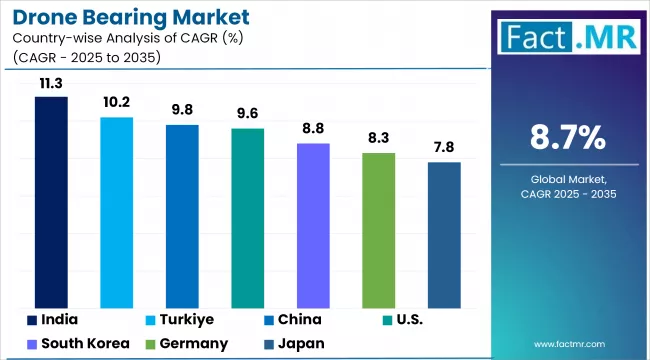
The Asia-Pacific region is emerging as a key growth area, driven by rapid industrialization, expanding drone manufacturing capabilities, and rising adoption across various sectors. Countries in this region are investing heavily in drone technology to enhance productivity and address challenges in agriculture, logistics, and infrastructure development.
Key Trends & Forecast:
One of the most notable trends in the drone bearing market is the shift toward lightweight and high-performance materials. Bearings made from advanced ceramics and hybrid combinations are gaining popularity due to their ability to reduce weight while maintaining strength and durability. This is particularly important for drones, where weight directly impacts flight time and efficiency.
Another significant trend is the increasing focus on precision engineering. As drones are used for more complex and sensitive applications, the demand for highly accurate and reliable components is growing. Precision bearings help ensure stable flight, minimize vibrations, and improve overall system performance.
The market is also witnessing the integration of smart technologies. Sensor-enabled bearings that can monitor performance and detect potential issues are becoming more prevalent. These innovations enable predictive maintenance, reducing downtime and enhancing operational reliability.
Additionally, the rise of autonomous drones is creating new opportunities for the market. As drones become more advanced and capable of operating without human intervention, the need for durable and maintenance-free components is increasing.
Applications & End-Use Outlook:
Drone bearings are used across a wide range of applications, reflecting the versatility of UAV technology. In the commercial sector, they are essential for drones used in aerial photography, surveying, mapping, and inspection services. These applications require smooth and stable operation to capture accurate data and high-quality images.
In agriculture, drones equipped with advanced bearings are used for crop monitoring, spraying, and field analysis. The ability to operate efficiently over large areas makes them valuable tools for modern farming practices.
The defense and security sector is another major end-user, relying on drones for surveillance, reconnaissance, and tactical operations. In these applications, reliability and performance are critical, driving demand for high-quality bearings that can withstand demanding conditions.
The logistics industry is also adopting drones for last-mile delivery services. Bearings play a crucial role in ensuring the efficiency and safety of these operations, supporting the movement of motors and propellers.
Challenges and Opportunities:
Despite its growth potential, the drone bearing market faces several challenges. One of the primary concerns is the need for continuous innovation to meet evolving performance requirements. As drones become more advanced, bearings must be designed to handle higher speeds, heavier payloads, and more complex operations.
Cost considerations can also be a barrier, particularly for high-performance materials such as ceramics. Balancing cost and performance is a key challenge for manufacturers aiming to serve a wide range of customers.
Additionally, the market must address issues related to standardization and quality assurance. Ensuring consistent performance across different applications and environments is essential for building trust and supporting widespread adoption.
However, these challenges also present opportunities for growth. Investments in research and development can lead to the creation of more efficient and cost-effective solutions. Collaboration between manufacturers, drone developers, and research institutions can drive innovation and accelerate market expansion.
Conclusion:
The drone bearing market is a critical component of the rapidly evolving UAV ecosystem. By enabling smooth motion, reducing friction, and supporting high-performance operations, bearings play a fundamental role in the success of drone technology. As industries continue to adopt drones for a wide range of applications, the demand for advanced bearing solutions is expected to grow. With ongoing innovation, technological advancements, and expanding use cases, the market is well-positioned to support the future of drone-driven transformation.
Browse Full Report – https://www.factmr.com/report/drone-bearing-market