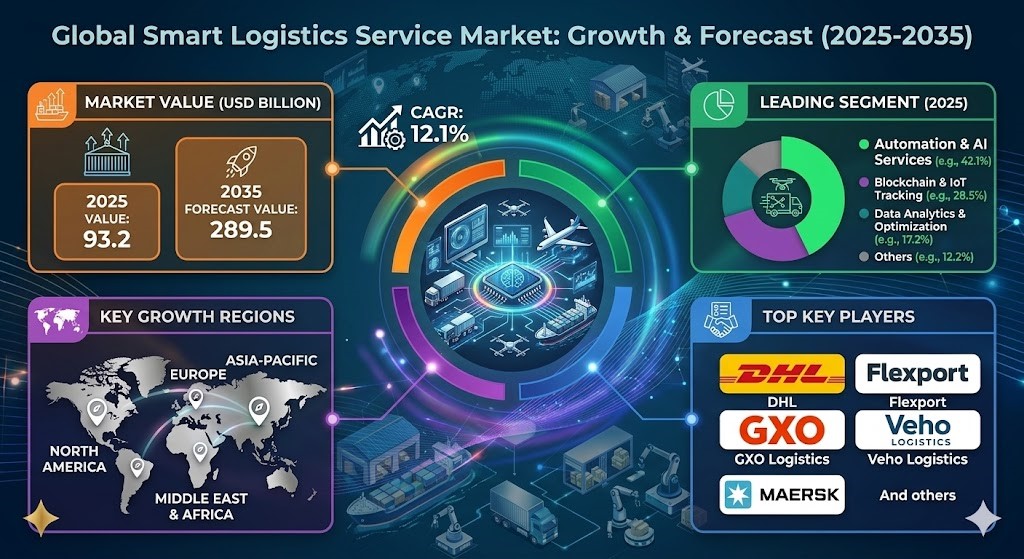
The logistics industry is undergoing a significant transformation as digital technologies reshape traditional supply chain operations. Smart logistics services are emerging as a key enabler of this evolution, integrating advanced technologies such as artificial intelligence, the Internet of Things (IoT), big data analytics, and automation to optimize efficiency and transparency. As global trade expands and customer expectations for faster deliveries increase, businesses are turning to smart logistics solutions to enhance operational performance and remain competitive in a rapidly changing market landscape.
Market Overview
Smart logistics services refer to the use of digital technologies and data-driven systems to streamline and automate logistics operations. These services encompass transportation management, warehouse automation, inventory tracking, and real-time monitoring of goods throughout the supply chain.
The growing complexity of global supply chains is driving the adoption of smart logistics solutions. Companies are increasingly seeking ways to reduce operational costs, minimize delays, and improve accuracy in order fulfillment. By leveraging real-time data and predictive analytics, smart logistics enables organizations to make informed decisions and respond quickly to disruptions.
Additionally, the rapid growth of e-commerce has significantly increased the demand for efficient logistics services. Consumers now expect faster and more reliable deliveries, prompting logistics providers to invest in advanced technologies that enhance speed and accuracy. Smart logistics platforms are helping businesses meet these expectations while improving overall supply chain visibility and coordination.
Regional Insights
North America is a leading market for smart logistics services, driven by the widespread adoption of advanced technologies and the presence of major logistics and e-commerce companies. The region’s well-developed infrastructure and strong focus on innovation are supporting the growth of smart logistics solutions.
Europe is also witnessing substantial adoption, particularly in countries such as Germany, the United Kingdom, and the Netherlands. The region’s emphasis on sustainability and efficient transportation systems is encouraging the integration of smart logistics technologies.
The Asia-Pacific region is emerging as a high-growth market, fueled by rapid industrialization, expanding e-commerce sectors, and increasing investments in digital infrastructure. Countries like China, India, and Japan are actively adopting smart logistics solutions to improve supply chain efficiency and support economic growth.
Meanwhile, regions such as Latin America and the Middle East & Africa are gradually embracing smart logistics services, driven by the need to modernize supply chain operations and improve connectivity across regions.
Key Trends & Forecast
The smart logistics service market is evolving rapidly, with several key trends shaping its future. One of the most prominent trends is the integration of artificial intelligence and machine learning into logistics operations. These technologies enable predictive analytics, demand forecasting, and route optimization, helping businesses improve efficiency and reduce costs.
Another significant trend is the increasing adoption of IoT devices for real-time tracking and monitoring. Sensors and connected devices provide valuable data on the location, condition, and status of goods, enhancing visibility across the supply chain. This capability is particularly important for industries dealing with perishable or high-value products.
Automation is also playing a critical role in transforming logistics operations. Automated warehouses, robotic picking systems, and autonomous vehicles are improving speed and accuracy while reducing reliance on manual labor.
Blockchain technology is gaining attention for its ability to enhance transparency and security in logistics processes. By providing a decentralized and tamper-proof record of transactions, blockchain helps build trust among stakeholders and reduces the risk of fraud.
Looking ahead, the market is expected to continue expanding as businesses increasingly adopt digital technologies to optimize their supply chains. The convergence of AI, IoT, and automation will drive further innovation, making smart logistics an essential component of modern supply chain management.
Applications & End-Use Outlook
Smart logistics services are widely used across various industries, each benefiting from improved efficiency and visibility.
In the e-commerce sector, smart logistics plays a crucial role in managing high volumes of orders and ensuring timely deliveries. Advanced tracking systems and automated warehouses help companies streamline operations and enhance customer satisfaction.
The manufacturing industry is leveraging smart logistics to optimize production processes and manage inventory more effectively. Real-time data and predictive analytics enable manufacturers to reduce downtime and improve supply chain coordination.
In the healthcare sector, smart logistics is essential for managing the distribution of medical supplies, pharmaceuticals, and vaccines. Accurate tracking and temperature monitoring ensure the safe and timely delivery of critical products.
The retail industry is also adopting smart logistics solutions to improve inventory management and enhance the customer experience. By integrating online and offline channels, retailers can provide seamless and efficient services.
Additionally, sectors such as automotive, food and beverage, and energy are utilizing smart logistics to improve operational efficiency and reduce costs. The versatility of these solutions makes them applicable across a wide range of industries.
Conclusion
The smart logistics service market is revolutionizing the way supply chains operate, offering intelligent solutions that enhance efficiency, transparency, and reliability. As businesses continue to navigate the challenges of global trade and rising customer expectations, the adoption of smart logistics technologies is becoming increasingly essential.
With ongoing advancements in artificial intelligence, IoT, and automation, smart logistics services are set to become a cornerstone of modern supply chain management. Organizations that invest in these solutions will be better equipped to optimize their operations, reduce costs, and deliver superior customer experiences.
As the demand for faster, smarter, and more sustainable logistics continues to grow, the smart logistics service market will play a pivotal role in shaping the future of global supply chains.
Browse Full Report – https://www.factmr.com/report/smart-logistics-service-market