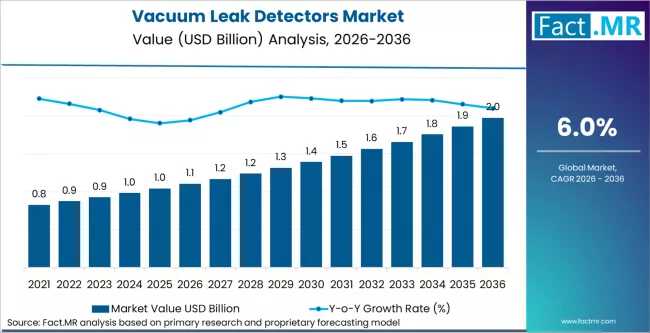
The global vacuum leak detectors market is projected to reach a valuation of USD 1.1 billion in 2026, expanding to USD 1.9 billion by 2036. This steady growth, representing a CAGR of 6.0%, is fueled by massive semiconductor fab expansions and the rapid rise of electric vehicle (EV) battery manufacturing requiring high-precision integrity testing.
global vacuum leak detectors market Quick Stats
Market size 2026? USD 1.1 billion.
Market size 2036? USD 1.9 billion.
CAGR? 6.0% (2026-2036).
Leading product segment(s) and shares? Helium Spray Probe Vacuum Leak Detectors hold a 38.0% share; Vacuum Leak Detectors for Automobile Manufacturing represent 27.0% of the market.
Leading modularity type and share? Portable Vacuum Leak Detectors account for 47.0% of the market.
Leading end use and share? Semiconductor and EV battery testing are primary drivers; Automobile Manufacturing holds a 27.0% share.
Key growth regions? China (8.8% CAGR), India (7.9% CAGR), and Germany (7.1% CAGR).
Top companies? INFICON, Agilent Technologies, Leybold GmbH (Atlas Copco), Edwards Vacuum (Atlas Copco), Pfeiffer Vacuum (Busch Group), YAMAHA Corporation, Cincinnati Test Systems, and ATEQ Corporation.
Market Momentum (YoY Path)
The Vacuum Leak Detectors Market follows a structurally well-supported expansion path. Following a valuation of over USD 1.0 billion in 2025, the market hits USD 1.1 billion in 2026. Growth continues steadily to USD 1.25 billion in 2028 and USD 1.41 billion in 2030. By 2031, the market is expected to reach USD 1.49 billion, climbing to USD 1.68 billion in 2033 and achieving its forecast peak of USD 1.9 billion in 2036.
Why the Market is Growing
The market is primarily driven by the semiconductor fab buildout, catalyzed by the US CHIPS Act and investments in Germany and India. Furthermore, the EV battery manufacturing surge requires mandatory leak testing for every battery cell housing. Innovations in multi-gas platforms and new product launches, such as cleanroom-optimized detectors, are expanding the addressable market while supporting premium pricing for high-specification systems.
Segment Spotlight
1) Test Type
Helium Spray Probe Vacuum Leak Detectors are estimated to hold a 38.0% share in 2026. This dominance is due to their ultra-high sensitivity (below $10^{-12} text{ mbar}cdottext{l/s}$) and the precise leak localization capabilities required in critical semiconductor and automotive applications.
2) Modularity Type
Portable Vacuum Leak Detectors account for approximately 47.0% of the market in 2026. This is driven by the practical necessity of moving instruments to installed equipment in semiconductor fabs, aerospace hangars, and HVAC testing sites, where stationary testing is often unfeasible.
3) Industry Focus
Automobile Manufacturing represents a 27.0% share in 2026. This segment is characterized by high-volume automated testing for components and the emerging demand for EV battery housing integrity, where systems like the LDS3000 support rising test points.
Drivers, Opportunities, Trends, Challenges
Drivers: The simultaneous investment cycles in semiconductor fabs, EV gigafactories, and aerospace MRO are the primary engines of growth. Legislative support like the US CHIPS Act and India’s Semiconductor Mission are creating localized demand for high-end helium leak detection infrastructure.
Opportunities: EV battery manufacturing presents a massive opportunity for hydrogen and helium accumulation systems. Manufacturers like Pfeiffer Vacuum are already targeting this with modular systems like the ASI 35, designed specifically for high-throughput battery cell housing testing in gigafactory environments.
Trends: There is a clear shift toward multi-gas capability and connectivity. New product launches, such as the SMART Spray handheld microdispenser, highlight a trend toward reducing tracer gas waste while improving sensitivity and testing speed through advanced signal processing.
Challenges: Growth is moderated by the high cost of helium tracer gas. This has led to the increasing penetration of multi-gas platforms that can substitute forming gas (hydrogen/nitrogen) for helium, which reduces operating costs for users but can compress revenue for traditional helium-only system providers.
Country Growth Outlook (CAGR)
Country CAGR (2026-2036)
China 8.8%
India 7.9%
Germany 7.1%
Brazil 6.8%
United States 5.9%
United Kingdom 5.3%
Browse Full Report : https://www.factmr.com/report/vacuum-leak-detectors-market
Competitive Landscape
The Vacuum Leak Detectors Market is concentrated in high-specification sectors like semiconductors and fragmented in standard industrial uses. INFICON leads in high-sensitivity detection with its UL3000 Fab and SMART Spray systems. Pfeiffer Vacuum (Busch Group) maintains a strong position in portable and accumulation testing. Other key players include Agilent Technologies, Leybold, and Edwards Vacuum. Competitive advantage is increasingly tied to sensor technology, signal processing software, and securing qualification for semiconductor and aerospace protocols.