The global grow light market is rapidly gaining traction as controlled environment agriculture (CEA), indoor farming, and vertical farming become mainstream approaches to food production and horticulture. Grow lights—specialized lighting solutions that supplement or replace natural sunlight—are increasingly essential for plant cultivation in spaces where natural light is unavailable or insufficient. Fueled by technological advancements, sustainability goals, and evolving agricultural needs, the grow light industry is poised for significant expansion in the coming decade.
What Are Grow Lights?
Grow lights are artificial lighting systems designed to support plant photosynthesis in environments lacking adequate natural light. These systems provide specific light spectra that align with the biological needs of plants at various growth stages, enabling growers to optimize plant health, yield, and quality. Grow lights are used across a broad range of settings—from commercial greenhouses and high-tech vertical farms to research labs and residential setups.
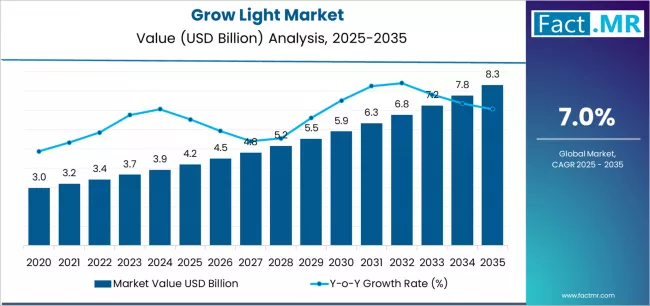
Market Growth and Forecast
The global grow light market is expected to witness strong growth over the next decade, supported by the increasing shift toward modern agricultural practices. As climate uncertainty, shrinking arable land, and rising population pressures challenge traditional farming, growers are turning to controlled environments that allow consistent production regardless of weather conditions.
Grow lights play a critical role in extending crop cycles, improving productivity, and ensuring predictable harvests. Their ability to create ideal growing conditions makes them an indispensable tool for commercial growers seeking higher efficiency and profitability. The steady adoption of advanced farming techniques indicates a promising outlook for the industry.
Key Market Drivers
Rise of Indoor and Vertical Farming
One of the most influential drivers of the grow light market is the expansion of indoor farming and vertical agriculture. These innovative cultivation methods allow crops to be grown in stacked layers or enclosed environments, removing dependence on seasonal changes and geographic limitations.
Grow lights are fundamental to these systems because they replicate optimal sunlight conditions while allowing precise control over light intensity and duration. This capability helps farmers produce crops closer to urban centers, reduce transportation costs, and minimize food waste.
Technological Advancement and LED Dominance
Rapid technological progress—particularly in light-emitting diode (LED) technology—is transforming the grow light landscape. LED grow lights are widely preferred due to their energy efficiency, long operational life, and ability to deliver tailored light spectra for different plant species and growth phases.
Unlike traditional lighting technologies, LEDs generate less heat, lowering cooling requirements and reducing overall operational expenses. Their adaptability enables growers to fine-tune lighting strategies, ultimately enhancing crop quality and yield while supporting sustainability initiatives.
Demand for Year-Round Cultivation and Food Security
Global concerns surrounding food security are accelerating the adoption of grow lights. With extreme weather events and climate variability affecting outdoor agriculture, controlled farming environments offer a reliable alternative for consistent food production.
Grow lights empower growers to cultivate crops throughout the year, ensuring stable supply chains and helping meet the dietary needs of expanding populations. This reliability is particularly valuable in regions where agricultural productivity is constrained by environmental factors.
Smart Integration and IoT Adoption
The integration of smart technologies and Internet of Things (IoT) capabilities is emerging as a significant trend in the grow light market. Modern lighting systems increasingly incorporate sensors and automated controls that monitor plant health, humidity, temperature, and energy consumption.
These intelligent systems provide actionable insights, enabling growers to make real-time adjustments that optimize plant growth while reducing resource usage. Data-driven cultivation is quickly becoming a cornerstone of next-generation agriculture.
Segmentation and Applications
The grow light market can be categorized across several dimensions, including technology, application, and light spectrum.
- By Technology: LED, high-pressure sodium (HPS), fluorescent, and other lighting solutions.
- By Application: Indoor vertical farms, commercial greenhouses, research facilities, and residential cultivation.
- By Spectrum: Full-spectrum, tunable-spectrum, and single-band lighting options.
Full-spectrum lighting is gaining strong popularity because it supports plants throughout their entire growth cycle—from germination to flowering—making it a versatile choice for diverse cultivation needs.
Regional Insights
The grow light market demonstrates varied growth patterns across regions, reflecting differences in agricultural infrastructure and technology adoption.
North America remains a major contributor due to its well-established controlled environment agriculture ecosystem and strong investment in agri-tech innovation.
Europe is witnessing steady adoption, supported by advanced greenhouse practices and a growing focus on sustainability and resource efficiency.
Asia-Pacific is emerging as a high-growth region, driven by rapid urbanization, limited farmland, and increasing demand for modern agricultural solutions. Governments and private players alike are investing in smart farming technologies to strengthen food resilience.
Competitive Landscape
Leading companies in the grow light market are prioritizing research, innovation, and strategic collaborations to maintain a competitive edge. Manufacturers are focusing on improving spectral precision, enhancing energy efficiency, and integrating smart features into their lighting systems.
Many providers are also developing customizable solutions tailored to specific crops and farming environments, helping growers achieve higher productivity while managing operational costs effectively.
Challenges and Opportunities
Despite its promising outlook, the grow light market faces certain challenges. High upfront costs associated with advanced lighting systems can discourage adoption among small-scale growers. Additionally, energy consumption remains a concern in regions with elevated electricity prices.
However, these challenges present opportunities for innovation. The continued transition toward energy-efficient LEDs, combined with advances in automation and lighting controls, is expected to lower long-term costs and expand accessibility. As technology becomes more affordable, adoption is likely to accelerate across both commercial and residential sectors.
Conclusion
The grow light market is at the forefront of an agricultural transformation, enabling growers to produce more efficiently while reducing dependence on natural environmental conditions. Driven by technological innovation, sustainability goals, and the rapid expansion of indoor farming, grow lights are becoming a cornerstone of modern horticulture.
As agriculture evolves to meet the demands of a growing global population, the importance of controlled cultivation will only increase. Grow light technologies are well-positioned to support this shift, delivering solutions that enhance productivity, conserve resources, and shape the future of food production.
Browse Full Report – https://www.factmr.com/report/grow-light-market