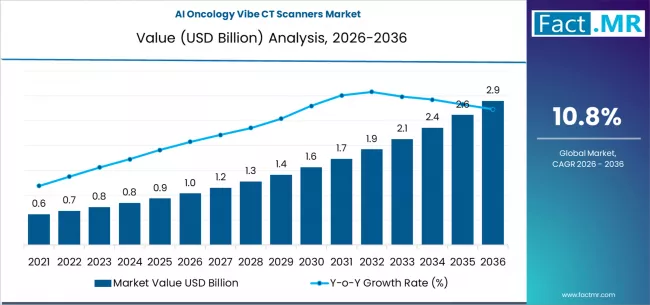
The global AI Oncology Vibe CT Scanners market is entering a decade of sustained expansion, driven by rapid advances in artificial intelligence (AI), rising global cancer incidence, and the healthcare industry’s shift toward precision diagnostics. The market is valued at approximately USD 1.0 billion in 2026 and is projected to reach USD 3.0 billion by 2036, expanding at a compound annual growth rate (CAGR) of around 10.8% during the forecast period.
Market Overview
AI Oncology Vibe CT scanners represent a new generation of computed tomography systems specifically optimized for oncology applications. These systems integrate AI-driven image reconstruction, workflow automation, and advanced analytics to improve tumor detection, staging, and treatment planning. Compared with conventional CT scanners, AI-enabled oncology CT systems deliver higher image clarity at lower radiation doses, faster scan times, and improved diagnostic confidence—key requirements in cancer care pathways.
The strong outlook for this market aligns with broader trends in medical imaging. Within this context, oncology-focused AI CT scanners are emerging as one of the fastest-growing subsegments of the imaging market.
Market Size and Growth Forecast (2026–2036)
Between 2026 and 2036, the AI Oncology Vibe CT Scanners market is projected to nearly triple in value. Estimates indicate steady annual gains, with the market reaching approximately USD 1.4 billion by 2028, USD 1.8 billion by 2030, and crossing USD 2.0 billion by 2031, before accelerating toward the USD 3.0 billion mark by 2036.
This growth is underpinned by:
-
Increasing adoption of AI in diagnostic imaging to reduce radiologist workload and interpretation errors.
-
Rising global cancer burden, particularly in aging populations.
-
Expansion of cancer treatment centers and advanced imaging infrastructure in emerging economies.
-
Integration of AI-enabled CT systems into precision oncology and personalized treatment workflows.
Market Segmentation Insights
By Application, oncology diagnosis and staging dominates the market, accounting for approximately 51% of total revenue. AI-driven CT scanners are increasingly used for early tumor detection, accurate staging, and therapy response monitoring, making them indispensable in modern oncology practices.
By Technology, AI-assisted image reconstruction is the leading segment, holding nearly 38% market share. These solutions enhance image quality while minimizing radiation exposure, a critical factor for oncology patients who require repeated imaging over the course of treatment.
By End User, cancer treatment centers represent the largest customer base, contributing around 43% of market demand. Hospitals, diagnostic imaging centers, and academic research institutions also form key end-user segments, particularly in regions investing heavily in oncology infrastructure.
Regional Outlook
North America currently leads the AI Oncology Vibe CT Scanners market, supported by advanced healthcare systems, early technology adoption, and high oncology imaging volumes. The region benefits from strong investments in AI-driven medical imaging and the presence of major industry players.
Asia-Pacific is expected to be the fastest-growing regional market from 2026 to 2036. Rapid expansion of healthcare infrastructure, increasing cancer prevalence, and government initiatives to modernize diagnostic capabilities in countries such as China and India are key growth drivers. India is one of the most promising growth markets during the forecast period.
Competitive Landscape
The competitive landscape of the AI Oncology Vibe CT Scanners market is characterized by the presence of global medical technology leaders and specialized AI imaging innovators. Key players include Siemens Healthineers, GE Healthcare, and Medtronic, all of which are actively integrating AI capabilities into their CT imaging portfolios.
Leading companies are focusing on:
-
Developing AI algorithms for automated tumor detection and segmentation.
-
Enhancing low-dose imaging technologies to improve patient safety.
-
Strategic partnerships with AI software providers and oncology solution developers.
-
Continuous R&D investment to differentiate products in a highly competitive environment.
Siemens Healthineers, for example, has positioned itself at the forefront of AI-enabled CT innovation, leveraging advanced imaging platforms and AI-assisted workflows to support precision oncology applications.
Future Growth Outlook
Looking ahead to 2036, the AI Oncology Vibe CT Scanners market is expected to benefit from the broader expansion of the AI in oncology ecosystem, which is forecast to grow rapidly through the mid-2030s. As AI becomes more deeply embedded across cancer diagnostics, treatment planning, and monitoring, demand for intelligent imaging platforms will continue to rise.
Technological advancements such as deep learning–based image analysis, cloud-enabled imaging platforms, and integration with multimodal diagnostics are expected to further enhance the value proposition of AI oncology CT scanners. Combined with increasing awareness of early cancer detection and precision medicine, these factors position the market for robust, long-term growth.
Browse Full Report : https://www.factmr.com/report/ai-oncology-vibe-ct-scanners-market
About the Market
The AI Oncology Vibe CT Scanners market represents a critical intersection of artificial intelligence and advanced medical imaging, addressing the growing need for accurate, efficient, and patient-centric cancer diagnostics. With strong fundamentals, accelerating adoption, and continuous innovation, the market is set to play a pivotal role in shaping the future of oncology care between 2026 and 2036.