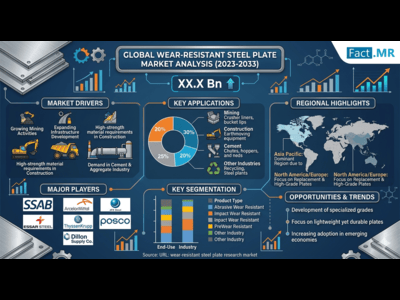
The global wear resistant steel plate (WRSP) market is witnessing a steady upward trajectory, projected to grow from US$ 31.46 billion in 2024 to US$ 46.58 billion by 2034. According to a detailed industry report by Fact.MR, this 4% CAGR is being fueled by an urgent need to extend the lifespan of heavy-duty machinery in the face of harshening operational environments across the mining, construction, and agriculture sectors.
As global infrastructure projects become increasingly complex and “behemoth” in scale—particularly in the Middle East and Asia Pacific—demand for high-strength low-alloy (HSLA) steel is spiking. These advanced materials, often three times harder than mild steel, are proving essential for reducing equipment downtime and optimizing fuel efficiency through significant weight reduction.
Quick Stats: Wear Resistant Steel Plate Market at a Glance
- Market Value (2024E): US$ 31.46 Billion
- Projected Value (2034F): US$ 46.58 Billion
- Global Growth Rate: 4% CAGR (2024–2034)
- Leading Segment: Mining Industry (US$ 19.23 Billion by 2034)
- High-Growth Region: East Asia (37.4% market share by 2034)
- Key Product Trend: AR400 Demand (4% CAGR)
Strategic Drivers: Mining Longevity and Agricultural Resilience
The shift toward specialized, abrasion-resistant alloys is transforming industrial maintenance from a reactive to a proactive strategy.
Maximizing Mining Lifespan:
The mining sector remains the primary consumer of WRSP, with a projected segment value of US$ 19.23 billion by 2034. Industry leaders are integrating AR400 and A514 plates into excavators, dump trucks, and silos to withstand the constant pouring and sliding of mineral ores. By shielding machinery from deterioration, these plates significantly lower maintenance costs and increase payload capacity.
Agricultural and Waste Management Demand:
In agriculture, the frequency of wear-part replacement is being drastically reduced by the use of wear resistant steel in field equipment. Furthermore, its resistance to acidic and corrosive environments has made it the preferred metal for municipal garbage trucks and industrial waste containers, where surfaces are regularly exposed to harsh chemical conditions.
Regional Performance: East Asia Dominates; Middle East Pivots
While East Asia maintains its manufacturing and consumption lead, the Middle East is emerging as a critical growth hub due to a shift away from oil-based revenue.
| Country/Region | 2034 Forecast Value | Growth Catalyst |
| East Asia | 37.4% Market Share | Dominant production hub; high integration of AI and IIoT in steel manufacturing. |
| United States | US$ 6.77 Billion | Momentum in large-scale infrastructure and high-tonnage mining activities. |
| South Korea | US$ 4.59 Billion | Strong demand for high-strength steel in the heavy machinery and automotive sectors. |
| Japan | US$ 4.4 Billion | Strict environmental regulations driving the use of HSLA steel to lower vehicle weight. |
Category Insights: The Versatility of A514 Steel
- A514 Steel Plates (US$ 14.95 Billion by 2034): Widely preferred for their excellent machinability and weldability, A514 quenched and tempered (Q&T) steel is the standard for crane booms, lifting equipment, and welded bridges. Its ability to withstand heavy impacts makes it indispensable for high-stakes construction and hauling tasks.
- AR400 Plates: This segment continues to see robust growth at a 4% CAGR, particularly for lining chutes and deflectors where constant abrasion is a primary concern.
Innovation & Competition: AI-Driven Steel and the Aluminum Challenge
The market is facing new competition from aluminum, which is gaining ground in the automotive and food sectors due to its lightweight and recyclable nature. To maintain an edge, steel startups are turning to digital transformation. German startup Mecorad, for instance, is using the Industrial Internet of Things (IIoT) for in-line precise measurement and automation, minimizing manufacturing loss and ensuring high-quality hot metal forming.
Recent Industry Moves:
- China Baowu Steel Group recently solidified its market position by acquiring a 51% stake in Xinsteel, reflecting a trend of consolidation among the world’s largest producers.
- Industry leaders like SSAB AB, Nippon Steel, and Thyssenkrupp AG are increasingly focusing on “non-legacy” markets through strategic collaborations and strengthening global distribution networks.
Analyst Opinion:
“We are entering an era of ‘Intelligent Metallurgy.’ The integration of AI and ML isn’t just a trend; it’s a requirement for producing the next generation of wear resistant plates that are thinner, lighter, and harder. While alternative metals like aluminum are popular for light-duty tasks, the heavy-duty world of mining and construction still belongs to high-strength steel.” — Senior Analyst, Fact.MR
Browse Full Report: https://www.factmr.com/report/522/wear-resistant-steel-plate-market