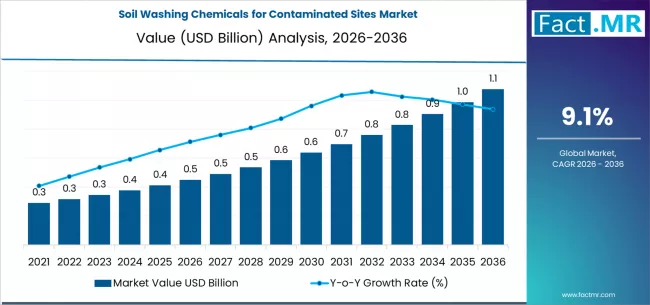
Rising industrial activity, urban expansion, and legacy pollution have increased the number of contaminated sites worldwide, creating an urgent need for effective soil remediation solutions. In this context, the soil washing chemicals for contaminated sites market is gaining traction as governments and environmental agencies prioritize land restoration and sustainable remediation practices. Soil washing has emerged as a practical approach for removing hazardous contaminants while preserving soil usability.
As environmental regulations become more stringent and redevelopment of polluted land accelerates, demand for efficient and environmentally responsible soil washing chemicals continues to grow.
Market Overview:
Soil washing chemicals are specialized formulations used to separate and remove contaminants such as heavy metals, hydrocarbons, pesticides, and industrial residues from polluted soil. These chemicals work by enhancing the solubility or mobilization of contaminants, allowing them to be washed away from soil particles during treatment.
The soil washing process is widely recognized for its effectiveness in treating heavily contaminated sites, including former industrial zones, mining areas, landfills, and military sites. Compared to traditional excavation and disposal methods, soil washing offers the advantage of reducing waste volume and enabling soil reuse, making it an attractive remediation option.
Regional Insights:
Regions with a high concentration of legacy industrial sites and strong environmental enforcement are leading the adoption of soil washing chemicals. North America remains a prominent market due to extensive remediation programs and ongoing redevelopment of brownfield sites. Europe follows closely, driven by strict environmental regulations and increasing focus on land rehabilitation and circular economy principles.
The Asia-Pacific region is emerging as a significant growth area as rapid industrialization has led to increased soil contamination in several countries. Governments in the region are strengthening environmental policies and investing in remediation technologies to address pollution and support sustainable urban development.
Key Trends & Forecast:
- Increasing preference for in-situ and on-site remediation technologies
- Growing adoption of environmentally friendly and biodegradable soil washing agents
- Rising focus on cost-effective remediation methods that enable soil reuse
- Integration of soil washing with other remediation technologies for improved efficiency
- Collaboration between chemical suppliers, environmental consultants, and remediation contractors
These trends indicate a shift toward holistic and sustainable approaches to contaminated site management.
Applications & End-Use Outlook:
Soil washing chemicals are widely used in the remediation of contaminated industrial sites, mining areas, construction sites, and agricultural land affected by chemical residues. These solutions are particularly effective in treating soils contaminated with metals, petroleum hydrocarbons, and persistent organic pollutants.
End users include government agencies, environmental remediation firms, construction companies, and industrial site owners responsible for site cleanup and redevelopment. The growing demand for brownfield redevelopment and infrastructure expansion is further driving the adoption of soil washing technologies and associated chemicals.
Technological Advancements and Innovation:
Innovation plays a crucial role in the soil washing chemicals market. Manufacturers are developing advanced formulations that improve contaminant removal efficiency while minimizing environmental impact. These include chelating agents, surfactants, and pH-adjusting chemicals designed for targeted remediation.
Research efforts are also focused on enhancing compatibility with different soil types and contaminant profiles. Advances in process optimization and equipment design are enabling more efficient soil washing operations, reducing treatment time and operational costs.
Competitive Landscape and Strategic Developments:
The market features a diverse mix of global chemical manufacturers and specialized environmental solution providers. Companies are investing in research and development to expand their product offerings and address complex contamination challenges.
Strategic initiatives include partnerships with environmental engineering firms, participation in government remediation projects, and development of customized soil washing solutions. Suppliers that offer technical expertise and comprehensive remediation support are well-positioned to strengthen their market presence.
Future Outlook:
The future of the soil washing chemicals for contaminated sites market is closely tied to global efforts to restore polluted land and protect ecosystems. As environmental awareness increases and regulatory frameworks tighten, demand for effective soil remediation solutions is expected to remain strong.
Continued innovation, increased investment in remediation infrastructure, and adoption of integrated treatment approaches will further support market growth. Soil washing chemicals will continue to play a vital role in sustainable land management and environmental restoration.
Conclusion:
Soil washing chemicals for contaminated sites represent an important tool in modern environmental remediation strategies. By enabling efficient removal of hazardous contaminants and supporting soil reuse, these solutions contribute to sustainable land restoration and redevelopment. Access to comprehensive market insights can help stakeholders navigate evolving trends and implement effective remediation solutions in an increasingly environmentally conscious landscape.
Browse Full Report – https://www.factmr.com/report/soil-washing-chemicals-for-contaminated-sites-market