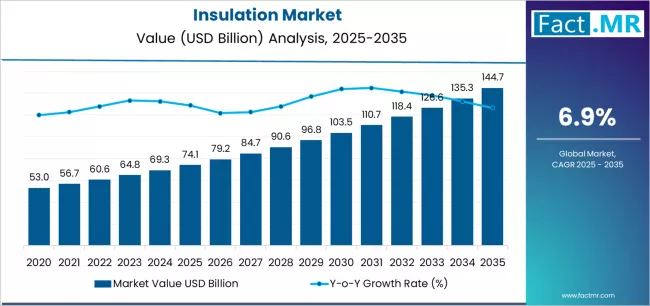
The insulation market is experiencing significant growth as building owners, industrial operators, and developers focus on energy efficiency, operational cost reduction, and sustainable construction practices. Modern insulation materials provide superior thermal resistance, moisture management, and fire safety, enabling buildings and industrial facilities to meet regulatory requirements while optimizing energy consumption. The rising adoption of green building certifications, climate control standards, and energy-saving initiatives further reinforces the market’s expansion.
Market Overview:
Insulation materials encompass a variety of products, including expanded polystyrene (EPS), glass wool, mineral wool, extruded polystyrene (XPS), and other specialized solutions. EPS dominates the market due to its versatile applications, cost-effectiveness, and reliable thermal performance. Glass wool and mineral wool provide additional benefits such as acoustic insulation, fire resistance, and suitability for residential, commercial, and industrial applications.
Insulation materials are increasingly integrated into new construction projects, retrofitting programs, and industrial facilities to improve energy efficiency, reduce utility costs, and enhance indoor comfort. Transportation applications, including automotive thermal management and cold chain logistics, also contribute to market growth by enabling temperature-controlled operations and energy conservation.
Regional Insights:
Asia-Pacific is witnessing the fastest growth in insulation demand, driven by rapid urbanization, large-scale infrastructure development, and expanding construction activities. China and India are leading the region with extensive residential and commercial building projects, along with cold chain logistics expansion. North America focuses on energy code compliance, building retrofits, and sustainability initiatives, while Europe emphasizes green building certifications and strict building energy regulations. Latin America, the Middle East, and Africa present emerging opportunities for insulation adoption in residential and industrial construction projects.
Key Trends & Drivers:
Several factors are influencing the insulation market:
- Energy Efficiency and Regulatory Compliance:Modern insulation materials help meet increasingly stringent building codes and sustainability mandates, reducing energy consumption and carbon footprints.
- Green Building Certifications:Certifications such as LEED and BREEAM encourage the use of high-performance insulation solutions in residential and commercial construction.
- Technological Innovation:Advancements in materials, including aerogel-based super-insulation and vacuum insulation panels, support high-performance applications in space-constrained installations.
- Retrofit Programs:Aging building stock creates opportunities for insulation upgrades, improving thermal efficiency and operational cost savings.
- Sustainability Focus:Manufacturers are increasingly integrating recycled content and circular economy principles into insulation products.
Applications & End-Use Outlook:
Infrastructure remains the dominant end-use segment, encompassing residential buildings, commercial complexes, and industrial facilities. EPS and glass wool are widely applied in walls, roofs, foundations, and construction boards, providing reliable thermal performance and structural compatibility. Transportation applications, including automotive and cold chain logistics, are growing due to temperature-sensitive operations and energy management needs. Industrial facilities benefit from insulation in process systems, HVAC, and equipment to reduce energy losses and maintain operational efficiency.
Technological Developments:
Technological innovation is transforming the insulation market. EPS products now feature enhanced flame retardancy, improved compressive strength, and moisture resistance, ensuring long-term performance in diverse construction applications. Glass wool and mineral wool combine thermal insulation with acoustic benefits, making them suitable for high-comfort residential and commercial environments. Advanced solutions such as aerogel-based panels and vacuum insulation materials provide ultra-high thermal resistance in limited spaces, supporting energy-efficient and sustainable building designs.
Market Opportunities:
The insulation market offers several growth opportunities:
- High-Performance Construction:Increasing demand for passive houses and net-zero energy buildings drives adoption of advanced insulation solutions.
- Energy-Efficient Retrofits:Upgrading existing building stock improves energy efficiency and meets regulatory compliance.
- Emerging Market Expansion:Rapid urbanization and industrialization in Asia-Pacific, Latin America, and the Middle East provide new market potential.
- Sustainability Initiatives:Eco-friendly insulation materials and recycled-content solutions meet growing environmental and regulatory expectations.
- Specialized Applications:High-performance insulation for transportation, cold storage, and industrial systems supports energy management and operational efficiency.
Conclusion:
The insulation market is poised for steady growth, driven by energy efficiency demands, regulatory compliance, green building initiatives, and technological innovation. EPS dominates the market due to its versatility, cost-effectiveness, and consistent thermal performance, while glass wool, mineral wool, and advanced insulation solutions provide additional benefits in acoustics, fire safety, and specialized applications. Regional dynamics, retrofit programs, and emerging construction markets present sustained opportunities for manufacturers and suppliers. With increasing emphasis on sustainable building practices, energy conservation, and operational cost reduction, insulation remains a critical component of modern construction and industrial applications worldwide.
Browse Full Report – https://www.factmr.com/report/insulation-market