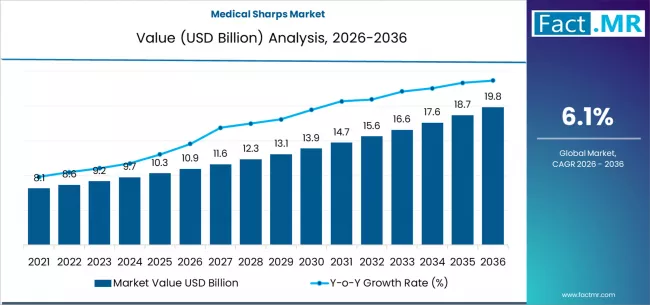
The global medical sharps market is poised for sustained expansion between 2026 and 2036, driven by rising healthcare utilization, increasing focus on occupational safety, and continuous innovation in medical device design. Medical sharps—such as needles, syringes, lancets, and scalpels—are fundamental to modern healthcare delivery, supporting applications ranging from routine injections and diagnostics to complex surgical procedures. As healthcare systems expand in scale and complexity, the demand for safer, more efficient, and environmentally responsible sharps solutions is accelerating worldwide.
Market Growth Dynamics and Demand Fundamentals
Over the next decade, the medical sharps market is projected to grow steadily, supported by a consistent increase in the volume of medical procedures performed globally. Chronic diseases remain a major demand catalyst. Conditions such as diabetes, cancer, autoimmune disorders, and cardiovascular diseases require frequent injections, blood sampling, and minimally invasive interventions, all of which rely heavily on medical sharps. The global diabetic population alone continues to rise annually, directly translating into higher consumption of insulin delivery needles and lancets.
Demographic trends further reinforce this growth outlook. The global population aged 60 years and above is expanding rapidly, leading to higher hospitalization rates, long-term care needs, and greater utilization of injectable therapies. In parallel, expanding access to healthcare services in emerging economies is increasing procedural volumes in both public and private healthcare facilities, contributing to a broader and more resilient demand base for medical sharps.
Vaccination programs also remain a structurally important growth driver. Routine childhood immunizations, adult booster programs, and large-scale public health initiatives collectively account for billions of injections each year. Even outside of emergency scenarios, preventive healthcare strategies are ensuring consistent, long-term demand for single-use needles and syringes.
Regulatory Environment Elevating Market Value
Regulatory frameworks aimed at reducing needlestick injuries and improving medical waste management are reshaping the medical sharps market. Healthcare workers face ongoing risks from accidental needle injuries, which can lead to the transmission of bloodborne pathogens and significant economic costs related to treatment, compensation, and lost productivity.
As a result, regulatory bodies across developed and developing regions are enforcing stricter standards for sharps safety and disposal. Mandatory adoption of safety-engineered sharps in hospitals and clinical settings is increasing the average selling price of products while improving overall safety outcomes. These regulations are not only influencing purchasing decisions but are also accelerating the phase-out of conventional, non-safety sharps in favor of advanced alternatives.
Compliance requirements related to sharps disposal are also driving demand for compatible products and systems. Healthcare facilities are increasingly accountable for the full lifecycle of sharps, from point of use to final disposal, creating opportunities for manufacturers that offer compliant, integrated solutions.
Innovation as a Core Competitive Differentiator
Innovation remains central to long-term competitiveness in the medical sharps market. Product development efforts are increasingly focused on enhancing safety without compromising usability or efficiency. Retractable needles, automatic needle shielding, and passive safety mechanisms that activate without additional user steps are becoming widely adopted across hospitals and diagnostic centers.
In addition to safety, sustainability is emerging as a key innovation driver. The volume of medical waste generated globally is increasing, prompting healthcare providers to seek solutions that reduce environmental impact. Manufacturers are responding with lighter-weight designs, reduced plastic content, and materials that are more compatible with recycling or advanced waste treatment technologies. While patient and worker safety remains the primary purchasing criterion, sustainability considerations are gaining influence in procurement decisions, particularly among large healthcare systems.
Digitalization is also beginning to influence the sharps ecosystem. Smart sharps containers and tracking technologies are being developed to monitor fill levels, usage frequency, and disposal timelines. These solutions support better compliance, reduce overflow risks, and align with broader digital health and hospital automation initiatives.
Product Segment Trends: Safety Sharps Gain Momentum
Single-use medical sharps dominate the market by volume, reflecting strict infection control standards and the global shift away from reusable devices. Disposable needles and syringes are now standard across most healthcare settings, supported by their cost-effectiveness, ease of use, and reduced contamination risk.
Within this category, safety-engineered sharps represent the fastest-growing segment. Hospitals, ambulatory surgical centers, and large healthcare networks are increasingly prioritizing these devices to protect staff and reduce liability exposure. Although safety sharps typically carry a higher upfront cost, their long-term economic benefits—through reduced injury rates and associated costs—are driving widespread adoption. As manufacturing scales improve and competition intensifies, price gaps between conventional and safety sharps are narrowing, further accelerating market penetration.
Regional Outlook: Emerging Markets Drive Incremental Growth
From a regional perspective, North America and Europe remain high-value markets characterized by advanced healthcare infrastructure, strong regulatory enforcement, and high adoption of safety-engineered sharps. Growth in these regions is primarily driven by replacement demand, technological upgrades, and incremental innovation.
Asia-Pacific, however, is expected to deliver the fastest growth over the 2026–2036 period. Rapid urbanization, expanding healthcare infrastructure, and rising public and private healthcare expenditure are significantly increasing medical procedure volumes across the region. As safety regulations evolve and awareness of occupational health risks improves, demand for advanced sharps solutions is expected to rise sharply. Latin America, the Middle East, and Africa also present attractive long-term opportunities as healthcare access continues to improve.
Browse Full Report : https://www.factmr.com/report/medical-sharps-market
Strategic Opportunities and Long-Term Outlook
The decade ahead presents substantial opportunities for stakeholders across the medical sharps value chain. Manufacturers that combine cost efficiency with strong safety performance are well positioned to succeed, particularly in price-sensitive emerging markets. Strategic investments in innovation, sustainable materials, and digital integration can further strengthen competitive positioning.
Partnerships with healthcare providers, distributors, and waste management companies are likely to play an important role in delivering end-to-end solutions that address both usage and disposal challenges. As healthcare systems worldwide intensify their focus on safety, efficiency, and sustainability, the medical sharps market is expected to remain a resilient and strategically important segment of the global medical devices industry through 2036.