Orthopedic care is witnessing significant advancements as surgical technologies evolve to address complex joint conditions more effectively. One such innovation is the growing adoption of augmented glenoid systems, which are designed to improve outcomes in shoulder arthroplasty procedures. These systems play a crucial role in managing glenoid bone loss and anatomical deformities, helping surgeons restore joint alignment and enhance implant stability. As the prevalence of shoulder disorders rises globally, the augmented glenoid systems market is gaining steady momentum.
Market Overview
Augmented glenoid systems are specialized orthopedic implants used primarily in total shoulder arthroplasty and reverse shoulder arthroplasty procedures. They are engineered to compensate for bone defects in the glenoid cavity, enabling better implant fixation and joint biomechanics. These systems are particularly valuable in cases involving severe arthritis, trauma, or revision surgeries where conventional implants may not provide optimal results.
The market is shaped by ongoing innovation in implant design, materials, and surgical techniques. Manufacturers are focusing on offering anatomically contoured and modular solutions that support personalized treatment approaches while improving long-term implant performance.
Key Growth Drivers
One of the primary drivers of the augmented glenoid systems market is the increasing incidence of degenerative shoulder conditions, including osteoarthritis and rotator cuff-related disorders. Aging populations and active lifestyles are contributing to higher demand for shoulder replacement procedures.
Another important factor is the growing preference for joint-preserving and precision-based orthopedic solutions. Surgeons are increasingly adopting augmented glenoid systems to address bone loss more accurately, reduce intraoperative complications, and improve postoperative outcomes.
Advancements in medical imaging and preoperative planning technologies are also supporting market growth. Enhanced visualization of glenoid anatomy allows surgeons to select and position augmented components with greater accuracy, driving confidence in these systems.
Regional Insights
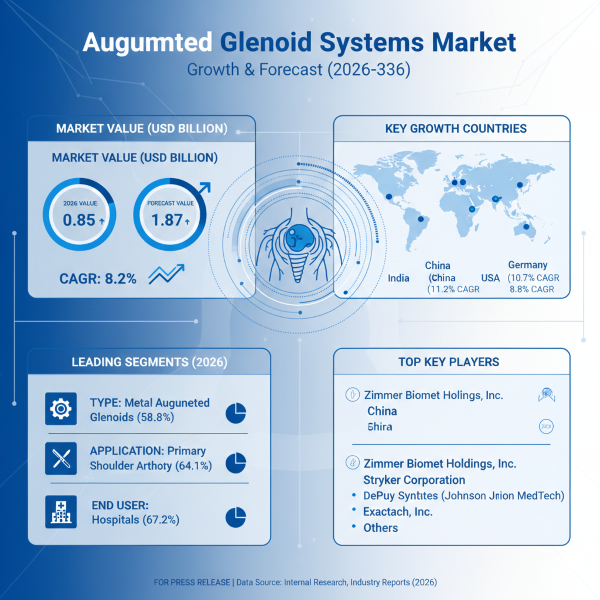
North America represents a leading market for augmented glenoid systems, supported by a well-established orthopedic surgery ecosystem and high adoption of advanced implant technologies. The region’s focus on improving surgical outcomes and reducing revision rates continues to drive demand.
Europe follows closely, driven by rising orthopedic procedure volumes and strong emphasis on clinical outcomes and patient safety. The presence of specialized orthopedic centers and experienced surgeons supports the adoption of augmented glenoid solutions across the region.
Asia-Pacific is emerging as a promising market due to increasing healthcare investments, expanding access to orthopedic care, and growing awareness of advanced joint replacement options. Improvements in surgical infrastructure and training are expected to further support market expansion.
Key Trends and Market Evolution
A key trend shaping the augmented glenoid systems market is the shift toward patient-specific and modular implant designs. Customizable solutions allow surgeons to tailor implants based on individual anatomy and bone loss patterns, enhancing fit and function.
Another notable trend is the integration of digital planning tools and surgical navigation systems. These technologies enable more precise implant placement and alignment, reducing variability and improving reproducibility in complex shoulder procedures.
Material innovation is also influencing market evolution. Manufacturers are exploring advanced biomaterials and surface treatments to enhance implant longevity, osseointegration, and biomechanical performance.
Applications and End-Use Outlook
Augmented glenoid systems are primarily used in orthopedic and specialty hospitals, where complex shoulder arthroplasty procedures are performed. These settings benefit from access to advanced imaging, skilled surgical teams, and comprehensive postoperative care.
Ambulatory surgical centers are gradually adopting these systems as minimally invasive techniques and outpatient joint replacement procedures become more common. The growing emphasis on cost-effective care and faster recovery is supporting this shift.
From an application perspective, reverse shoulder arthroplasty remains a significant area of use, particularly in patients with severe bone loss or compromised rotator cuff function. Conventional total shoulder arthroplasty also continues to drive demand for augmented glenoid components in revision and complex cases.
Competitive Landscape
The augmented glenoid systems market is characterized by the presence of established orthopedic implant manufacturers and specialized medical device companies. Competition is driven by innovation in implant design, clinical evidence, and surgeon training support.
Companies are investing in research and development to expand their product portfolios and address a wider range of anatomical challenges. Strategic collaborations with healthcare providers and technology firms are helping manufacturers enhance surgical precision and product adoption.
Conclusion
The augmented glenoid systems market is playing a vital role in advancing shoulder arthroplasty outcomes by addressing complex anatomical challenges with precision and reliability. As orthopedic care continues to evolve toward personalized and technology-enabled solutions, these systems are expected to gain wider acceptance among surgeons and healthcare providers.
Browse Full Report – https://www.factmr.com/report/augmented-glenoid-systems-market