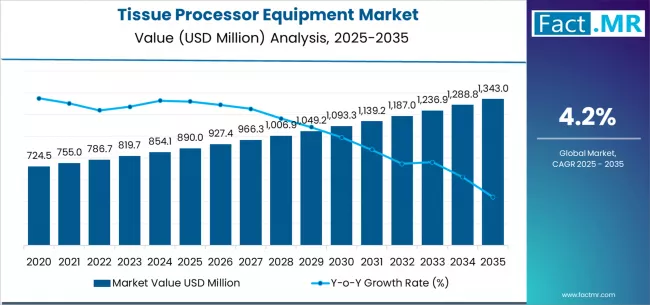
The tissue processor equipment market plays a vital role in modern histopathology and diagnostic laboratories by enabling accurate and efficient preparation of tissue samples for microscopic examination. Tissue processors are essential instruments used to fix, dehydrate, clear, and infiltrate biological tissue samples with paraffin, ensuring structural integrity for precise pathological analysis. As diagnostic accuracy becomes increasingly important in disease detection and treatment planning, the demand for reliable and automated tissue processing equipment continues to grow.
Rising prevalence of chronic diseases, increasing cancer diagnostics, and growing demand for advanced laboratory automation are driving the adoption of tissue processor equipment across healthcare and research environments. Laboratories are focusing on improving turnaround times, minimizing manual errors, and ensuring consistent sample quality, positioning tissue processors as critical components in diagnostic workflows.
Market Overview
Tissue processor equipment is widely used in pathology laboratories, hospitals, diagnostic centers, and research institutions. These systems are designed to standardize tissue preparation, ensuring reproducibility and high-quality histological results. The market includes manual, semi-automated, and fully automated tissue processors, each catering to different laboratory sizes and throughput requirements.
Automated tissue processors are gaining significant traction due to their ability to handle high sample volumes while reducing labor dependency. These systems enhance laboratory efficiency by enabling programmable workflows, precise reagent handling, and controlled processing conditions. Compact benchtop models are also increasingly preferred by small and mid-sized laboratories seeking space-efficient solutions without compromising performance.
Manufacturers are focusing on developing user-friendly interfaces, flexible processing protocols, and improved reagent management systems to meet the evolving needs of diagnostic laboratories.
Regional Insights
North America represents a mature market for tissue processor equipment, supported by advanced healthcare infrastructure, high diagnostic volumes, and strong adoption of laboratory automation. The presence of well-established pathology laboratories and continuous investment in healthcare technology contribute to sustained demand in the region.
Europe remains a prominent market, driven by rising cancer screening programs, strong regulatory standards, and emphasis on diagnostic accuracy. Laboratories across the region are increasingly upgrading to automated and standardized tissue processing systems to improve operational efficiency and compliance with quality guidelines.
Asia-Pacific is emerging as a high-growth region, supported by expanding healthcare infrastructure, growing awareness of early disease diagnosis, and increasing investments in diagnostic laboratories. Rapid urbanization and improvements in hospital networks are further accelerating the adoption of modern tissue processor equipment.
Other regions, including Latin America and the Middle East & Africa, are gradually witnessing increased adoption as healthcare systems modernize and access to pathology services improves.
Key Trends and Market Outlook
Automation continues to be a defining trend in the tissue processor equipment market. Laboratories are transitioning from manual methods to fully automated systems to reduce processing time, improve consistency, and enhance technician productivity. Integration with laboratory information systems is further streamlining workflow management and traceability.
Another notable trend is the growing demand for environmentally conscious and reagent-efficient tissue processors. Manufacturers are focusing on reducing reagent consumption, minimizing hazardous waste, and improving energy efficiency to align with sustainability goals.
Customization and flexibility are also gaining importance, with laboratories seeking systems that can accommodate diverse tissue types and varying processing protocols. Modular designs and programmable settings are enabling laboratories to tailor workflows according to diagnostic requirements.
Advancements in safety features, such as closed-system processing and enhanced ventilation, are improving laboratory safety by reducing exposure to harmful reagents and fumes.
Applications and End-Use Outlook
Clinical diagnostics represent the primary application area for tissue processor equipment. Hospitals and diagnostic laboratories rely on these systems for accurate histopathological analysis of biopsy and surgical samples, supporting disease diagnosis, staging, and treatment planning.
Research and academic institutions use tissue processors extensively for biomedical research, including studies related to disease mechanisms, drug development, and biomarker discovery. Consistent tissue preparation is essential for reproducible research outcomes.
Pharmaceutical and biotechnology companies also utilize tissue processor equipment in preclinical research and quality control processes. Reliable tissue processing supports histological evaluation during drug development and toxicology studies.
Veterinary diagnostic laboratories represent another growing end-use segment, driven by increasing focus on animal health diagnostics and research.
Challenges and Constraints
Despite favorable market conditions, certain challenges persist. High acquisition and maintenance costs of advanced tissue processor equipment may limit adoption among smaller laboratories. Additionally, the need for trained personnel to operate automated systems can pose operational challenges.
Compatibility with existing laboratory workflows and space constraints may also influence purchasing decisions. Regulatory compliance requirements can increase the complexity of product development and validation, particularly for equipment used in clinical diagnostics.
Conclusion
The tissue processor equipment market remains a cornerstone of histopathology and diagnostic laboratory operations. As demand for accurate, timely, and standardized tissue analysis continues to rise, these systems will play an increasingly critical role in supporting diagnostic precision and research advancements.
Ongoing innovation in automation, safety, sustainability, and workflow integration is reshaping the market landscape. Access to comprehensive market intelligence can help manufacturers, healthcare providers, and investors navigate evolving trends, optimize laboratory performance, and capitalize on emerging opportunities in the tissue processor equipment market.
Browse Full Report – https://www.factmr.com/report/433/tissue-processor-equipment-market