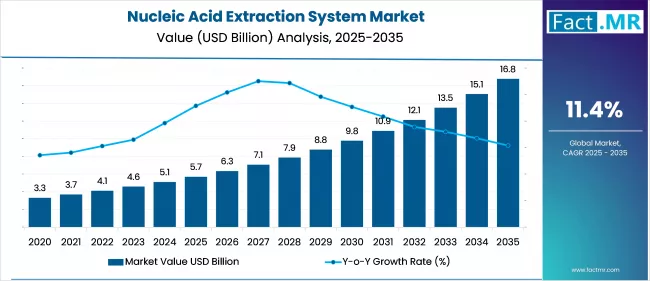
The nucleic acid extraction system market plays a foundational role in modern molecular biology, diagnostics, and life sciences research. As genomic and molecular testing becomes increasingly central to disease diagnosis, drug development, and biomedical research, the demand for reliable and efficient nucleic acid extraction systems continues to rise. These systems enable the isolation and purification of DNA and RNA from a wide range of biological samples, forming the first and most critical step in downstream molecular workflows.
Growing adoption of molecular diagnostics, expanding applications in infectious disease testing, oncology, and genetic screening, along with advancements in automation and laboratory efficiency, are reshaping the market. Nucleic acid extraction systems are becoming indispensable tools in clinical laboratories, research institutions, biotechnology companies, and diagnostic centers worldwide.
Market Overview
Nucleic acid extraction systems are designed to isolate high-quality DNA or RNA from samples such as blood, tissues, swabs, saliva, and cultured cells. These systems range from manual kits to semi-automated and fully automated platforms, offering varying levels of throughput, precision, and workflow integration. Automated systems, in particular, are gaining traction due to their ability to reduce human error, improve reproducibility, and support high-volume testing environments.
The market includes instruments, consumables, reagents, and software components that together streamline sample preparation for molecular assays. These systems are widely used in applications such as polymerase chain reaction (PCR), next-generation sequencing, microarray analysis, and other genomic techniques. Increasing emphasis on accuracy, speed, and contamination-free processing continues to drive innovation across product categories.
Regional Insights
North America represents a mature and technologically advanced market for nucleic acid extraction systems. Strong research infrastructure, widespread adoption of molecular diagnostics, and continuous investment in biotechnology and life sciences support steady demand. Clinical laboratories and research organizations in the region increasingly favor automated solutions to meet growing testing volumes.
Europe remains a significant market, driven by advancements in clinical diagnostics, academic research, and public health initiatives. Regulatory emphasis on diagnostic quality and laboratory standardization encourages the adoption of reliable and validated extraction platforms. Collaborative research programs and expanding genomic studies further contribute to market growth.
Asia-Pacific is emerging as a high-potential region, supported by expanding healthcare infrastructure, rising focus on molecular diagnostics, and increasing government investment in biotechnology research. Growing awareness of early disease detection and personalized medicine is accelerating the adoption of nucleic acid extraction systems across both clinical and research settings.
Other regions, including Latin America and the Middle East & Africa, are gradually increasing their use of molecular diagnostic tools as healthcare modernization efforts and laboratory capabilities continue to improve.
Key Trends and Market Outlook
Automation remains one of the most influential trends in the nucleic acid extraction system market. Laboratories are increasingly adopting fully automated platforms to handle higher sample volumes while maintaining consistency and reducing turnaround time. Integration with downstream analytical instruments is further enhancing workflow efficiency.
Another key trend is the development of flexible systems capable of processing diverse sample types and supporting multiple applications. Manufacturers are focusing on modular designs and adaptable protocols to meet the evolving needs of diagnostic and research laboratories.
Miniaturization and compact system design are also gaining attention, particularly for decentralized testing environments and smaller laboratories. Portable and benchtop extraction systems are enabling broader access to molecular testing, especially in resource-limited settings.
In addition, the growing emphasis on contamination control and biosafety is driving the use of closed-system extraction platforms. These systems minimize manual handling and reduce the risk of cross-contamination, which is critical for sensitive molecular assays.
Applications and End-Use Outlook
Clinical diagnostics represent a major application area for nucleic acid extraction systems. These platforms are essential for detecting infectious diseases, identifying genetic disorders, and supporting oncology diagnostics. Reliable extraction is crucial for ensuring accurate and reproducible test results.
Research and academic institutions extensively use nucleic acid extraction systems for genomics, transcriptomics, and molecular biology studies. High-quality nucleic acid isolation supports advanced research in areas such as gene expression analysis, biomarker discovery, and functional genomics.
Biotechnology and pharmaceutical companies rely on these systems for drug discovery, vaccine development, and clinical research. Efficient sample preparation enables faster progression from research to development while maintaining data integrity.
Public health laboratories also represent an important end-use segment, particularly for surveillance, outbreak response, and large-scale screening programs.
Challenges and Constraints
Despite positive market dynamics, the nucleic acid extraction system market faces certain challenges. High initial costs associated with automated platforms may limit adoption in smaller laboratories or budget-constrained settings. Additionally, ongoing consumable expenses can impact long-term operational costs.
Technical complexity and the need for trained personnel may also pose barriers, particularly in regions with limited laboratory expertise. Compatibility issues between extraction systems and downstream analytical platforms can further complicate purchasing decisions.
Regulatory requirements and validation processes can extend product development timelines, especially for systems intended for clinical diagnostic use.
Conclusion
The nucleic acid extraction system market is a critical enabler of modern molecular diagnostics and life sciences research. As demand for accurate, rapid, and high-throughput molecular testing continues to grow, these systems will remain central to laboratory workflows worldwide.
Ongoing innovation in automation, system integration, and usability is enhancing efficiency and expanding application potential across clinical, research, and industrial settings. Access to comprehensive market intelligence can help stakeholders identify emerging opportunities, address challenges, and develop strategies aligned with the evolving landscape of nucleic acid extraction technologies.
Browse Full Report – https://www.factmr.com/report/432/nucleic-acid-extraction-system-market