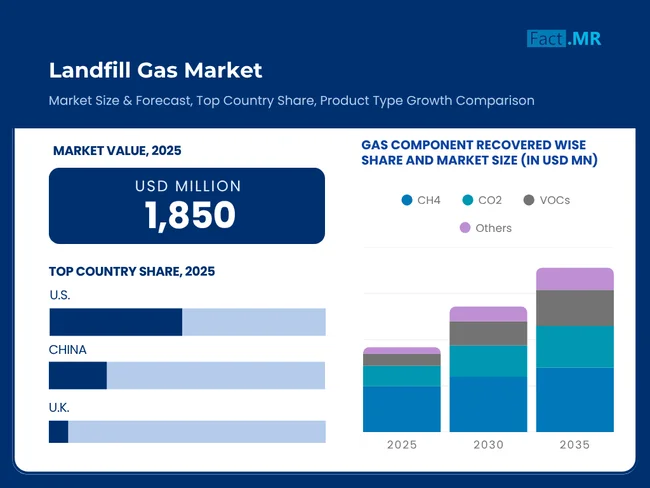
The landfill gas market is gaining increasing attention as governments, utilities, and industrial stakeholders seek sustainable solutions to manage waste while reducing greenhouse gas emissions. Landfill gas, primarily composed of methane and carbon dioxide, is generated through the natural decomposition of organic waste in landfills. When captured and utilized effectively, this gas serves as a valuable renewable energy source while mitigating environmental and climate risks associated with uncontrolled methane release.
As global emphasis on circular economy practices and low-carbon energy systems intensifies, landfill gas recovery and utilization are emerging as critical components of integrated waste management and renewable energy strategies. The market is evolving with advancements in gas collection technologies, energy conversion systems, and regulatory frameworks supporting emission reduction and clean energy generation.
Market Overview
Landfill gas is produced continuously throughout the lifespan of a landfill and can be collected through engineered well systems and piping networks. Once captured, it can be flared to reduce emissions or processed for beneficial uses such as electricity generation, direct thermal applications, or upgrading into renewable natural gas for pipeline injection and vehicle fuel.
The landfill gas market encompasses equipment and services related to gas collection, processing, monitoring, and utilization. Applications span power generation facilities, industrial heating systems, and fuel supply for transportation. Municipalities, waste management companies, utilities, and industrial users are key participants in the market, leveraging landfill gas projects to achieve sustainability targets while generating long-term economic and environmental benefits.
Regional Insights
North America represents a mature and well-established market for landfill gas utilization, supported by strong regulatory frameworks, landfill infrastructure, and widespread adoption of waste-to-energy projects. Public-private partnerships and utility-led initiatives have played a significant role in expanding landfill gas recovery across the region.
Europe follows closely, driven by strict environmental regulations, landfill diversion policies, and ambitious climate action goals. Many countries in the region prioritize methane capture and renewable energy integration, encouraging investment in advanced landfill gas utilization technologies.
Asia-Pacific is emerging as a high-potential region due to rapid urbanization, increasing waste generation, and growing focus on sustainable waste management. Governments in the region are gradually adopting landfill gas projects as part of broader renewable energy and emission reduction strategies.
Latin America and the Middle East & Africa are witnessing steady progress, supported by expanding urban infrastructure and international funding initiatives aimed at improving waste management practices and reducing environmental impact.
Key Trends and Market Outlook
One of the most notable trends in the landfill gas market is the increasing shift toward renewable natural gas production. Upgrading landfill gas to pipeline-quality fuel enables broader applications, including transportation fuel and integration with existing gas infrastructure.
Technological advancements in gas collection efficiency, monitoring systems, and emission control are improving project performance and reliability. Automated monitoring and digital control systems are enabling better optimization of gas recovery and compliance with environmental standards.
Policy support and regulatory incentives continue to shape market development. Emission reduction mandates, renewable energy targets, and carbon credit mechanisms are encouraging investment in landfill gas projects across both developed and developing regions.
The integration of landfill gas projects with broader waste management and energy systems is also gaining momentum. Hybrid facilities combining landfill gas recovery with solar or other renewable sources are being explored to enhance energy output and operational resilience.
Applications and End-Use Outlook
Electricity generation remains one of the primary applications of landfill gas, supplying power to local grids and on-site facilities. These projects contribute to energy diversification while reducing dependence on fossil fuels.
Direct-use applications, such as industrial boilers, kilns, and district heating systems, are gaining traction where proximity to end users allows efficient energy utilization. These applications offer cost-effective alternatives to conventional fuels.
The transportation sector is emerging as a promising end-use segment, particularly through the adoption of renewable natural gas as a low-carbon vehicle fuel. Fleet operators and public transit systems are increasingly exploring landfill gas–derived fuels to meet sustainability commitments.
Municipalities benefit from landfill gas projects by improving landfill safety, reducing odor and explosion risks, and generating additional revenue streams to support waste management operations.
Challenges and Constraints
Despite strong growth potential, the landfill gas market faces several challenges. Variability in gas generation rates and landfill conditions can impact project feasibility and performance. High upfront investment requirements and long development timelines may limit adoption, particularly in regions with limited financial resources.
Regulatory complexity and permitting requirements can also slow project implementation. In some regions, lack of technical expertise and infrastructure poses barriers to efficient gas capture and utilization.
Additionally, competition from other renewable energy sources and waste diversion initiatives, such as composting and recycling, may influence long-term landfill gas availability in certain markets.
Conclusion
The landfill gas market plays a vital role in advancing sustainable waste management and renewable energy objectives. By converting waste-derived emissions into valuable energy resources, landfill gas projects support environmental protection, energy security, and economic development.
Continued technological innovation, supportive policies, and integrated waste-to-energy strategies are expected to strengthen market adoption worldwide. Stakeholders that invest in efficient recovery systems, advanced utilization technologies, and regulatory alignment will be well positioned to capitalize on long-term opportunities. Comprehensive market insights and strategic analysis remain essential for navigating the evolving landscape of the global landfill gas market.
Browse Full Report – https://www.factmr.com/report/429/landfill-gas-market