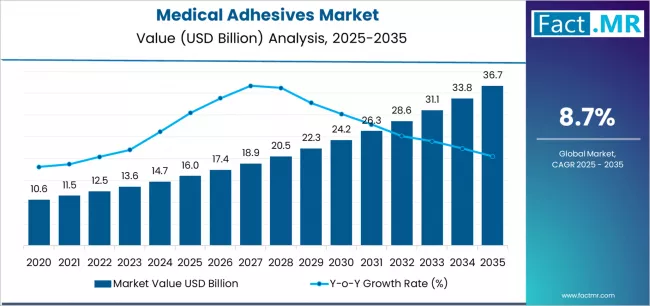
The global medical adhesives market is poised for steady growth through 2035 as healthcare delivery shifts toward faster, less invasive procedures, increased outpatient care, and expanded use of adhesive-based devices and dressings. Medical adhesives — ranging from cyanoacrylates and polyurethane adhesives to silicone-based adhesives, hydrogels, and bioadhesives — are increasingly used across wound closure, surgical sealing, topical dressings, wearable devices, transdermal drug delivery, and medical device assembly. As technology advances and clinicians seek solutions that reduce procedure time, improve cosmetic outcomes, and lower infection risk, adhesives are moving from a niche adjunct to a mainstream tool in modern medicine.
Quick Stats (2025–2035)
-
Market Value 2025: USD 4.2 billion
-
Market Forecast Value 2035: USD 7.1 billion
-
Absolute Growth (2025–2035): USD 2.9 billion
-
Forecast CAGR (2025–2035): ≈ 5.4%
-
Leading Product Type (2025): Tissue adhesives & surgical sealants (≈ 34% share)
-
Leading End-Use (2025): Hospitals & surgical centers
-
Key Growth Regions: North America, Asia-Pacific, Europe
To access the complete data tables and in-depth insights, request a Discount On The Report here: https://www.factmr.com/connectus/sample?flag=S&rep_id=12220
Key Market Drivers
Minimally Invasive & Ambulatory Care Trends
As laparoscopy, robotic surgery, and same-day procedures expand, demand grows for adhesives that enable quick wound closure, hemostasis, and reduced reliance on sutures or staples. Adhesives can shorten operative time and facilitate faster patient throughput, supporting adoption in ambulatory surgical centers and outpatient clinics.
Aging Population & Rising Chronic Wounds
An aging demographic contributes to higher incidence of chronic wounds (pressure ulcers, diabetic foot ulcers, venous leg ulcers). Advanced adhesive dressings—with integrated antimicrobial properties, moisture management, and skin-friendly adhesives—are increasingly used in wound care regimes to promote healing and reduce dressing change frequency.
Growth of Wearable Medical Devices & Transdermal Delivery
Adhesives are essential for secure attachment of sensors, infusion sets, continuous glucose monitors, and transdermal patches. As digital health and at-home monitoring expand, demand rises for hypoallergenic, long-wear, breathable adhesives that maintain adhesion without skin irritation.
Technological Innovation in Bioadhesives
Next-generation bioadhesives (biodegradable, tissue-bonding glues, adhesive hydrogels) and multifunctional adhesives (antimicrobial, hemostatic, drug-releasing) are opening new clinical applications—especially where sutureless closure and internal sealing are advantageous. These innovations improve outcomes and broaden clinical adoption.
Regulatory & Reimbursement Alignment
Favorable reimbursement for procedures that reduce hospital stays and costs, together with regulatory approvals for innovative adhesive platforms, are helping accelerate market uptake in developed healthcare systems.
Market Structure & Segment Insights
By Product Type
-
Tissue Adhesives & Surgical Sealants: Lead demand due to versatility in skin closure, hemostasis, and internal sealing.
-
Adhesive Dressings & Film Dressings: High-volume segment for wound management, ostomy care, and catheter fixation.
-
Medical Tapes & Fixation Adhesives: Widely used for device securement and short-term fixation.
-
Wearable & Transdermal Adhesives: Rapidly growing as remote patient monitoring and patch therapies expand.
-
Specialty Bioadhesives & Hydrogels: Niche but high-value, targeting internal tissue bonding and regenerative medicine.
By End-Use
Hospitals and surgical centers are primary revenue contributors due to high procedure volumes; home healthcare and long-term care facilities are important growth segments for adhesive dressings and wearable device adhesives.
By Region
North America leads on value due to high adoption rates, strong R&D, and reimbursement systems. Europe follows with emphasis on wound-care adoption and device regulation. Asia-Pacific is the fastest-growing region, driven by expanding healthcare infrastructure, rising surgical volumes, and increased adoption of advanced wound-care technologies.
Challenges & Restraints
Biocompatibility & Skin Reactions
Adhesive-related skin irritation, allergic contact dermatitis, and adhesive residue are ongoing concerns. Development of hypoallergenic formulations and better removal systems is necessary to widen patient acceptance.
Regulatory & Clinical Validation Hurdles
Adhesives intended for internal use or as surgical sealants face rigorous safety and efficacy testing. Long development timelines and expensive clinical programs can be barriers to entry for smaller innovators.
Cost & Reimbursement Sensitivity
Premium bioadhesives and advanced dressing systems carry higher unit costs. Healthcare providers balance clinical benefits against budget constraints; reimbursement availability significantly affects adoption.
Supply Chain & Raw-Material Volatility
Specialty polymers, medical-grade silicones, and certain adhesives depend on petrochemical feedstocks; volatility in raw-material prices can affect manufacturing costs and margins.
Opportunities & Strategic Directions
Integrated Adhesive Systems
Products that combine adhesive function with drug delivery (antimicrobial, analgesic), sensing (smart dressings), or hemostatic properties will command premium positioning and drive clinical adoption.
Adhesives for Minimally Invasive Devices
As minimally invasive and implantable devices proliferate, demand for biocompatible adhesives suited to device assembly and in-vivo fixation will grow. Partnerships with device OEMs offer a clear path to scale.
Sustainable & Skin-Friendly Formulations
Development of skin-friendly, breathable, and recyclable adhesive substrates—plus adhesives using bio-based polymers—addresses clinician and patient demand for better tolerability and sustainability.
Emerging Market Expansion
Investments in education, clinician training, and local supply chains in emerging economies can unlock significant volume growth as surgical capabilities and outpatient care expand.
Outlook
The medical adhesives market is set for steady value growth through 2035 as clinical trends favor sutureless techniques, home healthcare, and device-based monitoring. Manufacturers who invest in biocompatible, multifunctional formulations, secure regulatory approvals, and robust supply chains—while demonstrating clear clinical and economic benefits—will capture the largest share of this evolving market. Adhesives that combine performance, patient comfort, and sustainability are likely to lead the next wave of adoption across surgical, wound care, and device applications.
Browse Full Report: https://www.factmr.com/report/medical-adhesives-market