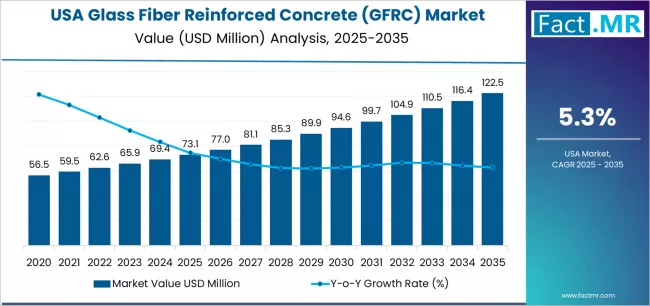
The United States glass fiber reinforced concrete (GFRC) market is set for steady expansion over the next decade, supported by rising demand for lightweight, durable, and design-flexible construction materials. According to an analysis by Fact.MR, demand for GFRC in the USA is projected to grow from USD 73.10 million in 2025 to approximately USD 122.5 million by 2035, registering an absolute increase of USD 45.54 million over the forecast period.
This growth represents a total expansion of 62.30%, with market demand expected to advance at a compound annual growth rate (CAGR) of 5.30% from 2025 to 2035. The increasing adoption of GFRC across architectural facades, infrastructure renovation, and commercial construction is a key factor accelerating market momentum.
Browse Full Report: https://www.factmr.com/report/united-states-glass-fiber-reinforced-concrete-gfrc-market
Strategic Market Drivers
Lightweight & High-Strength Construction Materials Gain Preference
GFRC offers significant advantages over traditional concrete, including:
- Reduced structural weight
- High tensile and flexural strength
- Enhanced crack resistance
- Superior durability
These properties make GFRC an ideal solution for modern construction projects, where design flexibility and structural efficiency are critical.
Growth in Architectural & Decorative Applications
Architects and developers across the U.S. are increasingly adopting GFRC for:
- Exterior wall panels and facades
- Decorative cladding and cornices
- Columns, domes, and custom architectural elements
Its ability to replicate natural stone while reducing material weight and installation cost is driving widespread adoption in commercial buildings, cultural landmarks, and high-end residential projects.
Infrastructure Renovation & Urban Redevelopment
Ongoing investments in infrastructure refurbishment, urban redevelopment, and public building upgrades are supporting GFRC demand. Its corrosion resistance and long service life make it suitable for bridges, transit stations, parking structures, and public spaces.
Sustainability & Energy-Efficient Building Trends
With the U.S. construction industry increasingly focused on sustainable building materials, GFRC aligns well with green construction goals by:
- Reducing raw material usage
- Lowering transportation and installation energy
- Supporting long-lasting, low-maintenance structures
Regional Demand Highlights (USA)
Commercial Construction Leads Adoption
Office complexes, shopping centers, hotels, and institutional buildings remain the largest consumers of GFRC due to its aesthetic appeal and performance benefits.
Residential & Multi-Family Projects Gain Momentum
Rising urban housing demand and modern architectural trends are driving GFRC usage in high-rise apartments, luxury homes, and mixed-use developments.
Public Infrastructure & Cultural Projects
GFRC is increasingly used in museums, stadiums, airports, and government buildings, where durability and complex architectural designs are required.
Market Segmentation Insights
By Application
- Architectural Panels & Facades – Dominant segment due to extensive use in commercial and institutional buildings
- Decorative Elements – Growing adoption in modern and heritage restoration projects
- Infrastructure Components – Steady demand from renovation and public works
By End Use
- Commercial Construction – Largest share driven by large-scale developments
- Residential Construction – Increasing use in modern housing projects
- Public & Institutional Buildings – Strong long-term growth outlook
Challenges Impacting Market Growth
Higher Initial Costs
Compared to traditional concrete, GFRC involves higher material and fabrication costs, which can limit adoption in cost-sensitive projects.
Skilled Labor & Manufacturing Complexity
GFRC production requires specialized manufacturing processes and skilled workmanship, posing entry barriers for smaller contractors.
Competitive Landscape
The U.S. GFRC market features a mix of specialized manufacturers, architectural material suppliers, and construction solution providers. Companies are focusing on:
- Advanced GFRC mix designs
- Improved fiber technology
- Custom architectural solutions
- Faster and more cost-effective installation methods
Recent Developments
- 2024: Increased adoption of prefabricated GFRC panels in commercial construction to reduce project timelines
- 2023: Rising use of GFRC in infrastructure renovation projects across major U.S. cities
- 2022: Growth in demand for custom GFRC architectural elements in luxury residential developments
Future Outlook: Steady Growth Driven by Design & Durability
Over the next decade, the U.S. GFRC market is expected to benefit from:
- Expansion of commercial and mixed-use construction
- Growing emphasis on lightweight and sustainable materials
- Increased architectural innovation and customization
- Infrastructure modernization initiatives
As builders and architects prioritize durability, aesthetics, and construction efficiency, demand for glass fiber reinforced concrete (GFRC) in the USA is poised for consistent and long-term growth through 2035.