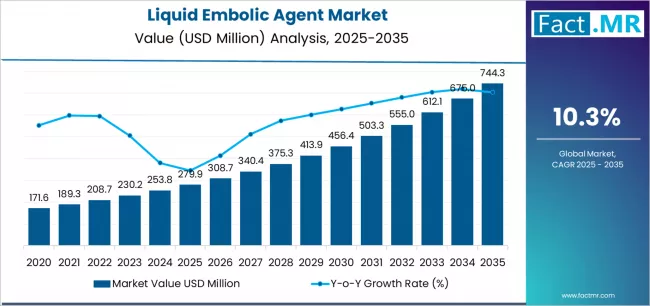
The global Liquid Embolic Agent Market is poised for substantial expansion over the next decade, propelled by rising prevalence of neurovascular disorders, growing adoption of minimally invasive endovascular procedures, and increasing demand for advanced embolization materials across clinical applications such as arteriovenous malformations (AVMs), hypervascular tumors, hemorrhage control, and other vascular conditions. As treatment paradigms continue shifting away from open surgeries toward less invasive catheter-based interventions, liquid embolic agents have become integral to modern vascular therapy—offering precise, permanent vessel occlusion and improved safety profiles.
Quick Stats (2025–2035)
-
Market Value 2025: USD 279.9 million
-
Market Forecast Value 2035: USD 744.3 million
-
Absolute Growth (2025–2035): USD 464.4 million
-
Forecast CAGR (2025–2035): 10.3%
-
Leading Product Type (2025): EVOH (≈ 51.2% share)
-
Top Application Segment (2025): AVM (≈ 46.7% share)
-
Key Growth Regions: Asia-Pacific, North America, Europe
To access the complete data tables and in-depth insights, request a Discount On The Report here: https://www.factmr.com/connectus/sample?flag=S&rep_id=12264
Market Drivers
Rising Incidence of Neurovascular Conditions & Aging Populations
Aging demographics worldwide and improved diagnostic imaging are detecting more vascular abnormalities, such as arteriovenous malformations and aneurysms, increasing demand for effective embolic therapies. The growing burden of cerebrovascular disease and the emphasis on reducing morbidity have prompted more frequent use of endovascular solutions.
Preference for Minimally Invasive Procedures
Healthcare systems globally are prioritizing interventions that reduce hospital stays, lower complication rates, and speed patient recovery. Liquid embolic agents enable targeted vessel occlusion via catheter-based techniques, aligning with the broader trend toward minimally invasive care in neurointerventional and interventional radiology.
Clinical Advantages of Modern Embolic Materials
Ethylene vinyl alcohol copolymer (EVOH) based agents dominate the market due to non-adhesive delivery, controlled precipitation, reliable radiopacity, and favorable biocompatibility. These characteristics make EVOH especially useful in complex neurovascular anatomies and high-flow lesions. Other agents, such as cyanoacrylates, remain important where rapid polymerization and immediate occlusion are needed.
Expansion of Interventional Infrastructure
Investments in interventional radiology suites, stroke centers, and neurovascular teams—particularly in Asia-Pacific and other emerging regions—are increasing access to embolization procedures. As hospitals upgrade capabilities and more specialists become available, the adoption of liquid embolic agents is expected to rise steadily.
Market Structure & Segment Insights
By Product Type
EVOH-based agents lead the market, accounting for roughly half of market share in 2025, driven by their predictable delivery and safety profile. Cyanoacrylates and newer polymer formulations comprise the balance, each chosen for specific clinical scenarios such as rapid vessel occlusion or tumor devascularization.
By Application
Arteriovenous malformations dominate application demand, representing nearly half of usage in 2025. Treatment protocols for AVMs often favor liquid embolics as primary or adjunctive therapy. Tumor embolization—used as pre-surgical devascularization or palliative therapy—along with trauma-related hemorrhage control and peripheral vascular applications, represent expanding use cases.
By End-Use
Hospitals are the primary end-users, equipped with advanced imaging and specialized teams for complex embolization procedures. Ambulatory surgical centers and specialty clinics are progressively adopting liquid embolics for select peripheral and interventional procedures, supported by improvements in device delivery systems and outpatient protocols.
Regional Dynamics
Asia-Pacific is one of the fastest-growing markets due to expanding healthcare infrastructure, rising disease awareness, and increasing access to interventional procedures in populous countries. North America maintains a significant share thanks to established clinical adoption, strong reimbursement, and mature neurointerventional centers. Europe continues steady growth led by specialized centers and favorable regulatory and clinical ecosystems. Emerging regions in Latin America, the Middle East, and Africa show gradual uptake as infrastructure and reimbursement improve.
Opportunities & Challenges
Opportunities
-
Development of next-generation agents offering enhanced radiopacity, ready-to-use formulations, and simplified delivery systems.
-
Expansion into new clinical indications such as broader tumor embolization and peripheral vascular interventions.
-
Growth of outpatient and ambulatory settings for less complex embolization procedures, improving accessibility and cost efficiency.
Challenges
-
High procedural and product costs may limit rapid adoption in cost-sensitive regions.
-
Technical complexity and the need for skilled neurointerventionalists present a steep learning curve that can slow penetration in facilities with limited expertise.
-
Limited long-term outcome data for some novel applications may temper faster clinical acceptance until additional evidence is generated.
Outlook
The Liquid Embolic Agent Market is projected to more than double by 2035, reflecting a robust CAGR of approximately 10.3% from 2025 to 2035. This trajectory underscores increased reliance on minimally invasive vascular interventions, the rising global burden of vascular disease, and the continued expansion of interventional radiology infrastructure. With innovation in polymer technologies, improved delivery platforms, and wider clinical adoption, liquid embolic agents are expected to become a standard therapeutic modality across a widening range of vascular conditions—delivering substantial value to patients, clinicians, and device manufacturers in the coming decade.
Browse Full Report: https://www.factmr.com/report/liquid-embolic-agent-market