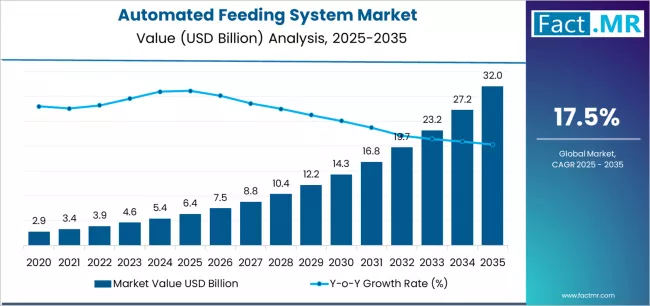
The global automated feeding system market is witnessing robust growth as livestock farmers and aquaculture operators increasingly adopt advanced feeding technologies to improve operational efficiency and reduce labor costs. According to the latest industry estimates, the market was valued at approximately $3.2 billion in 2024 and is projected to reach $6.5 billion by 2030, registering a compound annual growth rate (CAGR) of 7.8% during the forecast period. Market expansion is being driven by rising demand for precision agriculture, advancements in robotics, and a growing focus on sustainable farming practices.
Market Overview:
Automated feeding systems, which include devices and software solutions designed to optimize the delivery of feed to livestock and aquaculture species, are transforming traditional farming methods. Key segments of the market include poultry feeding systems, swine feeding systems, cattle feeding systems, and aquaculture feeders. As per recent industry research, poultry feeding systems account for nearly 35% of the market share, reflecting the global expansion of poultry production driven by rising protein demand.
The market’s growth is further supported by technology integration, such as IoT-enabled feed management, AI-driven monitoring systems, and sensor-based feeding automation. These innovations not only enhance feed efficiency but also minimize wastage and improve animal health, generating significant cost savings for farm operators.
Key Drivers and Trends:
-
Labor Efficiency and Cost Reduction: With increasing labor costs worldwide, automated feeding systems are becoming indispensable for commercial farms. Farms using automated solutions report up to 20–25% reduction in labor expenses, enhancing profitability.
-
Technological Advancements: Modern systems integrate real-time monitoring, predictive analytics, and remote control, enabling precise feed allocation per animal, which increases productivity and ensures optimal growth.
-
Sustainability and Environmental Concerns: Regulatory bodies are encouraging sustainable farming practices. Automated feeding helps reduce overfeeding by 15–20%, cutting down feed wastage and greenhouse gas emissions.
-
Smart Farm Integration: The trend toward fully automated smart farms is accelerating, with feeding systems forming a critical component of IoT-based farm management solutions.
Regional Insights:
North America remains a dominant market, accounting for over 40% of global revenue in 2024, supported by widespread adoption of precision agriculture and modern livestock practices. The United States, in particular, is leading adoption due to advanced agricultural infrastructure and high automation penetration.
Europe follows closely, driven by the EU’s stringent regulations on animal welfare and feed efficiency. Germany, France, and the Netherlands are key contributors, with increasing investments in smart farm technologies.
The Asia-Pacific region is emerging as the fastest-growing market, with a projected CAGR of 9.2% through 2030. Rapid urbanization, rising meat consumption, and government initiatives supporting modern livestock management in China, India, and Southeast Asia are key growth factors.
Latin America and the Middle East & Africa are also witnessing gradual adoption, largely due to modernization of dairy, poultry, and aquaculture sectors, along with increasing awareness about feed optimization and automation.
Browse Full Report : https://www.factmr.com/report/automated-feeding-system-market
Future Outlook / Forecast:
Looking ahead, the automated feeding system market is expected to experience sustained growth through 2030, driven by ongoing technological innovation and increasing demand for high-efficiency livestock operations. The integration of AI and machine learning into feeding systems is anticipated to further enhance predictive feeding accuracy, improve herd health, and reduce operational costs.
Industry analysts predict that by 2030, over 60% of large-scale livestock farms globally will adopt some form of automated feeding solution. The growing convergence of smart agriculture and sustainability objectives is expected to further solidify the market’s upward trajectory.