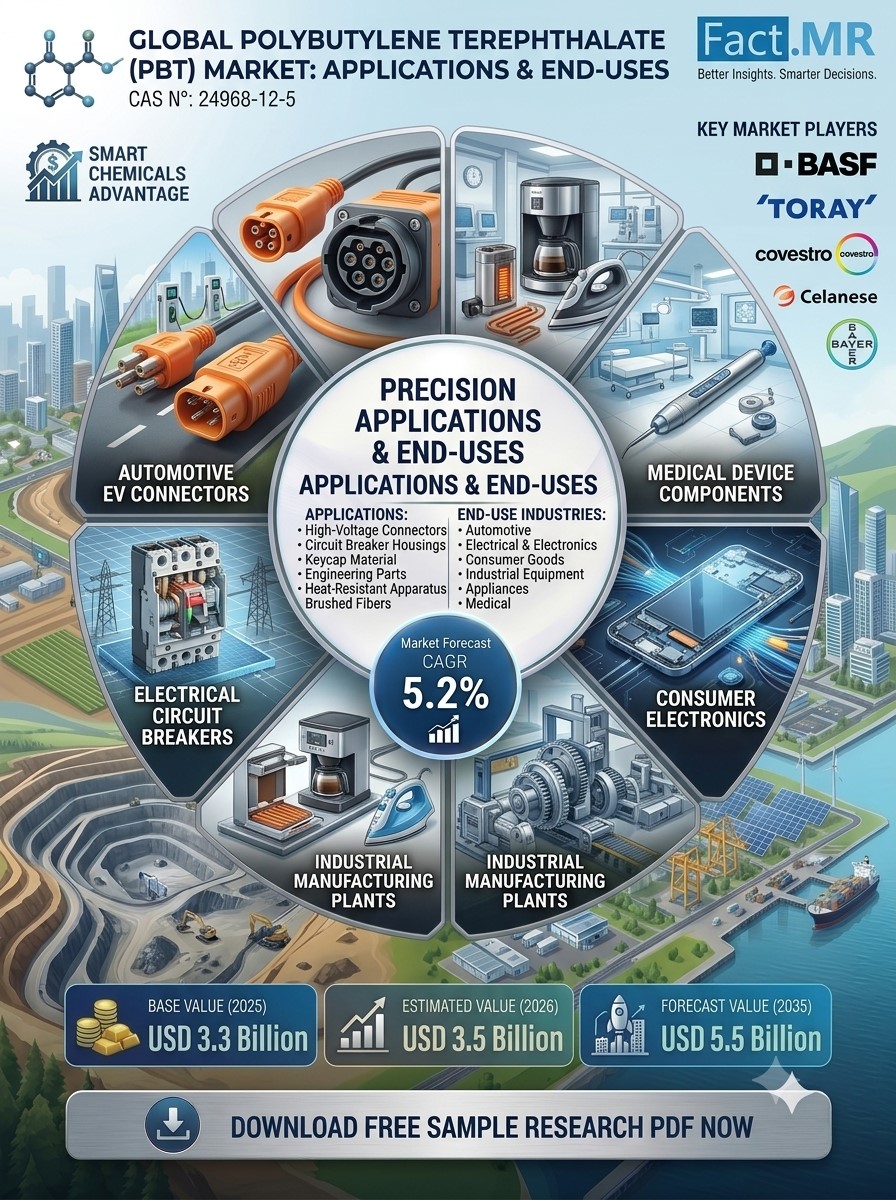
Rockville, MD., November 10, 2026 — The global Polybutylene Terephthalate (PBT) Market is projected to increase from USD 3.3 billion in 2025 to USD 5.5 billion by 2035, expanding at a 5.2% CAGR, according to Fact.MR’s August 11, 2025 report. China is expected to register 5.7% CAGR during the forecast period, supported by electric vehicle manufacturing and electronics production. Reinforced PBT accounted for a reported 62% market share in 2025.
Automotive electrification remains a central demand driver. Manufacturers use PBT in battery connectors, sensor housings and ignition components because of its electrical insulation and dimensional stability. The material also offers resistance to heat and chemicals, making PBT suitable for demanding automotive and electronic applications.
Get detailed market forecasts, competitive benchmarking, and pricing trends
Automotive Electrification Supports Polybutylene Terephthalate (PBT) Market Growth
Electric vehicle production is creating additional applications for engineering thermoplastics. Fact.MR identifies automotive lightweighting as a major driver of PBT consumption, particularly where manufacturers require dimensional accuracy and electrical reliability.
PBT is used in ignition systems, electrical connectors and under-the-hood components. Its mechanical properties allow manufacturers to replace certain metal parts while maintaining component performance.
The electrical and electronics industry provides another growth opportunity. Fact.MR identifies applications in circuit breakers, switches, sockets and compact electronic connectors. Increasing device miniaturization creates demand for materials capable of operating under thermal and electrical stress.
Material innovation is also changing product requirements. Manufacturers are developing hydrolysis-resistant, laser-weldable and radar-transparent PBT grades for automotive electronics and advanced industrial applications.
Reinforced PBT Holds 62% Market Share
Reinforced polybutylene terephthalate accounted for 62% of the market in 2025, according to Fact.MR.
Glass-fiber reinforcement improves mechanical strength and dimensional precision. These characteristics support applications in automotive components, fuse boxes and electrical housings.
Unreinforced PBT serves applications requiring easier processing and lower material costs. Fact.MR identifies consumer electronics and appliances among its important end-use categories.
Injection moulding leads the market by processing method. Manufacturers use this technique to produce precision components with repeatable dimensions and relatively short production cycles.
Extrusion is identified as the fastest-growing processing category. Applications include fiber-optic cables, industrial profiles and electrical insulation products.
Automotive remains the leading end-use industry, while electrical and electronics is identified as the fastest-growing end-use segment.
China Leads PBT Market Country Growth at 5.7% CAGR
China — 5.7% CAGR: China is the fastest-growing country explicitly identified in Fact.MR’s market summary. Demand is linked to electric vehicle production and electronics manufacturing. The report identifies BYD, NIO and Geely as automotive manufacturers contributing to China’s expanding electric mobility ecosystem.
United States: Demand is supported by automotive electrification and electrical components. PBT is used in battery systems, connectors and sensor housings. Fact.MR also identifies smart electronics and charging infrastructure as application areas.
Japan: Electronics manufacturing supports PBT consumption. Japanese automotive manufacturers also use advanced polymer grades in connectors and components requiring thermal resistance.
Germany: Germany is identified as an important European market because of its automotive manufacturing base. Demand includes high-performance polymers for electric vehicles and industrial applications.
United Kingdom: Fact.MR identifies the United Kingdom among Europe’s relevant PBT markets, with demand associated with automotive development and industrial applications.
France: Automotive manufacturing and Europe’s focus on recyclable materials provide context for PBT adoption. The report does not publish a separate French CAGR.
Asia Pacific holds the largest regional market share, according to Fact.MR. Regional demand is supported by established automotive and electronics manufacturing capacity.
Material Innovation Shapes Competitive Strategies
The Polybutylene Terephthalate (PBT) Market includes DSM, Röchling, RTP Company, Chang Chun Group, Duromer Products Pty Ltd, Nan Ya Plastics, Polyplastics Co., Ltd., Sahara International Petrochemicals Co., Samyang Corporation and Toray Industries, Inc.
Manufacturers compete through specialized polymer formulations, processing capabilities and regional supply networks.
Fact.MR highlights two developments:
- October 2024: Envalior introduced its Pocan X-MB series of PBT compounds, targeting demand for bio-based and circular materials.
- July 2024: BASF announced an expansion of PBT resin production at its Ludwigshafen facility in Germany, targeting automotive demand.
These developments illustrate how manufacturers are addressing material performance and sustainability requirements.
Raw Material Costs Remain a Market Challenge
PBT production depends on feedstocks including 1,4-butanediol and terephthalic acid. Fact.MR identifies raw material price volatility as a constraint affecting production costs.
Competition from polyamide, polycarbonate and polyethylene terephthalate also influences material selection.
Environmental regulations create additional considerations. European REACH requirements and electronics-related RoHS rules encourage manufacturers to assess chemical compliance and alternative material formulations.
Bio-based PBT offers another development pathway, although Fact.MR identifies production costs and scalability as continuing challenges.
Research Scope and Market Outlook
Fact.MR’s PBT study contains 170 pages, 64 tables and 94 figures, covering product types, processing methods, end-use industries and regional markets.
The forecast indicates an increase of USD 2.2 billion between 2025 and 2035, based on the published market valuations.
For manufacturers, the commercial focus remains on application-specific performance. Automotive suppliers require dependable electrical components, while electronics manufacturers increasingly need compact insulating materials.
Top Reports:
Abrasion-Resistant Polyurethane Formulations Market
About Fact.MR
Fact.MR is a market research and consulting firm providing syndicated research and custom market intelligence across global industries. Its research covers market forecasts, competitive developments, segmentation and regional business opportunities.