The GLP-1 Adherence Platforms Market is projected to rise from USD 220.7 million in 2026 to USD 1.15 billion by 2036 at an 18.0% CAGR, Fact.MR finds.
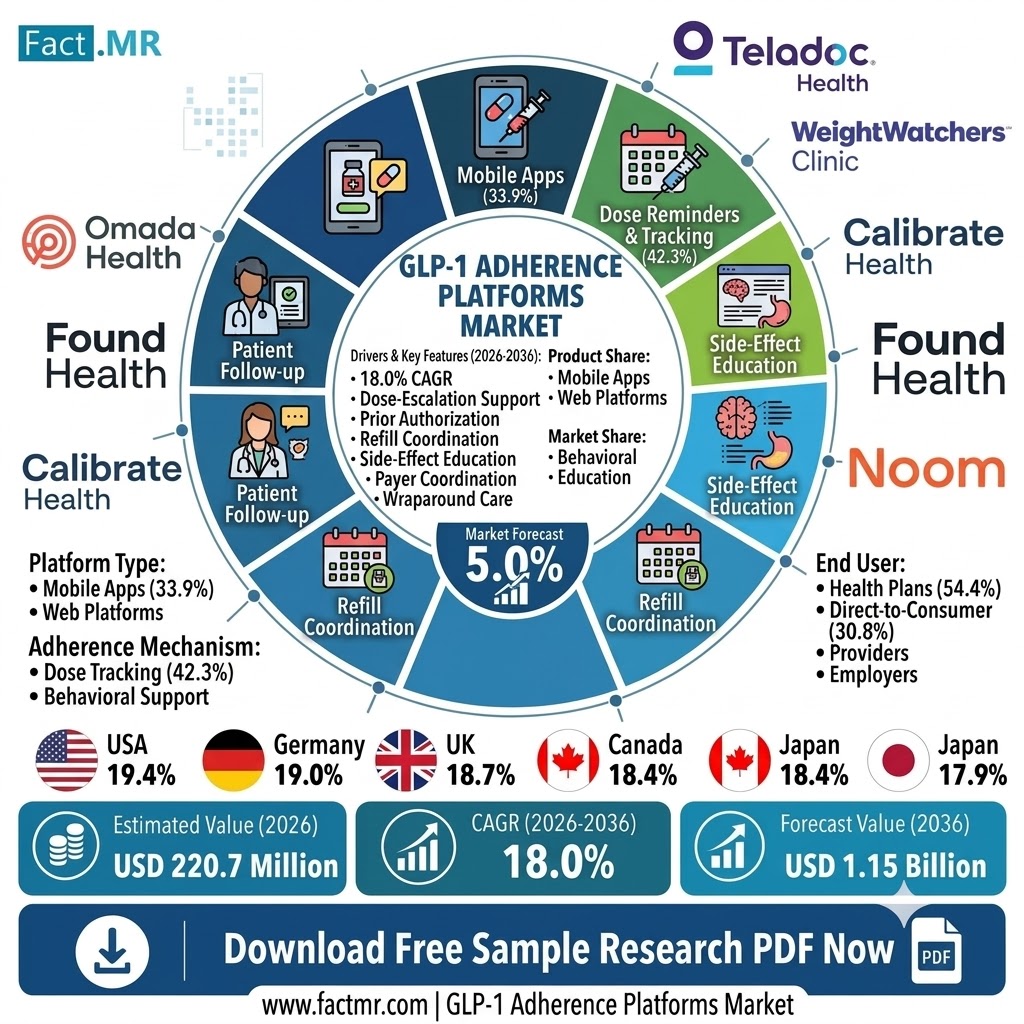
ROCKVILLE, MD — October 6, 2026 — The GLP-1 Adherence Platforms Market is forecast to reach USD 1,150.0 million by 2036, increasing from USD 220.7 million in 2026 at an 18.0% CAGR, according to Fact.MR. The market was valued at USD 187.0 million in 2025 as obesity care programs added medication support to digital weight-management services.
The market is expected to create an absolute opportunity of USD 929.3 million between 2026 and 2036. Demand is being shaped by dose-escalation support, refill coordination, side-effect education, and patient follow-up. These functions address practical gaps that can emerge after the first prescription.
Get detailed market forecasts, competitive benchmarking, and pricing trends: https://www.factmr.com/connectus/sample?flag=S&rep_id=15699
GLP-1 Adherence Platforms Market Growth Tied to Treatment Continuity
GLP-1 treatment can involve repeated decisions after therapy begins. Dose escalation and tolerance checks make patient education relevant beyond a basic medication reminder. Platforms can help patients record missed doses, prepare information for follow-up discussions, and remain connected with care teams.
Coverage requirements add another operational challenge. Prior authorization and eligibility checks can create delays around prescription access and refills. Platforms that provide benefit navigation and renewal tracking are therefore included within the market scope.
Fact.MR is a market research company that provides market sizing, forecasting, competitive analysis, and industry intelligence across global markets.
The analysis behind the report draws on 120+ sources, 35+ company portfolios, 25+ countries, and more than 20 industry interviews. Primary research includes discussions with manufacturers, service providers, technology developers, distributors, end users, procurement teams, and subject-matter experts.
Mobile Apps and Dose Tracking Hold Leading Shares
Mobile adherence apps are expected to account for 33.9% of the platform type segment in 2026. Most patients already carry a device capable of receiving reminders or recording medication activity. The report notes that mobile applications can also place side-effect education alongside dosing schedules.
Dose reminders and tracking are projected to represent 42.3% share in 2026, making the mechanism the leading segment. Many injectable GLP-1 medicines follow weekly schedules, while a missed action can affect medication continuity and dose-escalation planning.
Direct-to-consumer platforms are anticipated to capture 30.8% share in 2026. Patients may seek support before an employer or health plan introduces a formal program. These platforms can combine education and tracking with access to clinical teams.
Health plans are forecast to represent 54.4% share in 2026, the highest share among end users. Health plans manage eligibility and prior authorization requirements, creating a direct need for structured medication-access support.
Analyst Highlights Clinical Oversight
Shambhu Nath Jha, Senior Analyst at Fact.MR, said, “GLP-1 adherence platforms must manage the steps between prescription and persistence.”
The analyst also emphasized the importance of maintaining appropriate clinical boundaries. “They need safeguards that keep clinical judgment with licensed care teams.”
The report identifies structured wraparound care as an important adoption factor. Fragmented reimbursement and limited outcome evidence for individual platforms remain constraints, particularly where buyers require proof that a specific program improves treatment support.
Integrated pharmacy and refill support represents a high-impact opportunity in the USA and Canada. Provider dashboards with escalation rules are identified as a medium-impact opportunity for Germany and the UK, while localized guidance and safety content may support adoption in Japan and multilingual markets.
USA Leads Country Growth at 19.4% CAGR
The USA is projected to record a 19.4% CAGR from 2026 to 2036, supported by payer coordination and employer benefit pathways. Platforms can help patients manage prior authorization, refill timing, and benefit questions while prescribing decisions remain with licensed clinicians.
Germany follows at 19.0% CAGR, with evidence requirements and data governance shaping platform adoption. The UK is forecast to advance at 18.7% CAGR, supported by structured obesity-treatment pathways and wraparound care.
Canada is projected to grow at 18.4% CAGR, with licensed medication access and pharmacy-based navigation influencing demand. Japan is expected to record a 17.9% CAGR, as treatment eligibility and clinician-led health guidance remain central.
Competitive Landscape
Key companies profiled in the report include Omada Health, Noom, Calibrate Health, Found Health, Teladoc Health, and WeightWatchers Clinic.
Omada Health supports GLP-1 users through coaching, side-effect guidance, prescribing support, and medication-access coordination. Noom combines behavior-change content with GLP-1 companion tools. Teladoc Health provides GLP-1 support through a broader weight-management service, while WeightWatchers Clinic combines obesity-trained clinical care with behavioral support.
Calibrate Health and Found Health also remain relevant within the competitive landscape through services combining clinical oversight, medication access, coaching, and patient follow-up.
View Related Reports :
About Fact.MR
Fact.MR is a market research and consulting firm providing industry intelligence, market sizing, forecasting, and strategic analysis across global markets. Its research combines primary interviews, desk research, market modeling, data validation, and company portfolio analysis.