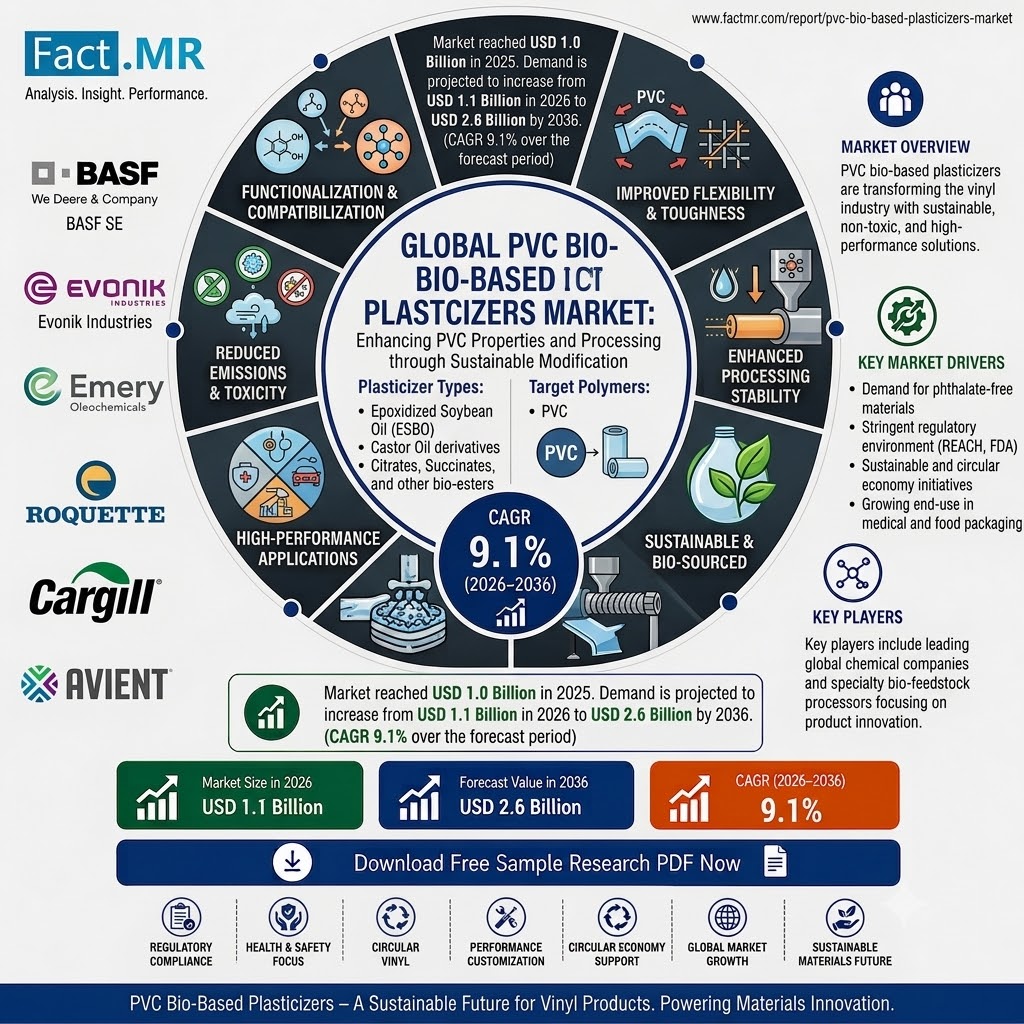
The PVC Bio-Based Plasticizers Market is projected to reach USD 2.6 billion by 2036, rising from USD 1.1 billion in 2026 at a 9.1% CAGR, according to Fact.MR analysis. The market was valued at USD 1.0 billion in 2025, with an absolute opportunity of USD 1.5 billion expected between 2026 and 2036.
Demand is being shaped by phthalate restrictions, renewable-material requirements, and qualification needs across flexible PVC applications. EU REACH restrictions on DEHP, DBP, BBP and DIBP, alongside U.S. Consumer Product Safety Commission rules covering phthalates in children’s products, are encouraging converters to assess non-phthalate alternatives.
Get detailed market forecasts, competitive benchmarking, and pricing trends
Epoxidized Vegetable Oils Hold 36% Market Share
The Epoxidized soybean/vegetable oil category is projected to account for 36.0% of the PVC bio-based plasticizers market in 2026, equivalent to USD 388.8 million. These materials can provide plasticization while contributing secondary heat stabilization through oxirane functionality.
PVC bio-based plasticizers are renewable-origin additives used to plasticize flexible PVC across applications such as wire and cable, flooring, films, medical devices, and coated fabrics.
Performance requirements remain application-specific. Compatibility, volatility, migration resistance and extraction behavior influence formulation decisions, while citrates, bio-succinates and castor-oil derivatives address applications with different documentation or performance requirements.
The Wire & cable application is projected to hold 28.0% of the market in 2026. Cable compounds require flexibility during installation and service while maintaining thermal and electrical performance. Demand is also supported by customer requests for renewable-sourced insulation compounds.
Construction represents another major demand center. The Construction end-use industry is expected to account for 34.0% of the market in 2026, supported by flexible PVC used in cable, flooring, wall coverings and coated products.
Regulation Creates Demand for Non-Phthalate Systems
The transition away from restricted phthalates is creating opportunities for certified citrate, bio-succinate and epoxidized-oil systems. [LINK: Non-phthalate plasticizers market report] demand is also connected to food-contact and medical-device requirements where migration and documentation can determine material selection.
Medical-device manufacturers are evaluating plasticizer systems for tubing, blood bags and infusion applications. These uses require documented performance and compliance because plasticizer migration can receive close scrutiny.
Wire and cable converters face another qualification hurdle. Renewable plasticizers must preserve insulation resistance, low-temperature flexibility and smoke performance while fitting existing compound specifications.
Green-building requirements provide a separate demand pathway. Renewable material content can support material-selection objectives in flooring and wall-covering specifications, particularly across commercial construction projects.
Fact.MR identifies several measurable market drivers. EU REACH and U.S. consumer-safety restrictions are estimated to contribute a +1.1% impact on CAGR, while medical-device and food-contact clearances for citrate and bio-succinate chemistries carry a +0.9% impact.
South Korea Leads Country Growth at 10.9% CAGR
South Korea is projected to record a 10.9% CAGR from 2026 to 2036, followed by the United States at 10.3% and the Netherlands at 10.2%. France is forecast to expand at 9.6%, Germany at 9.0%, and Italy at 8.5%.
South Korea benefits from an integrated polymer and PVC conversion ecosystem serving cable, flooring and film applications. Germany combines established PVC processing with automotive, construction, and wire and cable demand.
The United States is projected to grow at 10.3% CAGR as converters serving children’s products, wire and cable and consumer goods evaluate certified citrate and epoxidized-oil plasticizers.
Price premiums and limited supplies of certified bio-based chemistries remain constraints. Fact.MR estimates this restraint at a -0.6% impact on CAGR, while formulation re-validation and legacy-equipment costs can further slow conversion.
Analyst View
“PVC processors do not replace a plasticizer on feedstock origin alone. The alternative has to deliver the required softness, volatility and extraction resistance through the product’s service life,” said Shambhu Nath Jha, Sr. Consultant at Fact.MR.
Jha added, “Epoxidized vegetable oils have a practical position because they can combine plasticization with secondary stabilization, while medical and wire applications require tighter qualification.”
The competitive landscape includes BASF, Evonik Industries, Emery Oleochemicals, Roquette, Cargill, and Avient. Suppliers are competing across renewable-content documentation, PVC compatibility, consistent performance and technical support during formulation changes.
One notable market detail is the USD 388.8 million represented by epoxidized soybean and vegetable oils within the 2026 Type segment. That figure reflects the category’s projected 36.0% share of the market.
To View Top Reports
Network Operations Center as a Service Market
About Fact.MR
Fact.MR is a market research and consulting firm providing syndicated and customized research across industrial, technology, chemical, healthcare and consumer markets. Fact.MR delivers market intelligence covering market sizing, forecasting, competitive analysis, industry trends and strategic insights.