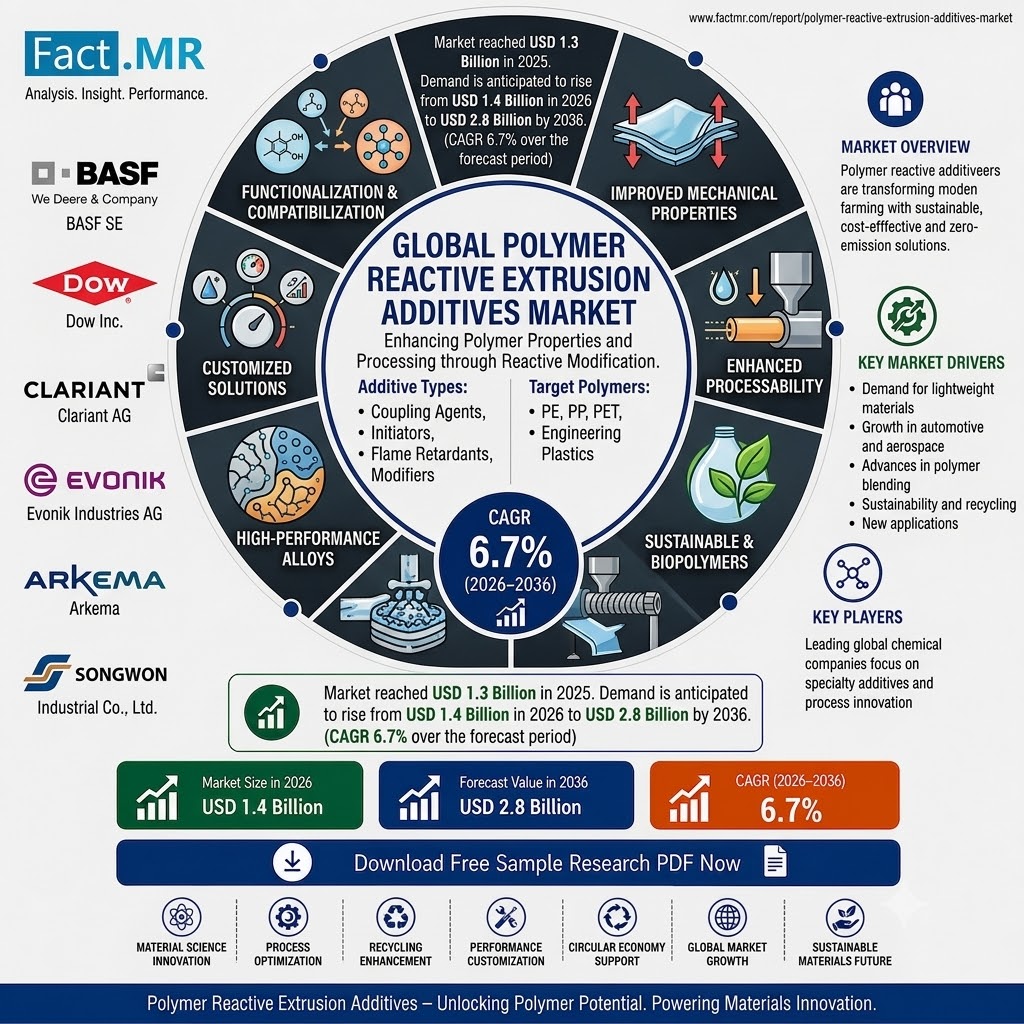
The global Polymer Reactive-Extrusion Additives Market is projected to reach USD 2.8 billion by 2036, rising from USD 1.4 billion in 2026 at a 6.7% CAGR through the forecast period, according to Fact.MR analysis. The market was valued at USD 1.3 billion in 2025, with the forecast indicating an absolute opportunity of approximately USD 1.3 billion between 2026 and 2036.
The growth outlook is closely linked to rising recycled-plastic requirements. The European Union’s 2026 vehicle-circularity regulation introduces phased recycled-plastic requirements for new vehicles, while the Packaging and Packaging Waste Regulation establishes recycled-content requirements for plastic packaging. These developments increase the need for additives that help compounders maintain material performance as recycled and mixed polymer streams enter production.
Get detailed market forecasts, competitive benchmarking, and pricing trends
Recycled polymer requirements reshape additive demand
Polymer Reactive-Extrusion Additives Market demand is being shaped by the technical challenges of processing recycled, immiscible, and filled polymer systems. Compatibilisers, coupling agents, chain extenders, grafting agents, and initiators or peroxides can modify polymer interfaces or molecular structure during extrusion.
The market’s defining segment shares show where demand is concentrated. Compatibilisers account for 31.0% of additive function in 2026, while polyolefins represent 34.0% of the base-polymer segment. Automotive applications hold 29.0%, liquid formulations account for 41.0%, and compounders represent 57.0% of end-use demand.
Fact.MR identifies recycled-content regulations as a near-term demand driver. The EU’s packaging and vehicle rules can encourage compounders to use compatibilisers and coupling agents when recovered polymers need to meet established processing and part-performance requirements.
Automotive lightweighting adds another layer. Filled and reinforced polyolefin compounds require consistent bonding between non-polar polymer matrices and polar reinforcement. Maleic-anhydride-grafted coupling chemistry can support these interfaces in qualified formulations.
Bioplastics and recycled blends also expand the technical requirement. Polyester or polyamide combinations with polyolefins may require reactive compatibilisation to stabilize phase morphology during extrusion.
Compounders remain the central purchasing group
Compounders represent 57.0% of end-use demand in 2026 because they determine polymer blends, additive packages, extrusion conditions, and resulting pellet properties. They are therefore positioned directly within the purchasing process for additives designed to react inside an extruder.
Liquid formulations account for 41.0% of the market by form. Direct metering can help processors adjust additive dosage when feedstock quality or throughput changes. However, the approach requires suitable pumps, injection points, and controlled residence time.
Shambhu Nath Jha, Principal Consultant at Fact.MR, said, “Reactive extrusion lets compounders repair an interface or rebuild a chain without adding a separate reaction step.”
He added, “An additive that improves impact strength in one polyolefin mix may alter melt flow or color in another, so suppliers need polymer-specific evidence and disciplined dosing guidance.”
Country markets show varied growth rates
Country-level forecasts indicate different expansion rates through 2036. South Korea is projected to grow at 8.5% CAGR, followed by the United States at 8.1%, Germany and the Netherlands at 7.5% each, Italy at 7.0%, and Japan at 6.4%.
South Korea’s chemical and manufacturing base supports demand for recycled compounds used in electronics and automotive applications. In the United States, recycled-content measures and corporate packaging targets are increasing the use of recovered polymer in established formulations.
Germany’s automotive supply chain creates demanding qualification requirements for recycled compounds. Japan’s Plastic Resource Circulation framework supports material recovery while precision manufacturing places tight limits on property variation.
Italy and the Netherlands are also positioned within European circular-plastics activity. Their compounding and recycling ecosystems support demand for compatibilisers, coupling agents, and chain-repair chemistries.
Suppliers focus on polymer-specific performance
The competitive landscape includes BASF SE, Dow Inc., Clariant AG, Evonik Industries AG, Arkema, and SONGWON Industrial Co., Ltd.
Dow Inc. adds relevance through RETAIN™ 3000, which promotes compatibility between polyolefins and polar polymers. BASF SE positions its plastic-additive portfolio around mechanical-recycling support, while Evonik Industries AG offers TEGO Cycle solutions for recycling applications.
Arkema supplies Lotader reactive terpolymers and Orevac grafted polyolefins for mixed polymer streams. Clariant AG and SONGWON Industrial Co., Ltd. also participate through additive solutions supporting polymer processing and recycling.
Supplier selection depends on polymer pairing, reaction window, dosage format, and qualification evidence. Automotive and food-contact applications can add documentation requirements before a formulation moves into regular production.
Market outlook
The Fact.MR analysis places the Polymer Reactive-Extrusion Additives Market at USD 1.45 billion in 2026 and USD 2.773 billion in 2036, representing a 6.7% CAGR over 2026-2036.
Demand is expected to remain connected to recycled-content requirements, mixed-polymer processing, automotive qualification, and the need to restore melt strength in recycled streams. At the same time, formulation sensitivity and tighter process-control requirements can restrict adoption where extrusion conditions are difficult to control.
To View Top Reports
Global Microbiology Culture Market
Brain Cancer Diagnostics Market
About Fact.MR
Fact.MR is a market research and consulting firm providing syndicated and customized research across technology, chemicals, materials, healthcare, automotive, and other industries. Its research combines primary interviews, secondary research, market modeling, and validation to assess market size, competitive developments, growth opportunities, and industry trends.